You send a longitudinal pulse along a Slinky, from left to right. Which direction(s) do the...
You send a longitudinal pulse along a Slinky, from left to right. Which direction(s) do the individual pieces of the Slinky move? (Answer: Left and right) Please explain WHY in details.
Homework Answers
Yes, the individual pieces will move left and right.
Pulse is travelling through the medium of slinky but as we notice the slinky itself does not move. The slinky just displaces left and right from its rest position and then comes back.
Add Answer to:
You send a longitudinal pulse along a Slinky, from left to
right. Which direction(s) do the...
Pulse 1 moves to the right along a spring, as shown in Figure (a) below. Another...
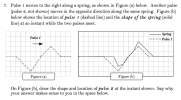 Pulse 1 moves to the right along a spring, as shown in Figure
(a) below. Another pulse (pulse 2, not shown) moves in the opposite
direction along the same spring. Figure (b) below shows the
location ofpulse 1 (dashed line) and the shape of the spring (solid
line) at an instant while the two pulses meet.
7. Pulse 1 moves to the right along a spring, as shown in Figure (a) below. Another pulse (pulse 2, not shown) moves in...
Pulse 1 moves to the right along a spring, as shown in Figure
(a) below. Another pulse (pulse 2, not shown) moves in the opposite
direction along the same spring. Figure (b) below shows the
location ofpulse 1 (dashed line) and the shape of the spring (solid
line) at an instant while the two pulses meet.
7. Pulse 1 moves to the right along a spring, as shown in Figure (a) below. Another pulse (pulse 2, not shown) moves in...
You need to guide a robot from the red dot on the left to the green dot on the right, avoiding the blue walls along the...
 You need to guide a robot from the red dot on the left to the green dot on the right, avoiding the blue walls along the way. To do this, you must feed it a series of commands of the form "turn degrees and move units forward". Angles are measured in de with positive angles turning counterclockwise, and negative angles turning clockwise. All turns are relative to the robot's current direction wi turns. The grid marks 1 unit squares From...
Please make a diorama of spatial and temporal waves with explanations. Thx! Diagram* Longitudinal wave Transverse...
 Please make a diorama of spatial and temporal waves
with explanations. Thx!
Diagram*
Longitudinal wave Transverse Wave Sourre mones Cails move left and right SeuIre mотеs up and doun Ceils moe ф авd dew left and right Enengy Transpart Eeg Transpart In a longitudinal wave the particles move parallel to the direction the wave is moving. a transverse wave the particles move at right angles to the direction of wave travel Wavelength Crest Сrest Amplitude Rest position Transverse Trongh OTOKOW...
Please make a diorama of spatial and temporal waves
with explanations. Thx!
Diagram*
Longitudinal wave Transverse Wave Sourre mones Cails move left and right SeuIre mотеs up and doun Ceils moe ф авd dew left and right Enengy Transpart Eeg Transpart In a longitudinal wave the particles move parallel to the direction the wave is moving. a transverse wave the particles move at right angles to the direction of wave travel Wavelength Crest Сrest Amplitude Rest position Transverse Trongh OTOKOW...
R r up Left Right Down A spinning disk is rotating at a rate of 2 rad/s in the counterclockwise d...
 r r up Left Right Down A spinning disk is rotating at a rate of 2 rad/s in the counterclockwise direction as shown in the figure. What is the direction of the angular velocity vector? Incorrect right Incorrect down Correct: up Incorrect left s answer now shown above. You are correct. receipt no. is 160-4295 If the disk is speeding up at a rate of 2 rad/s2, what is the direction of the angular acceleration vector? Incorrect down Incorrect left...
showing the path of the left-turning algorithm and the path of the right-turning algorithm. A switching...
 showing the path of the left-turning algorithm and the path of the right-turning algorithm. A switching Bug 0 algorithm (25 points). E1.2 (i) (10 points) Draw a flowchart for the following pseudo-code implementation of the switching Bug 0 algorithm: 1: choose an initial direction (either left or right) 2: while not at goal : move towards the goal if hit an obstacle : while not able to move towards goal : take a step along the obstacle boundary moving in...
You are moving from left to right along the graph of y = In(a) (a) If...
 You are moving from left to right along the graph of y = In(a) (a) If the x-corrdinate of your location at time t seconds is given by x(t) = 6 + 13, then how fast is your elevation increasing at t = 2.6? units per second (b) If the y-coordinate of your location at time t seconds is given by y(t) = 2.4t, then how fast are you moving horizontally at t = 4.3? units per second
direction while particle 2 travels along the positive y direction, Two positively charged particles are travelling...
 direction while particle 2 travels along the positive y direction, Two positively charged particles are travelling through space in each others' vicinity. Using the standard r-y-z coordinate grid, particle 1 travels along the positive heading directly for the first particle from below. 3) Which combination of options below are the most accurate combination of statements. [Enter your answer as a string of the letter options you believe are correct. For instance, if you think options A, D, and E are...
If you were building a velocity selector where the electric field pointed along the upward direction...
If you were building a velocity selector where the electric field pointed along the upward direction and a positively charged particle was traveling left to right; a.) Would you rather the magnetic field go into or out of the page. Explain. b.) Show that the veloicty will not be deflected. v=E/B c.) Would your answer to part A change if the charge was negative. Explain.
Can you please explain how you get the answer, thank you 1. (1 point) 1. Consider...
 Can you please explain how you
get the answer, thank you
1. (1 point) 1. Consider the snapshot and history graphs shown below for a wave pulse travelling through a rope d(em) d (em) -x (cm) -4 s) -4 The snapshot graph is at t = 0.01s and the history graph is at xcm. a) The snapshot graph is shown on the . A. Left . B. Right b) The wave is travelling in which direction? . A. Left ....
Can you please explain how you
get the answer, thank you
1. (1 point) 1. Consider the snapshot and history graphs shown below for a wave pulse travelling through a rope d(em) d (em) -x (cm) -4 s) -4 The snapshot graph is at t = 0.01s and the history graph is at xcm. a) The snapshot graph is shown on the . A. Left . B. Right b) The wave is travelling in which direction? . A. Left ....
Part III Cars move from left to right on the section of road shown below. The...
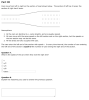 Part III Cars move from left to right on the section of road shown below. The section of left has 2 lanes; the section of right has 4 lanes. Assumptions: 1. All the cars are identical (i.e., same length), and are equally spaced. 2. All cars move with the same speed on the left section and on the right section, but the speeds on the two section may not be the same 3. All the lanes are fully occupied with...
 Pulse 1 moves to the right along a spring, as shown in Figure
(a) below. Another pulse (pulse 2, not shown) moves in the opposite
direction along the same spring. Figure (b) below shows the
location ofpulse 1 (dashed line) and the shape of the spring (solid
line) at an instant while the two pulses meet.
7. Pulse 1 moves to the right along a spring, as shown in Figure (a) below. Another pulse (pulse 2, not shown) moves in...
Pulse 1 moves to the right along a spring, as shown in Figure
(a) below. Another pulse (pulse 2, not shown) moves in the opposite
direction along the same spring. Figure (b) below shows the
location ofpulse 1 (dashed line) and the shape of the spring (solid
line) at an instant while the two pulses meet.
7. Pulse 1 moves to the right along a spring, as shown in Figure (a) below. Another pulse (pulse 2, not shown) moves in...
 You need to guide a robot from the red dot on the left to the green dot on the right, avoiding the blue walls along the way. To do this, you must feed it a series of commands of the form "turn degrees and move units forward". Angles are measured in de with positive angles turning counterclockwise, and negative angles turning clockwise. All turns are relative to the robot's current direction wi turns. The grid marks 1 unit squares From...
 Please make a diorama of spatial and temporal waves
with explanations. Thx!
Diagram*
Longitudinal wave Transverse Wave Sourre mones Cails move left and right SeuIre mотеs up and doun Ceils moe ф авd dew left and right Enengy Transpart Eeg Transpart In a longitudinal wave the particles move parallel to the direction the wave is moving. a transverse wave the particles move at right angles to the direction of wave travel Wavelength Crest Сrest Amplitude Rest position Transverse Trongh OTOKOW...
Please make a diorama of spatial and temporal waves
with explanations. Thx!
Diagram*
Longitudinal wave Transverse Wave Sourre mones Cails move left and right SeuIre mотеs up and doun Ceils moe ф авd dew left and right Enengy Transpart Eeg Transpart In a longitudinal wave the particles move parallel to the direction the wave is moving. a transverse wave the particles move at right angles to the direction of wave travel Wavelength Crest Сrest Amplitude Rest position Transverse Trongh OTOKOW...
 r r up Left Right Down A spinning disk is rotating at a rate of 2 rad/s in the counterclockwise direction as shown in the figure. What is the direction of the angular velocity vector? Incorrect right Incorrect down Correct: up Incorrect left s answer now shown above. You are correct. receipt no. is 160-4295 If the disk is speeding up at a rate of 2 rad/s2, what is the direction of the angular acceleration vector? Incorrect down Incorrect left...
 showing the path of the left-turning algorithm and the path of the right-turning algorithm. A switching Bug 0 algorithm (25 points). E1.2 (i) (10 points) Draw a flowchart for the following pseudo-code implementation of the switching Bug 0 algorithm: 1: choose an initial direction (either left or right) 2: while not at goal : move towards the goal if hit an obstacle : while not able to move towards goal : take a step along the obstacle boundary moving in...
 You are moving from left to right along the graph of y = In(a) (a) If the x-corrdinate of your location at time t seconds is given by x(t) = 6 + 13, then how fast is your elevation increasing at t = 2.6? units per second (b) If the y-coordinate of your location at time t seconds is given by y(t) = 2.4t, then how fast are you moving horizontally at t = 4.3? units per second
 direction while particle 2 travels along the positive y direction, Two positively charged particles are travelling through space in each others' vicinity. Using the standard r-y-z coordinate grid, particle 1 travels along the positive heading directly for the first particle from below. 3) Which combination of options below are the most accurate combination of statements. [Enter your answer as a string of the letter options you believe are correct. For instance, if you think options A, D, and E are...
 Can you please explain how you
get the answer, thank you
1. (1 point) 1. Consider the snapshot and history graphs shown below for a wave pulse travelling through a rope d(em) d (em) -x (cm) -4 s) -4 The snapshot graph is at t = 0.01s and the history graph is at xcm. a) The snapshot graph is shown on the . A. Left . B. Right b) The wave is travelling in which direction? . A. Left ....
Can you please explain how you
get the answer, thank you
1. (1 point) 1. Consider the snapshot and history graphs shown below for a wave pulse travelling through a rope d(em) d (em) -x (cm) -4 s) -4 The snapshot graph is at t = 0.01s and the history graph is at xcm. a) The snapshot graph is shown on the . A. Left . B. Right b) The wave is travelling in which direction? . A. Left ....
 Part III Cars move from left to right on the section of road shown below. The section of left has 2 lanes; the section of right has 4 lanes. Assumptions: 1. All the cars are identical (i.e., same length), and are equally spaced. 2. All cars move with the same speed on the left section and on the right section, but the speeds on the two section may not be the same 3. All the lanes are fully occupied with...
Most questions answered within 3 hours.
-
Where is the error in this code sequence?
String s1 = "Hello";
String s2 = "ello";...
asked 10 months ago -
Financial data for Joel de Paris, Inc., for last year
follow:
Joel de Paris, Inc.
Balance...
asked 10 months ago -
Consider this reaction:
Al2(SO4)3 (aq)+ BaCl3
(aq) Al2Cl6 (aq)- +
3BaSO4(s) . What is the...
asked 10 months ago -
Suppose that Savneet is considering increasing her
recent random sample from 20 car rentals to 40...
asked 10 months ago -
Trucks arrive at an unloading terminal at an average rate of 120
per hour.
Trucks arrive...
asked 10 months ago -
Why are methanol and ethanol completely soluble in water while
octanol is not very little soluble....
asked 10 months ago -
A facilities manager at a university reads in a research report
that the mean amount of...
asked 10 months ago -
When the CuSO4 is rehydrated by adding water to the anhydrous
compound, is this an endothermic...
asked 10 months ago -
A ray of sunlight is passing from diamond into crown glass; the
angle of incidence is...
asked 10 months ago -
A block of mass 0.249 kg is placed on top of a light, vertical
spring of...
asked 10 months ago -
how do the kidneys compensate in the presences of acidosis
a) trigger hyperventilate
b) reserve acid...
asked 10 months ago -
Question 501 pts
The rental rate of capital to the firm increases. Which of the
following...
asked 10 months ago