. Explain why glucose-6-phosphate is the major product from glycogen breakdown in the muscle cell, whereas...
. Explain why glucose-6-phosphate is the major product from glycogen breakdown in the muscle cell, whereas glucose is a minor product (think debranching enzyme).
Homework Answers


Add Answer to:
. Explain why glucose-6-phosphate is the major product from
glycogen breakdown in the muscle cell, whereas...
Glucose-6-phosphate dehydrogenase is a rate-limiting cytosolic enzyme controlling the pentose phosphate pathway whereas glucose-6-phosphatase is an...
Glucose-6-phosphate dehydrogenase is a rate-limiting cytosolic enzyme controlling the pentose phosphate pathway whereas glucose-6-phosphatase is an enzyme found mainly in the liver and kidney that hydrolyzes glucose-6-phosphate and plays a major role in glucose homeostasis. These enzymes are often confused and their deficiencies cause serious metabolic complications. Explain in detail the biochemistry behind the deficiency of these enzymes in an individual and their clinical manifestations. 20 marks
During glycogenolysis, muscle cells consume most of the glucose released from the stored glycogen; while liver...
During glycogenolysis, muscle cells consume most of the glucose released from the stored glycogen; while liver cells export most of the glucose released from the stored glycogen. Why do the muscles and liver behave so differently and how do you explain this phenomenon?
QUESTION 14 What is the ratio of carbon-bound hydrogens to carbon of glucose? O 6/6 O...
 QUESTION 14 What is the ratio of carbon-bound hydrogens to carbon of glucose? O 6/6 O 7/6 O 12/6 6/7 QUESTION 22 Which of the following is false about gluconeogenesis? Glycolysis is catabolic, while gluconeogenesis is anabolic There are four reactions unique to gluconeogenesis Gluconeogenesis is simply the reverse of glycolysis Gluconeogenesis synthesizes glucose All of these are true QUESTION 36 Use the information below to answer questions 36-38 The concentration of glucose in human blood plasma is maintained at...
€ → C .ap2020.collegeboard.org/Praott-aa857320- glucagon (a) A cell where PKB is always active has a mutation...
 € → C .ap2020.collegeboard.org/Praott-aa857320- glucagon (a) A cell where PKB is always active has a mutation that results in the permanent activation of GSK3. Based on the information in Figure 2, predict the effect of this mutation on the activity of glycogen synthase. (b) Justify your prediction in part (a). Describe the process that results in the activation of multiple copies of PKB in response to the binding of a single molecule of insulin to its receptor. (d) Explain why...
explain why please. 3. (3 pts) Consider the metabolite glucose 6-phosphate in the muscle, which of...
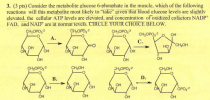 explain why please.
3. (3 pts) Consider the metabolite glucose 6-phosphate in the muscle, which of the following reactions will this metabolite most likely to "take" given that blood glucose levels are slightly elevated, the cellular ATP levels are elevated, and concentration of oxidized cofactors NADP+ FAD, and NAD are at normal levels. CIRCLE YOUR CHOICE BELOW. CH,OPO, 2 CH,OPO, 2 CH,OPO, 2 CH,OPO, 20. OH A. HOCH2OH AOH HO ON / ТОН OH OH OH CH,OP0,2 OH CHOPO, 2...
explain why please.
3. (3 pts) Consider the metabolite glucose 6-phosphate in the muscle, which of the following reactions will this metabolite most likely to "take" given that blood glucose levels are slightly elevated, the cellular ATP levels are elevated, and concentration of oxidized cofactors NADP+ FAD, and NAD are at normal levels. CIRCLE YOUR CHOICE BELOW. CH,OPO, 2 CH,OPO, 2 CH,OPO, 2 CH,OPO, 20. OH A. HOCH2OH AOH HO ON / ТОН OH OH OH CH,OP0,2 OH CHOPO, 2...
1. Beer is produced from wheat and/or barley. Explain why the grains are allowed to sprout,...
 1. Beer is produced from wheat and/or barley. Explain why the grains are allowed to sprout, a process in which their starch is broken down to glucose before fermentation (breakdown of sugar to ethanol) begins. 2. Some bread bakers add amylase (reaction shown below) to bread dough prior to the fermentation process. What role does this enzyme play in making bread? B-Amylase OH OH OH OH OH -2,8 OH Qyo O 0400 Poly-a-D-glucose Maltose 3. The disaccharide trehalose is one...
Question 1 1 pts The enzyme hexokinase transfers a phosphate from ATP to glucose, to make...
 Question 1 1 pts The enzyme hexokinase transfers a phosphate from ATP to glucose, to make ADP and glucose-6- phosphate. Which of the following is a substrate? hexokinase ADP glucose glucose-6-phosphate two of the above Question 2 1 pts The enzyme hexokinase transfers a phosphate from ATP to glucose, to make ADP and glucose-6- phosphate. Which of the following is a product? hexokinase ADP glucose glucose-6-phosphate two of the above
7,9,11 please Free glucose Glucose-6-phosphatase Pucho s -6-phosphate Glycogen in o s--one Galacs 6. Why do...
 7,9,11 please
Free glucose Glucose-6-phosphatase Pucho s -6-phosphate Glycogen in o s--one Galacs 6. Why do patients with GSD exhibit hepatomegaly? 7. Hundreds of mutations in the name glucose-6-phosphatase have been discovered most reult in small amore in mnace sequence. Based on your introductory exposure to protein structure, explain why this would impact the entryme's function & What kind of bond do you think is broken to digest cornstarch (be specific 9. In the comstarch therapy, what is the solvent...
7,9,11 please
Free glucose Glucose-6-phosphatase Pucho s -6-phosphate Glycogen in o s--one Galacs 6. Why do patients with GSD exhibit hepatomegaly? 7. Hundreds of mutations in the name glucose-6-phosphatase have been discovered most reult in small amore in mnace sequence. Based on your introductory exposure to protein structure, explain why this would impact the entryme's function & What kind of bond do you think is broken to digest cornstarch (be specific 9. In the comstarch therapy, what is the solvent...
4. (6 points) a. Draw the product(s) of an aldol cleavage carried out on glucose-6-phosphate. (This...
 4. (6 points) a. Draw the product(s) of an aldol cleavage carried out on glucose-6-phosphate. (This reaction is not part of glycolysis, but please give the products of what this reaction would be if it took place.) b. Explain why the aldol cleavage in glycolysis takes place on fructose-1,6-bisphophate instead of glucose-6-phosphate.
Steps 6 and 8 of the citric acid cycles are _____ reactions. phosphate-transfer hydrolysis oxidation–reduction carboxylation...
Steps 6 and 8 of the citric acid cycles are _____ reactions. phosphate-transfer hydrolysis oxidation–reduction carboxylation The 4-carbon intermediates of the citric acid cycle can be used for _____. gluconeogenesis fatty acid synthesis nucleotide synthesis glycolysis Additional oxaloacetate for the citric acid cycle can be generated in one step from pyruvate glyoxylate citrate acetyl-CoA ΔG°' for a reaction is 800 J · mol–1. What is ΔG at 37°C when the ratio of product to reactant concentrations is 0.6? 640 J...
 QUESTION 14 What is the ratio of carbon-bound hydrogens to carbon of glucose? O 6/6 O 7/6 O 12/6 6/7 QUESTION 22 Which of the following is false about gluconeogenesis? Glycolysis is catabolic, while gluconeogenesis is anabolic There are four reactions unique to gluconeogenesis Gluconeogenesis is simply the reverse of glycolysis Gluconeogenesis synthesizes glucose All of these are true QUESTION 36 Use the information below to answer questions 36-38 The concentration of glucose in human blood plasma is maintained at...
 € → C .ap2020.collegeboard.org/Praott-aa857320- glucagon (a) A cell where PKB is always active has a mutation that results in the permanent activation of GSK3. Based on the information in Figure 2, predict the effect of this mutation on the activity of glycogen synthase. (b) Justify your prediction in part (a). Describe the process that results in the activation of multiple copies of PKB in response to the binding of a single molecule of insulin to its receptor. (d) Explain why...
 explain why please.
3. (3 pts) Consider the metabolite glucose 6-phosphate in the muscle, which of the following reactions will this metabolite most likely to "take" given that blood glucose levels are slightly elevated, the cellular ATP levels are elevated, and concentration of oxidized cofactors NADP+ FAD, and NAD are at normal levels. CIRCLE YOUR CHOICE BELOW. CH,OPO, 2 CH,OPO, 2 CH,OPO, 2 CH,OPO, 20. OH A. HOCH2OH AOH HO ON / ТОН OH OH OH CH,OP0,2 OH CHOPO, 2...
explain why please.
3. (3 pts) Consider the metabolite glucose 6-phosphate in the muscle, which of the following reactions will this metabolite most likely to "take" given that blood glucose levels are slightly elevated, the cellular ATP levels are elevated, and concentration of oxidized cofactors NADP+ FAD, and NAD are at normal levels. CIRCLE YOUR CHOICE BELOW. CH,OPO, 2 CH,OPO, 2 CH,OPO, 2 CH,OPO, 20. OH A. HOCH2OH AOH HO ON / ТОН OH OH OH CH,OP0,2 OH CHOPO, 2...
 1. Beer is produced from wheat and/or barley. Explain why the grains are allowed to sprout, a process in which their starch is broken down to glucose before fermentation (breakdown of sugar to ethanol) begins. 2. Some bread bakers add amylase (reaction shown below) to bread dough prior to the fermentation process. What role does this enzyme play in making bread? B-Amylase OH OH OH OH OH -2,8 OH Qyo O 0400 Poly-a-D-glucose Maltose 3. The disaccharide trehalose is one...
 Question 1 1 pts The enzyme hexokinase transfers a phosphate from ATP to glucose, to make ADP and glucose-6- phosphate. Which of the following is a substrate? hexokinase ADP glucose glucose-6-phosphate two of the above Question 2 1 pts The enzyme hexokinase transfers a phosphate from ATP to glucose, to make ADP and glucose-6- phosphate. Which of the following is a product? hexokinase ADP glucose glucose-6-phosphate two of the above
 7,9,11 please
Free glucose Glucose-6-phosphatase Pucho s -6-phosphate Glycogen in o s--one Galacs 6. Why do patients with GSD exhibit hepatomegaly? 7. Hundreds of mutations in the name glucose-6-phosphatase have been discovered most reult in small amore in mnace sequence. Based on your introductory exposure to protein structure, explain why this would impact the entryme's function & What kind of bond do you think is broken to digest cornstarch (be specific 9. In the comstarch therapy, what is the solvent...
7,9,11 please
Free glucose Glucose-6-phosphatase Pucho s -6-phosphate Glycogen in o s--one Galacs 6. Why do patients with GSD exhibit hepatomegaly? 7. Hundreds of mutations in the name glucose-6-phosphatase have been discovered most reult in small amore in mnace sequence. Based on your introductory exposure to protein structure, explain why this would impact the entryme's function & What kind of bond do you think is broken to digest cornstarch (be specific 9. In the comstarch therapy, what is the solvent...
 4. (6 points) a. Draw the product(s) of an aldol cleavage carried out on glucose-6-phosphate. (This reaction is not part of glycolysis, but please give the products of what this reaction would be if it took place.) b. Explain why the aldol cleavage in glycolysis takes place on fructose-1,6-bisphophate instead of glucose-6-phosphate.
Most questions answered within 3 hours.
-
Where is the error in this code sequence?
String s1 = "Hello";
String s2 = "ello";...
asked 10 months ago -
Financial data for Joel de Paris, Inc., for last year
follow:
Joel de Paris, Inc.
Balance...
asked 10 months ago -
Consider this reaction:
Al2(SO4)3 (aq)+ BaCl3
(aq) Al2Cl6 (aq)- +
3BaSO4(s) . What is the...
asked 10 months ago -
Suppose that Savneet is considering increasing her
recent random sample from 20 car rentals to 40...
asked 10 months ago -
Trucks arrive at an unloading terminal at an average rate of 120
per hour.
Trucks arrive...
asked 10 months ago -
Why are methanol and ethanol completely soluble in water while
octanol is not very little soluble....
asked 10 months ago -
A facilities manager at a university reads in a research report
that the mean amount of...
asked 10 months ago -
When the CuSO4 is rehydrated by adding water to the anhydrous
compound, is this an endothermic...
asked 10 months ago -
A ray of sunlight is passing from diamond into crown glass; the
angle of incidence is...
asked 10 months ago -
A block of mass 0.249 kg is placed on top of a light, vertical
spring of...
asked 10 months ago -
how do the kidneys compensate in the presences of acidosis
a) trigger hyperventilate
b) reserve acid...
asked 10 months ago -
Question 501 pts
The rental rate of capital to the firm increases. Which of the
following...
asked 10 months ago