Problem Set 3: (9 pts) This study investigated the cognitive effects of stimulant medication in children...
|
Problem Set 3: (9 pts) This study investigated the cognitive effects of stimulant medication in children with Attention-Deficit/Hyperactivity Disorder (ADHD). Shown below are data for the Connors’ Continuous Performance Test (CPT) for 15 children diagnosed with ADHD. This is a visual vigilance task that requires the child to respond to the computer screen any time they see any letter other than “X”. An overall index is calculated that can be used to indicate attention problems based on reaction time, omission errors, and variability of responses. A higher number indicates more problems with attention. Children were given various daily dosages of a drug methylphenidate (MPH) – given 0, 5mg, 10mg, and 25mg). The order of doses was counterbalanced so that all children received all doses at one point in the experiment. The children were on each dose one week before taking the CPT test (so each child took the test four times).
|
Homework Answers
SOLUTION:-
The hypothesis being tested is:-
H0: µ1 = µ2 = µ3 = µ4
Ha: At least one means is not equal
The output is:
| Source | SS | df | MS | F | P-Value |
| Treatment | 14.55 | 3 | 4.850 | 4.31 | .0208 |
| Error | 18.00 | 16 | 1.125 | ||
| Total | 32.55 | 19 |
The P-value from the output is 0.0208.
Since the P-value (0.0208) is less than the significance level (0.05), we can reject the null hypothesis.
Therefore, we can conclude that at least one means is not equal.
THANK YOU, if any queries please leave your valuable comment on comment box.........
Add Answer to:
Problem Set 3: (9 pts)
This study investigated the cognitive effects of stimulant
medication in children...
Problem Set 2: Two-way mixed design ANOVA (8 pts) Research Scenario: A researcher is attempting to determine the eff...
Problem Set 2: Two-way mixed design ANOVA (8 pts) Research Scenario: A researcher is attempting to determine the effects of age and sleep deprivation on a reaction time task. Participants (5 “old”; 5 “young”) in an experiment are given a computerized search task. They search a computer screen of various characters and attempt to find a particular character on each trial. When they find the designated character, they press a button to stop a timer. Their reaction time (in ms)...
1. often used to treat attention-deficit/hyperactivity disorder (ADHD) in a patient who has substance abuse problems?...
1. often used to treat attention-deficit/hyperactivity disorder (ADHD) in a patient who has substance abuse problems? A. phenobarbital (Luminal) 2. highly bound to protein in the bloodstream and can adhere to nasogastric tubing? B. levodopa/carbidopa (Sinemet) 3. the most effective treatment for Parkinson’s disease (PD)? C. topiramate (Topamax) 4. responsible for changing the color of urine to red, brown, or black? D. bromocriptine (Parlodel) 5. known to block the metabolism of tyramine, a substance in many aged and pickled foods?...
Body Wern 387 Chapter 13 Pediatric and Adult Dosages Based on Body Weight PRACTICE PROBLEMS-CHAPTER 13...
 Body Wern 387 Chapter 13 Pediatric and Adult Dosages Based on Body Weight PRACTICE PROBLEMS-CHAPTER 13 Convert the following weights to kilograms. Round to one decimal place. 112 - Siske 5.341 - 15.4 kg 2. 8 4 oz - 3.8 kg 6.6 lb 100 - 3.3 kg 3. 1,370 .6 kg 7. 52 lb - 2 4 kg 4. 2,300 g - 2-3 kg 8. 8902 0.9 kg The recommended dosage of tobramycin for adults with serious infections that are...
Suppose that strong claims, with weak evidence, have been made about the efficacy of an herbal...
Suppose that strong claims, with weak evidence, have been made about the efficacy of an herbal treatment for attention deficit disorder (ADD). You are a research assistant for a professor who decides to empirically test the validity of these claims. You locate 10 fifthgrade students, in 10 different classrooms, who have been diagnosed with ADD. Sitting unobtrusively at the back of each classroom with stopwatch in hand, you record the number of seconds that the child with ADD is out...
CASE STUDY 46 ATTENTION DEFICIT/HYPERACTIVITY DISORDER For the Di S CD-ROM mary for this study PATIENT...
 CASE STUDY 46 ATTENTION DEFICIT/HYPERACTIVITY DISORDER For the Di S CD-ROM mary for this study PATIENT CASE Mother's Chief Complaints "Tm at the end of my rope and I don't know what to do anymore. My son won't behave orlis ten at school and he most certainly will not listen to me at home He always seems to be in motion and can't sit still for even 5 minutes. He likes watching cartoons on TV but gets bored with them...
EXPERIMENT 13 REPORT SHEET DOSAGE CALCULATIONS Name: CHI01 Lab Section A. DIMENSIONAL ANALYSIS METHOD Please show...
 EXPERIMENT 13 REPORT SHEET DOSAGE CALCULATIONS Name: CHI01 Lab Section A. DIMENSIONAL ANALYSIS METHOD Please show all calculations for solving the problems. 1.2200 m- Date: Drawer: Instructor . 2. 3.44 mem km 3. 1,235,500 cm 4. 31,625 kg- km .8 - . - 6. 420 hr- wks 5, 49 oz = lb 1850 g = 8. 7. 78 ft /sec_ mi/hr 02.2Lt 9.0.82 qt- -mL A child requires a 7 mL dose of medicine each day. How many days would...
PROBLEM #3: Tardive dyskinesia denotes a syndrome comprising a variety of abnormal involuntary movements assumed to...
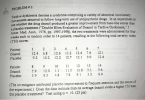 PROBLEM #3: Tardive dyskinesia denotes a syndrome comprising a variety of abnormal involuntary movements assumed to follow long-term use of antipsychotic drugs. In an experiment to see whether the drug deanol produced a greater improvement from base-line scores than a placebo treatment (“Double Blien Evaluation of Deanol in Tardive Dyskinesia," Amer. Med. Assn., 1978, pp. 1997-1998), the two treatments were administered for four weeks each in random order to 14 patients, resulting in the following total severity index (TSI) scores:...
SECTION 1 CIinica! Calculations 2. Order: filgrastim 5 mcg/kg/day for myelosuppression secondary to chemotherapy administration Supply:...
 SECTION 1 CIinica! Calculations 2. Order: filgrastim 5 mcg/kg/day for myelosuppression secondary to chemotherapy administration Supply: filgrastim 480 mcg/1.6 ml. Patient's weight: 100 lb 楽How many milliliters per day will you give? 3 4 STIM NDC 59513-34 m NEUPOGEN O Courtesy of Amgen, Indc. 16m PD2.1.1リリリリリ10,.12.,14 10 .20 30 40.50 .60 .70 80 .90 1.00mL 3. Order: Epogen 100 units/kg/day SQ three times weekly for anemia secondary to AZT administration Supply: Epogen 10,000 units/mL Patients weight: 180 lb ※ How...
Case Study # 4 Type 2 Diabetes Mellitus Dorothy is a 45-year-old woman. She is in...
Case Study # 4 Type 2 Diabetes Mellitus Dorothy is a 45-year-old woman. She is in the office for a follow-up visit today, after having been diagnosed with Type 2 Diabetes 3 months ago. She has been attempting to control her Type 2 DM with diet and exercise, and was started on Metformin 1,000 mg twice daily last month. She monitors her blood sugar once a day. She has a record of her BS values over the past week, the range is 180...
PROBLEM #3: dyskinesia denotes a syndrome comprising a variety of abnormal involuntary 15 assumed to follow...
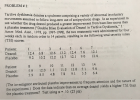 PROBLEM #3: dyskinesia denotes a syndrome comprising a variety of abnormal involuntary 15 assumed to follow long-term use of antipsychotic drugs. In an experiment to sce whether the drug deanol produced a greater improvement from base-line scores than a placebo treatment (“Double Blien Evaluation of Deanol in Tardive Dyskinesia," J. Amer. Med. Assn., 1978, pp. 1997-1998), the two treatments were administered for four- weeks each in random order to 14 patients, resulting in the following total severity index (TSI) scores:...
 Body Wern 387 Chapter 13 Pediatric and Adult Dosages Based on Body Weight PRACTICE PROBLEMS-CHAPTER 13 Convert the following weights to kilograms. Round to one decimal place. 112 - Siske 5.341 - 15.4 kg 2. 8 4 oz - 3.8 kg 6.6 lb 100 - 3.3 kg 3. 1,370 .6 kg 7. 52 lb - 2 4 kg 4. 2,300 g - 2-3 kg 8. 8902 0.9 kg The recommended dosage of tobramycin for adults with serious infections that are...
 CASE STUDY 46 ATTENTION DEFICIT/HYPERACTIVITY DISORDER For the Di S CD-ROM mary for this study PATIENT CASE Mother's Chief Complaints "Tm at the end of my rope and I don't know what to do anymore. My son won't behave orlis ten at school and he most certainly will not listen to me at home He always seems to be in motion and can't sit still for even 5 minutes. He likes watching cartoons on TV but gets bored with them...
 EXPERIMENT 13 REPORT SHEET DOSAGE CALCULATIONS Name: CHI01 Lab Section A. DIMENSIONAL ANALYSIS METHOD Please show all calculations for solving the problems. 1.2200 m- Date: Drawer: Instructor . 2. 3.44 mem km 3. 1,235,500 cm 4. 31,625 kg- km .8 - . - 6. 420 hr- wks 5, 49 oz = lb 1850 g = 8. 7. 78 ft /sec_ mi/hr 02.2Lt 9.0.82 qt- -mL A child requires a 7 mL dose of medicine each day. How many days would...
 PROBLEM #3: Tardive dyskinesia denotes a syndrome comprising a variety of abnormal involuntary movements assumed to follow long-term use of antipsychotic drugs. In an experiment to see whether the drug deanol produced a greater improvement from base-line scores than a placebo treatment (“Double Blien Evaluation of Deanol in Tardive Dyskinesia," Amer. Med. Assn., 1978, pp. 1997-1998), the two treatments were administered for four weeks each in random order to 14 patients, resulting in the following total severity index (TSI) scores:...
 SECTION 1 CIinica! Calculations 2. Order: filgrastim 5 mcg/kg/day for myelosuppression secondary to chemotherapy administration Supply: filgrastim 480 mcg/1.6 ml. Patient's weight: 100 lb 楽How many milliliters per day will you give? 3 4 STIM NDC 59513-34 m NEUPOGEN O Courtesy of Amgen, Indc. 16m PD2.1.1リリリリリ10,.12.,14 10 .20 30 40.50 .60 .70 80 .90 1.00mL 3. Order: Epogen 100 units/kg/day SQ three times weekly for anemia secondary to AZT administration Supply: Epogen 10,000 units/mL Patients weight: 180 lb ※ How...
 PROBLEM #3: dyskinesia denotes a syndrome comprising a variety of abnormal involuntary 15 assumed to follow long-term use of antipsychotic drugs. In an experiment to sce whether the drug deanol produced a greater improvement from base-line scores than a placebo treatment (“Double Blien Evaluation of Deanol in Tardive Dyskinesia," J. Amer. Med. Assn., 1978, pp. 1997-1998), the two treatments were administered for four- weeks each in random order to 14 patients, resulting in the following total severity index (TSI) scores:...
Most questions answered within 3 hours.
-
Where is the error in this code sequence?
String s1 = "Hello";
String s2 = "ello";...
asked 11 months ago -
Financial data for Joel de Paris, Inc., for last year
follow:
Joel de Paris, Inc.
Balance...
asked 11 months ago -
Consider this reaction:
Al2(SO4)3 (aq)+ BaCl3
(aq) Al2Cl6 (aq)- +
3BaSO4(s) . What is the...
asked 11 months ago -
Suppose that Savneet is considering increasing her
recent random sample from 20 car rentals to 40...
asked 11 months ago -
Trucks arrive at an unloading terminal at an average rate of 120
per hour.
Trucks arrive...
asked 11 months ago -
Why are methanol and ethanol completely soluble in water while
octanol is not very little soluble....
asked 11 months ago -
A facilities manager at a university reads in a research report
that the mean amount of...
asked 11 months ago -
When the CuSO4 is rehydrated by adding water to the anhydrous
compound, is this an endothermic...
asked 11 months ago -
A ray of sunlight is passing from diamond into crown glass; the
angle of incidence is...
asked 11 months ago -
A block of mass 0.249 kg is placed on top of a light, vertical
spring of...
asked 11 months ago -
how do the kidneys compensate in the presences of acidosis
a) trigger hyperventilate
b) reserve acid...
asked 11 months ago -
Question 501 pts
The rental rate of capital to the firm increases. Which of the
following...
asked 11 months ago