A 2.4 GHz wireless router transmits 800mW of power in omni-direction. If a receiver of 0-dB...
A 2.4 GHz wireless router transmits 800mW of power in omni-direction. If a receiver of 0-dB antenna gain can operate at minimum of -80dBm then calculate the coverage range. To extend a length of coverage, 9 dBi TP-Link antenna is used at WiFi transmitter. Calculate extended coverage distance.
Homework Answers


Add Answer to:
A 2.4 GHz wireless router transmits 800mW of power in
omni-direction. If a receiver of 0-dB...
A broadcaster transmits its program over a geosynchronous satellite. The uplink and downlink carrier frequencies are...
A broadcaster transmits its program over a geosynchronous satellite. The uplink and downlink carrier frequencies are 14 GHz and 12 GHz, respectively. The distance from the satellite to the gateway and the the receiver can both be approximated as 36,000 km. Assume that the uplink (the Gateway) antenna has a gain of 40 dBi, the receiver on the satellite has an antenna with a gain of 20 dBi and a noise temperature of 3500 K. The video encoder’s rate is...
Calculate the maximum allowable path loss in dB between a radio transmitter and a receiver for...
 Calculate the maximum allowable path loss in dB between a radio transmitter and a receiver for the following transmission parameters. Assume the free space propagation loss condition. Transmitter's power: 10 Watt. Minimum required SNR (Signal to Noise Ratio) at the receiver: 5 dB. . Transmission channel bandwidth: 25 kHz. Noise power density No-0.8 x 10⁻⁹ W/Hz .Transmitting and receiving antenna gains are 1 dBi and 2 dBi respectively
Designing a High speed Wireless Data Link Line of Sight Link Budget Analysis Several major factors that can impact...
 Designing a High speed Wireless Data Link Line of Sight Link Budget Analysis Several major factors that can impact the performance of a radio system are Available/permitted output power e Bandwidth, . Receiver sensitivity Antenna gains In this case study, the students will be required to calculate the link budget for a LOS Wireless link. Read through the following to understand some of the aspects and elements that need to be considered when calculating a Link Budget. If the estimated/calculated...
An Omni-directional antenna with a gain of 1.77 dB in horizontal direction is transmitting 1 Watt...
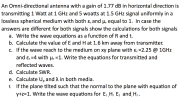 An Omni-directional antenna with a gain of 1.77 dB in horizontal direction is transmitting 1 Watt at 1 GHz and 5 woatts at 1.5 GHz signal uniformly in a lossless spherical medium with both ?,and ?,equal to 1, in case the answers are different for both signals show the calculations for both signals a. Write the wave equations as a function of R and t. b. Calculate the value of E and H at 1.6 km away from transmitter. c....
For the information given below, calculate the link budget analysis for the wireless system, which will involve calculat...
 For the information given below, calculate the link budget
analysis for the wireless system, which will involve calculating
the following:
• Received Power
• Link Margin
Assume that we are using the same antennas at the transmitter
and the receiver side, the link budget calculations will be the
same as the link budget in both directions is expected to be
symmetrical. In cases where 2 types of antenna systems with
different transmit power are used, we must perform two link...
For the information given below, calculate the link budget
analysis for the wireless system, which will involve calculating
the following:
• Received Power
• Link Margin
Assume that we are using the same antennas at the transmitter
and the receiver side, the link budget calculations will be the
same as the link budget in both directions is expected to be
symmetrical. In cases where 2 types of antenna systems with
different transmit power are used, we must perform two link...
For the information given below, calculate the link budget analysis for the wireless system, which will involve calculat...
For the information given below, calculate the link budget analysis for the wireless system, which will involve calculating the following: • Received Power • Link Margin Distance: 5 km Frequency: 5.8GHz Link Type: Point-to-Point, Line-of-Sight Tx power: +23dBm Antenna gain is 24dBi Assume negligible loss for cabling and connectors Receiver Sensitivity: -72dBm Assume that we are using the same antennas at the transmitter and the receiver side, the link budget calculations will be the same as the link budget in...
Consider the satellite relay link with the following parameters. Downlink EIRP of the satellite: 55 dBW...
 Consider the satellite relay link with the following parameters. Downlink EIRP of the satellite: 55 dBW Transmit frequency: Receiver noise temperature:700 K Receiver antenna gain Transmitter- receiver distance: 41,000 km System bandwidth: Total system losses (margin): 3 dB 2 GHz 0 dB 50 kHz (a) Find the received signal power in dBW (b) Find the receiver noise level in dBW (c) Calculate the signal-to-noise ratio at the receiver in dB
We wish to implement a 5 GHz communication link between Engineering building and Library (70 m...
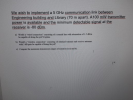 We wish to implement a 5 GHz communication link between Engineering building and Library (70 m apart). A100 mW transmitter power is available and the minimum detectable signal at the receiver is -80 dBm. a) Would a "wired connection consisting of a coaxial line with attention of 1.5 dBm be capable of doing the job? Explain. b) Would a wireless comme son consisting of identical transmit and receive antemas with 3 dB gain be capable of demg the job? c)...
QUESTION 12, 13, 14???? In 3.14, can write Gt and Gr directly in the answer, or...
 QUESTION 12, 13, 14????
In 3.14, can write Gt and Gr directly in the answer, or assume
Gt and Gr =1 (specify hypothesis)
P3.8. Path loss, fading, and delay spread are the three most important radio propagation issues. Explain why those issues are important in a cellular system. What is the difference between fast fading and slow fading? Р3.9. How is radio propagation on land different from that in free space? What does a small delay spread indicate about the...
QUESTION 12, 13, 14????
In 3.14, can write Gt and Gr directly in the answer, or assume
Gt and Gr =1 (specify hypothesis)
P3.8. Path loss, fading, and delay spread are the three most important radio propagation issues. Explain why those issues are important in a cellular system. What is the difference between fast fading and slow fading? Р3.9. How is radio propagation on land different from that in free space? What does a small delay spread indicate about the...
Please answer the questions 1-4. Thank you. IV. Useful Equations G a2 4mR)2 Friis Transmission formula:...
 Please answer the questions
1-4. Thank you.
IV. Useful Equations G a2 4mR)2 Friis Transmission formula: = Gain of horn antenna: G0.7 3-dB beam width of a horn antenna: -k (rad) Far-field: R 2 (m where Ξ received power level (W) Pttransmitted power level (w) 4 Gt gain of transmit antenna Gr gain of receive antenna λ wavelength (m) R range (distance) between transmitter and receiver Ap = aperture of horn antenna (m2) beamwidth in x-z plane lxlength of antenna...
Please answer the questions
1-4. Thank you.
IV. Useful Equations G a2 4mR)2 Friis Transmission formula: = Gain of horn antenna: G0.7 3-dB beam width of a horn antenna: -k (rad) Far-field: R 2 (m where Ξ received power level (W) Pttransmitted power level (w) 4 Gt gain of transmit antenna Gr gain of receive antenna λ wavelength (m) R range (distance) between transmitter and receiver Ap = aperture of horn antenna (m2) beamwidth in x-z plane lxlength of antenna...
 Calculate the maximum allowable path loss in dB between a radio transmitter and a receiver for the following transmission parameters. Assume the free space propagation loss condition. Transmitter's power: 10 Watt. Minimum required SNR (Signal to Noise Ratio) at the receiver: 5 dB. . Transmission channel bandwidth: 25 kHz. Noise power density No-0.8 x 10⁻⁹ W/Hz .Transmitting and receiving antenna gains are 1 dBi and 2 dBi respectively
 Designing a High speed Wireless Data Link Line of Sight Link Budget Analysis Several major factors that can impact the performance of a radio system are Available/permitted output power e Bandwidth, . Receiver sensitivity Antenna gains In this case study, the students will be required to calculate the link budget for a LOS Wireless link. Read through the following to understand some of the aspects and elements that need to be considered when calculating a Link Budget. If the estimated/calculated...
 An Omni-directional antenna with a gain of 1.77 dB in horizontal direction is transmitting 1 Watt at 1 GHz and 5 woatts at 1.5 GHz signal uniformly in a lossless spherical medium with both ?,and ?,equal to 1, in case the answers are different for both signals show the calculations for both signals a. Write the wave equations as a function of R and t. b. Calculate the value of E and H at 1.6 km away from transmitter. c....
 For the information given below, calculate the link budget
analysis for the wireless system, which will involve calculating
the following:
• Received Power
• Link Margin
Assume that we are using the same antennas at the transmitter
and the receiver side, the link budget calculations will be the
same as the link budget in both directions is expected to be
symmetrical. In cases where 2 types of antenna systems with
different transmit power are used, we must perform two link...
For the information given below, calculate the link budget
analysis for the wireless system, which will involve calculating
the following:
• Received Power
• Link Margin
Assume that we are using the same antennas at the transmitter
and the receiver side, the link budget calculations will be the
same as the link budget in both directions is expected to be
symmetrical. In cases where 2 types of antenna systems with
different transmit power are used, we must perform two link...
 Consider the satellite relay link with the following parameters. Downlink EIRP of the satellite: 55 dBW Transmit frequency: Receiver noise temperature:700 K Receiver antenna gain Transmitter- receiver distance: 41,000 km System bandwidth: Total system losses (margin): 3 dB 2 GHz 0 dB 50 kHz (a) Find the received signal power in dBW (b) Find the receiver noise level in dBW (c) Calculate the signal-to-noise ratio at the receiver in dB
 We wish to implement a 5 GHz communication link between Engineering building and Library (70 m apart). A100 mW transmitter power is available and the minimum detectable signal at the receiver is -80 dBm. a) Would a "wired connection consisting of a coaxial line with attention of 1.5 dBm be capable of doing the job? Explain. b) Would a wireless comme son consisting of identical transmit and receive antemas with 3 dB gain be capable of demg the job? c)...
 QUESTION 12, 13, 14????
In 3.14, can write Gt and Gr directly in the answer, or assume
Gt and Gr =1 (specify hypothesis)
P3.8. Path loss, fading, and delay spread are the three most important radio propagation issues. Explain why those issues are important in a cellular system. What is the difference between fast fading and slow fading? Р3.9. How is radio propagation on land different from that in free space? What does a small delay spread indicate about the...
QUESTION 12, 13, 14????
In 3.14, can write Gt and Gr directly in the answer, or assume
Gt and Gr =1 (specify hypothesis)
P3.8. Path loss, fading, and delay spread are the three most important radio propagation issues. Explain why those issues are important in a cellular system. What is the difference between fast fading and slow fading? Р3.9. How is radio propagation on land different from that in free space? What does a small delay spread indicate about the...
 Please answer the questions
1-4. Thank you.
IV. Useful Equations G a2 4mR)2 Friis Transmission formula: = Gain of horn antenna: G0.7 3-dB beam width of a horn antenna: -k (rad) Far-field: R 2 (m where Ξ received power level (W) Pttransmitted power level (w) 4 Gt gain of transmit antenna Gr gain of receive antenna λ wavelength (m) R range (distance) between transmitter and receiver Ap = aperture of horn antenna (m2) beamwidth in x-z plane lxlength of antenna...
Please answer the questions
1-4. Thank you.
IV. Useful Equations G a2 4mR)2 Friis Transmission formula: = Gain of horn antenna: G0.7 3-dB beam width of a horn antenna: -k (rad) Far-field: R 2 (m where Ξ received power level (W) Pttransmitted power level (w) 4 Gt gain of transmit antenna Gr gain of receive antenna λ wavelength (m) R range (distance) between transmitter and receiver Ap = aperture of horn antenna (m2) beamwidth in x-z plane lxlength of antenna...
Most questions answered within 3 hours.
-
Where is the error in this code sequence?
String s1 = "Hello";
String s2 = "ello";...
asked 11 months ago -
Financial data for Joel de Paris, Inc., for last year
follow:
Joel de Paris, Inc.
Balance...
asked 11 months ago -
Consider this reaction:
Al2(SO4)3 (aq)+ BaCl3
(aq) Al2Cl6 (aq)- +
3BaSO4(s) . What is the...
asked 11 months ago -
Suppose that Savneet is considering increasing her
recent random sample from 20 car rentals to 40...
asked 11 months ago -
Trucks arrive at an unloading terminal at an average rate of 120
per hour.
Trucks arrive...
asked 11 months ago -
Why are methanol and ethanol completely soluble in water while
octanol is not very little soluble....
asked 11 months ago -
A facilities manager at a university reads in a research report
that the mean amount of...
asked 11 months ago -
When the CuSO4 is rehydrated by adding water to the anhydrous
compound, is this an endothermic...
asked 11 months ago -
A ray of sunlight is passing from diamond into crown glass; the
angle of incidence is...
asked 11 months ago -
A block of mass 0.249 kg is placed on top of a light, vertical
spring of...
asked 11 months ago -
how do the kidneys compensate in the presences of acidosis
a) trigger hyperventilate
b) reserve acid...
asked 11 months ago -
Question 501 pts
The rental rate of capital to the firm increases. Which of the
following...
asked 11 months ago