Write a C function named f such that … the prototype of function f is … unsigned long...
- Write a C function named f such
that …
- the prototype of function f is …
-
unsigned long int f ( unsigned long int X, unsigned long int Y )
-
- function f returns …
- the nonnegative integer Z such that X 2 + Y 2 = Z 2 if such a nonnegative integer Z exists
- zero if there is no nonnegative integer Z such that X 2 + Y 2 = Z 2
- the prototype of function f is …
- Example 1
- If X = 3 and Y = 4 , then function f returns 5 because 5 is the nonnegative integer such that 32 + 42 = 52 .
- Example 2
- If X = 2 and Y = 5 , then function f returns 0 because there is no nonnegative integer Z such that 22 + 52 = Z2 .
Homework Answers
unsigned long int f ( unsigned long int X, unsigned long int Y ){
   unsigned long int result = X*X + Y*Y;
   unsigned long int Z = 0;
   while(result > (Z*Z)){
       Z = Z + 1;
   }
   if(result == (Z*Z)){
      return Z;
   }
   else{
      return 0;
   }
}
Add Answer to:
Write a C function named f such
that …
the prototype of function f is …
unsigned long...
Question 14; Write a C function named isSymmetric, the prototype of which is given below, that...
Question 14; Write a C function named isSymmetric, the prototype of which is given below, that returns 1 if the elements of an array of integers named myArray of size n are symmetric around the middle. If the array elements are not symmetric, the function should return 0. Both the array and its size are specified as parameters. (10 marks) Clue: Array myArray of size n is symmetric if myArray[0] is equal to myArray[n-1], myArray[1] is equal to myArray[n-2], and...
3. (12) Write a function named getSumSquares. You can skip writing the function prototype. This function...
 3. (12) Write a function named getSumSquares. You can skip writing the function prototype. This function has two int arguments called first and last. The function is to add up the tube of each number from first to last and return the total. (Note: the easy way to get the square of a number a is with: a * a). Square To see how the function works, here is an example. After the statement int c = getSumSquares (2, 4);...
Write a C function named date() that receives an integer number of the long date, date...
Write a C function named date() that receives an integer number of the long date, date form is yyyymmdd, such as 20070412; and the addresses of three variables named month, day, and year. determines the corresponding month, day, and year; and returns these three values to the calling function. For example, if date() is called using the statement longdate=20200411; date(longdate, &month, &day, &year); the number 4 should be returned in month, the number 11 in day, and the number...
11 Write a function with the following prototype: /* Determine whether arguments can be added without overflow */ int u...
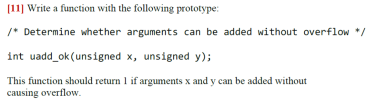 11 Write a function with the following prototype: /* Determine whether arguments can be added without overflow */ int uadd_ok (unsigned x, unsigned y); This function should return 1 if arguments x and y can be added without causing overflow
11 Write a function with the following prototype: /* Determine whether arguments can be added without overflow */ int uadd_ok (unsigned x, unsigned y); This function should return 1 if arguments x and y can be added without causing overflow
11 Write a function with the following prototype: /* Determine whether arguments can be added without overflow */ int uadd_ok (unsigned x, unsigned y); This function should return 1 if arguments x and y can be added without causing overflow
Write a C function named isSymmetric, the prototype of which is given below, that returns 1...
Write a C function named isSymmetric, the prototype of which is given below, that returns 1 if the elements of an array of integers named myArray of size n are symmetric around the middle. If the array elements are not symmetric, the function should return 0. Both the array and its size are specified as parameters.
write C code that uses pointers, arrays, and C strings. 3. Write a function called pow_xy....
write C code that uses pointers, arrays, and C strings. 3. Write a function called pow_xy. The function should be passed 2 parameters, as illustrated in the prototype below. int pow_xy(int *xptr, int y); Assuming that xptr contains the address of variable x, pow_xy should compute x to the y power, and store the result as the new value of x. The function should also return the result. Do not use the built-in C function pow. For the remaining problems,...
C programming KAM5 Write a function unsigned long long int factorial(int num) to compute the factorial...
 C programming
KAM5 Write a function unsigned long long int factorial(int num) to compute the factorial of a number. The factorial of a number is given by n! = 1*2* ... *n So 1! = 1, 2! = 1*2, 3! = 1*2*3 ... For example: Test Result printf("%llu\n", factorial(5)); 120 printf("%lu\n", factorial(20)); 2432902008176640000
C programming
KAM5 Write a function unsigned long long int factorial(int num) to compute the factorial of a number. The factorial of a number is given by n! = 1*2* ... *n So 1! = 1, 2! = 1*2, 3! = 1*2*3 ... For example: Test Result printf("%llu\n", factorial(5)); 120 printf("%lu\n", factorial(20)); 2432902008176640000
C++ Write a recursive function named sumSquares that returns the sum of the squares of the...
C++ Write a recursive function named sumSquares that returns the sum of the squares of the numbers from to num, in which num is a nonnegative int variable. Do not use global variables; use the appropriate parameters. Also write a program to test your function.
C++ Write a recursive function named sumSquares that returns the sum of the squares of the...
C++ Write a recursive function named sumSquares that returns the sum of the squares of the numbers from to num, in which num is a nonnegative int variable. Do not use global variables; use the appropriate parameters. Also write a program to test your function.
C++ //Write prototype for function factorial that accepts an int num and returns an int /*...
C++ //Write prototype for function factorial that accepts an int num and returns an int /* WITH LOOP OF YOUR CHOICE: Write code for function factorial that accepts an int num and returns the num's factorial factorial(5); 1*2*3*4*5 returns 120 DON'T FORGET TO WRITE TEST CASE. */ //write includes statements //write using statements for cin and cout /* Use a do while loop to prompt the user for a number, call the factorial function, and display the number's factorial. Also,...
 3. (12) Write a function named getSumSquares. You can skip writing the function prototype. This function has two int arguments called first and last. The function is to add up the tube of each number from first to last and return the total. (Note: the easy way to get the square of a number a is with: a * a). Square To see how the function works, here is an example. After the statement int c = getSumSquares (2, 4);...
 11 Write a function with the following prototype: /* Determine whether arguments can be added without overflow */ int uadd_ok (unsigned x, unsigned y); This function should return 1 if arguments x and y can be added without causing overflow
11 Write a function with the following prototype: /* Determine whether arguments can be added without overflow */ int uadd_ok (unsigned x, unsigned y); This function should return 1 if arguments x and y can be added without causing overflow
11 Write a function with the following prototype: /* Determine whether arguments can be added without overflow */ int uadd_ok (unsigned x, unsigned y); This function should return 1 if arguments x and y can be added without causing overflow
 C programming
KAM5 Write a function unsigned long long int factorial(int num) to compute the factorial of a number. The factorial of a number is given by n! = 1*2* ... *n So 1! = 1, 2! = 1*2, 3! = 1*2*3 ... For example: Test Result printf("%llu\n", factorial(5)); 120 printf("%lu\n", factorial(20)); 2432902008176640000
C programming
KAM5 Write a function unsigned long long int factorial(int num) to compute the factorial of a number. The factorial of a number is given by n! = 1*2* ... *n So 1! = 1, 2! = 1*2, 3! = 1*2*3 ... For example: Test Result printf("%llu\n", factorial(5)); 120 printf("%lu\n", factorial(20)); 2432902008176640000
Most questions answered within 3 hours.
-
Where is the error in this code sequence?
String s1 = "Hello";
String s2 = "ello";...
asked 11 months ago -
Financial data for Joel de Paris, Inc., for last year
follow:
Joel de Paris, Inc.
Balance...
asked 11 months ago -
Consider this reaction:
Al2(SO4)3 (aq)+ BaCl3
(aq) Al2Cl6 (aq)- +
3BaSO4(s) . What is the...
asked 11 months ago -
Suppose that Savneet is considering increasing her
recent random sample from 20 car rentals to 40...
asked 11 months ago -
Trucks arrive at an unloading terminal at an average rate of 120
per hour.
Trucks arrive...
asked 11 months ago -
Why are methanol and ethanol completely soluble in water while
octanol is not very little soluble....
asked 11 months ago -
A facilities manager at a university reads in a research report
that the mean amount of...
asked 11 months ago -
When the CuSO4 is rehydrated by adding water to the anhydrous
compound, is this an endothermic...
asked 11 months ago -
A ray of sunlight is passing from diamond into crown glass; the
angle of incidence is...
asked 11 months ago -
A block of mass 0.249 kg is placed on top of a light, vertical
spring of...
asked 11 months ago -
how do the kidneys compensate in the presences of acidosis
a) trigger hyperventilate
b) reserve acid...
asked 11 months ago -
Question 501 pts
The rental rate of capital to the firm increases. Which of the
following...
asked 11 months ago