Which of the following is correct order to process the growing colonies: 1. plasmid purification 2....
Which of the following is correct order to process the growing colonies:
1. plasmid purification
2. inoculate liquid culture
3. perform agarose gel electrophoresis
4. set up restriction enzyme digest
A. 1,2,3,4
B. 2,1,4,3
C.1,2,4,3
Homework Answers
The correct answers is ,
B.2,1,4,3
Screening by restriction digestion is the classical method to determine the recombinant colonies by performing inoculating in a liquid culture and a plasmid miniprep followed by restriction digestion.This technique is based on the principle that if the transformed colonies contain the insert of interest it can be digested from vector with the help of restriction enzyme and can be analysed by Agarose gel electrophoresis.
Add Answer to:
Which of the following is correct order to process the growing
colonies:
1. plasmid purification
2....
College students performed the following set of restriction digests on their plasmid pBLA 230. The following...
 College students performed the following set of restriction digests on their plasmid pBLA 230. The following below represents the enzyme, the number of bands produced, and the size of the DNA after going through gel electrophoresis. Draw the restriction map of the double digest.
Two experiments were performed in order to confirm the Beta-glucuronidase gene from E. coli was present...
 Two experiments were performed in order to confirm the
Beta-glucuronidase gene from E. coli was present in the pET28a
plasmid. (Lane1) PCR was performed to amplify the
Beta-glucuronidase gene and if the gene was present then a single
band would appear at ~7,300 bp. However, the band appeared to drag
down the gel but stopped ~7,300 bp. What would cause the PCR
product to smear down the gel and does this mean that the
amplification of the PCR product was...
Two experiments were performed in order to confirm the
Beta-glucuronidase gene from E. coli was present in the pET28a
plasmid. (Lane1) PCR was performed to amplify the
Beta-glucuronidase gene and if the gene was present then a single
band would appear at ~7,300 bp. However, the band appeared to drag
down the gel but stopped ~7,300 bp. What would cause the PCR
product to smear down the gel and does this mean that the
amplification of the PCR product was...
A. Your lab To see if you understand what you did in our lab, answer the...
 A. Your lab To see if you understand what you did in our lab, answer the following based in the procedures for the restriction digest and the gel electrophoresis. 1. Using the PGLO map on p7 of the gel electrophoresis procedure, predict the size of the fragments generated by each enzyme EcoRI Hindill, and Pst! (the sizes you would expect to see on the gel.) (6 pts) Hindill -8 fragments were produced by the restriction enzyme. 2. Answer the calculation...
colony which one express gene Only correct explanation not just answears pls. how to determine correct...
 colony which one express gene
Only correct explanation not just answears pls.
how to determine correct orientation by electrophoresis
CORI -Hindi mal kpn ! Aggi -Hind III Gene CDNA EcoRI 5. G' AAT TC 3 CTTAAG. 5 Бра 5GGT ACC 3 3 CCATGG 5 pMAE2 Avr 11 M5 CCTAGGS 3 GGATCC.5 Arell ACCGGT 3 3.. TGGCCA...5 Amp Hind 1 5: AAGCTT 3 S 3. TTCGAA53 Xma C CGGG.3 GGGCGC 5 You try the following strategies in order to see if...
colony which one express gene
Only correct explanation not just answears pls.
how to determine correct orientation by electrophoresis
CORI -Hindi mal kpn ! Aggi -Hind III Gene CDNA EcoRI 5. G' AAT TC 3 CTTAAG. 5 Бра 5GGT ACC 3 3 CCATGG 5 pMAE2 Avr 11 M5 CCTAGGS 3 GGATCC.5 Arell ACCGGT 3 3.. TGGCCA...5 Amp Hind 1 5: AAGCTT 3 S 3. TTCGAA53 Xma C CGGG.3 GGGCGC 5 You try the following strategies in order to see if...
Question 1. 1 2 3 4 5 6 7 8 Lane Name/Code Ladder 1B | 2B...
 Question 1. 1 2 3 4 5 6 7 8 Lane Name/Code Ladder 1B | 2B 2 DNA Sample/Treatment DNA ladder Digest Digest Digest Digest Digest Digest 3B 4B 5B Negative Figure 1: 1% Super buffer agarose gel electrophoresis of restriction digest of the plasmid containing the gdhA gene insert. Based on the information above answer the following questions? 1. What ladder size used? 2. What are the two top bands and bottom bands representing? 3. Explain why the observed...
A plasmid is cleaved by restriction endonucleases and analyzed by agarose gel electrophoresis. Assume there is...
 A plasmid is cleaved by restriction endonucleases and analyzed
by agarose gel electrophoresis. Assume there is no supercoiling.
Answer the following three questions about the plasmid.
Can you please help below? I also don't understand it so a
explanation for each would be helpful. For the first one I think
its 1000bp but unsure. For the second, I think there is 2 HindIII
sites and for the last one there is 1 EcoRI site? Please
explain.
A plasmid is cleaved...
A plasmid is cleaved by restriction endonucleases and analyzed
by agarose gel electrophoresis. Assume there is no supercoiling.
Answer the following three questions about the plasmid.
Can you please help below? I also don't understand it so a
explanation for each would be helpful. For the first one I think
its 1000bp but unsure. For the second, I think there is 2 HindIII
sites and for the last one there is 1 EcoRI site? Please
explain.
A plasmid is cleaved...
7. Explain the procedure for cloning DNA fragment into the plasmid PBR322 (shown on the right) (S...
 7. Explain the procedure for cloning DNA fragment into the plasmid PBR322 (shown on the right) (S pts.). The gene fragment of interest was obtained by digestion of chromosomal DNA with the restriction enzyme Sall and subsequent purification using agarose gel electrophoresis. Which antiblotic would you use in the final step of the cloning procedure, and Pst why? EcoR Sal Ampicillin Tetracycline resistanica(Ter Amp) PBR322 4,361 bp) Origin of replicatiorn (ori Pvull 8. Assume that your gene fragment from question...
You isolate plasmid DNA from bacteria (Questions 7-10) 7) A plasmid is an extrachromosomal circul...
 10 please and 7
You isolate plasmid DNA from bacteria (Questions 7-10) 7) A plasmid is an extrachromosomal circular DNA frequently found in prokaryotes. Aside from being smaller, how is it different from the prokaryotic genome? You place equal amounts of plasmid DNA in 4 different tubes and incubate the DNA with increasing amounts of the enzyme topoisomerase I for 1 hour (0 enzyme units 0.25 enzyme units, 0.5 enzyme units and 1 enzyme unit). You then analyze the plasmid...
10 please and 7
You isolate plasmid DNA from bacteria (Questions 7-10) 7) A plasmid is an extrachromosomal circular DNA frequently found in prokaryotes. Aside from being smaller, how is it different from the prokaryotic genome? You place equal amounts of plasmid DNA in 4 different tubes and incubate the DNA with increasing amounts of the enzyme topoisomerase I for 1 hour (0 enzyme units 0.25 enzyme units, 0.5 enzyme units and 1 enzyme unit). You then analyze the plasmid...
i nee help analysing this data Anssume that the fractions you collected from the partial purification...
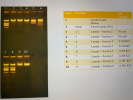 i nee help analysing this data
Anssume that the fractions you collected from the partial
purification by ionic chromatography were incubate with lambda DNA
and EcoR1 reaction buffer( Restriction enzyme reactions) and you
obtained the following bands in your agarose gel.
2 3 4 5 6 Lane Fraction Salt Content B and Lamda EcoR1 Marker 2 None 3 Lamda + fraction 2 Lamda + fraction 3 No salt No salt 21 3 4 5 7 8 9 10 6 6...
i nee help analysing this data
Anssume that the fractions you collected from the partial
purification by ionic chromatography were incubate with lambda DNA
and EcoR1 reaction buffer( Restriction enzyme reactions) and you
obtained the following bands in your agarose gel.
2 3 4 5 6 Lane Fraction Salt Content B and Lamda EcoR1 Marker 2 None 3 Lamda + fraction 2 Lamda + fraction 3 No salt No salt 21 3 4 5 7 8 9 10 6 6...
III. Subclone the gene into plasmid, extract the plasmid DNA. 5. You know that your insert...
 III. Subclone the gene into plasmid, extract the plasmid DNA. 5. You know that your insert (gene of interest, GOI) is flanked by the EcoRI sites, which makes this restriction enzyme a perfect candidate to cut out your gene. You also know that the GOI has a unique BamH1 restriction site. After subcloning the PCR product into the plasmid, a purified DNA preparation of the plasmid is digested to completion with BamHI restriction endonuclease. In separate reactions, the same preparation...
 College students performed the following set of restriction digests on their plasmid pBLA 230. The following below represents the enzyme, the number of bands produced, and the size of the DNA after going through gel electrophoresis. Draw the restriction map of the double digest.
 Two experiments were performed in order to confirm the
Beta-glucuronidase gene from E. coli was present in the pET28a
plasmid. (Lane1) PCR was performed to amplify the
Beta-glucuronidase gene and if the gene was present then a single
band would appear at ~7,300 bp. However, the band appeared to drag
down the gel but stopped ~7,300 bp. What would cause the PCR
product to smear down the gel and does this mean that the
amplification of the PCR product was...
Two experiments were performed in order to confirm the
Beta-glucuronidase gene from E. coli was present in the pET28a
plasmid. (Lane1) PCR was performed to amplify the
Beta-glucuronidase gene and if the gene was present then a single
band would appear at ~7,300 bp. However, the band appeared to drag
down the gel but stopped ~7,300 bp. What would cause the PCR
product to smear down the gel and does this mean that the
amplification of the PCR product was...
 A. Your lab To see if you understand what you did in our lab, answer the following based in the procedures for the restriction digest and the gel electrophoresis. 1. Using the PGLO map on p7 of the gel electrophoresis procedure, predict the size of the fragments generated by each enzyme EcoRI Hindill, and Pst! (the sizes you would expect to see on the gel.) (6 pts) Hindill -8 fragments were produced by the restriction enzyme. 2. Answer the calculation...
 colony which one express gene
Only correct explanation not just answears pls.
how to determine correct orientation by electrophoresis
CORI -Hindi mal kpn ! Aggi -Hind III Gene CDNA EcoRI 5. G' AAT TC 3 CTTAAG. 5 Бра 5GGT ACC 3 3 CCATGG 5 pMAE2 Avr 11 M5 CCTAGGS 3 GGATCC.5 Arell ACCGGT 3 3.. TGGCCA...5 Amp Hind 1 5: AAGCTT 3 S 3. TTCGAA53 Xma C CGGG.3 GGGCGC 5 You try the following strategies in order to see if...
colony which one express gene
Only correct explanation not just answears pls.
how to determine correct orientation by electrophoresis
CORI -Hindi mal kpn ! Aggi -Hind III Gene CDNA EcoRI 5. G' AAT TC 3 CTTAAG. 5 Бра 5GGT ACC 3 3 CCATGG 5 pMAE2 Avr 11 M5 CCTAGGS 3 GGATCC.5 Arell ACCGGT 3 3.. TGGCCA...5 Amp Hind 1 5: AAGCTT 3 S 3. TTCGAA53 Xma C CGGG.3 GGGCGC 5 You try the following strategies in order to see if...
 Question 1. 1 2 3 4 5 6 7 8 Lane Name/Code Ladder 1B | 2B 2 DNA Sample/Treatment DNA ladder Digest Digest Digest Digest Digest Digest 3B 4B 5B Negative Figure 1: 1% Super buffer agarose gel electrophoresis of restriction digest of the plasmid containing the gdhA gene insert. Based on the information above answer the following questions? 1. What ladder size used? 2. What are the two top bands and bottom bands representing? 3. Explain why the observed...
 A plasmid is cleaved by restriction endonucleases and analyzed
by agarose gel electrophoresis. Assume there is no supercoiling.
Answer the following three questions about the plasmid.
Can you please help below? I also don't understand it so a
explanation for each would be helpful. For the first one I think
its 1000bp but unsure. For the second, I think there is 2 HindIII
sites and for the last one there is 1 EcoRI site? Please
explain.
A plasmid is cleaved...
A plasmid is cleaved by restriction endonucleases and analyzed
by agarose gel electrophoresis. Assume there is no supercoiling.
Answer the following three questions about the plasmid.
Can you please help below? I also don't understand it so a
explanation for each would be helpful. For the first one I think
its 1000bp but unsure. For the second, I think there is 2 HindIII
sites and for the last one there is 1 EcoRI site? Please
explain.
A plasmid is cleaved...
 7. Explain the procedure for cloning DNA fragment into the plasmid PBR322 (shown on the right) (S pts.). The gene fragment of interest was obtained by digestion of chromosomal DNA with the restriction enzyme Sall and subsequent purification using agarose gel electrophoresis. Which antiblotic would you use in the final step of the cloning procedure, and Pst why? EcoR Sal Ampicillin Tetracycline resistanica(Ter Amp) PBR322 4,361 bp) Origin of replicatiorn (ori Pvull 8. Assume that your gene fragment from question...
 10 please and 7
You isolate plasmid DNA from bacteria (Questions 7-10) 7) A plasmid is an extrachromosomal circular DNA frequently found in prokaryotes. Aside from being smaller, how is it different from the prokaryotic genome? You place equal amounts of plasmid DNA in 4 different tubes and incubate the DNA with increasing amounts of the enzyme topoisomerase I for 1 hour (0 enzyme units 0.25 enzyme units, 0.5 enzyme units and 1 enzyme unit). You then analyze the plasmid...
10 please and 7
You isolate plasmid DNA from bacteria (Questions 7-10) 7) A plasmid is an extrachromosomal circular DNA frequently found in prokaryotes. Aside from being smaller, how is it different from the prokaryotic genome? You place equal amounts of plasmid DNA in 4 different tubes and incubate the DNA with increasing amounts of the enzyme topoisomerase I for 1 hour (0 enzyme units 0.25 enzyme units, 0.5 enzyme units and 1 enzyme unit). You then analyze the plasmid...
 i nee help analysing this data
Anssume that the fractions you collected from the partial
purification by ionic chromatography were incubate with lambda DNA
and EcoR1 reaction buffer( Restriction enzyme reactions) and you
obtained the following bands in your agarose gel.
2 3 4 5 6 Lane Fraction Salt Content B and Lamda EcoR1 Marker 2 None 3 Lamda + fraction 2 Lamda + fraction 3 No salt No salt 21 3 4 5 7 8 9 10 6 6...
i nee help analysing this data
Anssume that the fractions you collected from the partial
purification by ionic chromatography were incubate with lambda DNA
and EcoR1 reaction buffer( Restriction enzyme reactions) and you
obtained the following bands in your agarose gel.
2 3 4 5 6 Lane Fraction Salt Content B and Lamda EcoR1 Marker 2 None 3 Lamda + fraction 2 Lamda + fraction 3 No salt No salt 21 3 4 5 7 8 9 10 6 6...
 III. Subclone the gene into plasmid, extract the plasmid DNA. 5. You know that your insert (gene of interest, GOI) is flanked by the EcoRI sites, which makes this restriction enzyme a perfect candidate to cut out your gene. You also know that the GOI has a unique BamH1 restriction site. After subcloning the PCR product into the plasmid, a purified DNA preparation of the plasmid is digested to completion with BamHI restriction endonuclease. In separate reactions, the same preparation...
Most questions answered within 3 hours.
-
Where is the error in this code sequence?
String s1 = "Hello";
String s2 = "ello";...
asked 11 months ago -
Financial data for Joel de Paris, Inc., for last year
follow:
Joel de Paris, Inc.
Balance...
asked 11 months ago -
Consider this reaction:
Al2(SO4)3 (aq)+ BaCl3
(aq) Al2Cl6 (aq)- +
3BaSO4(s) . What is the...
asked 11 months ago -
Suppose that Savneet is considering increasing her
recent random sample from 20 car rentals to 40...
asked 11 months ago -
Trucks arrive at an unloading terminal at an average rate of 120
per hour.
Trucks arrive...
asked 11 months ago -
Why are methanol and ethanol completely soluble in water while
octanol is not very little soluble....
asked 11 months ago -
A facilities manager at a university reads in a research report
that the mean amount of...
asked 11 months ago -
When the CuSO4 is rehydrated by adding water to the anhydrous
compound, is this an endothermic...
asked 11 months ago -
A ray of sunlight is passing from diamond into crown glass; the
angle of incidence is...
asked 11 months ago -
A block of mass 0.249 kg is placed on top of a light, vertical
spring of...
asked 11 months ago -
how do the kidneys compensate in the presences of acidosis
a) trigger hyperventilate
b) reserve acid...
asked 11 months ago -
Question 501 pts
The rental rate of capital to the firm increases. Which of the
following...
asked 11 months ago