1. Describe the processes by which fatty acids are transported in the blood, activated and transported...
1. Describe the processes by which fatty acids are transported in the blood, activated and transported into the matrix of the mitochondria for breakdown to obtain energy. (Specifically, determine the role of carnitine palmitoyl transferase in the oxidation of fatty acids.)
2. Explain the processes by which fatty acids are released from triacylglycerol stored in adipose tissue.
3. Outline the β-oxidation pathway by which fatty acids are metabolized to acetyl-CoA and explain how this leads to the production of large quantities of ATP.
4. Identify the three compounds termed “ketone bodies” and describe the reactions by which they are formed in liver mitochondria.
5. Recognize that ketone bodies are important fuels for extrahepatic tissues and indicate the conditions in which their synthesis and use are favored.
Homework Answers
1-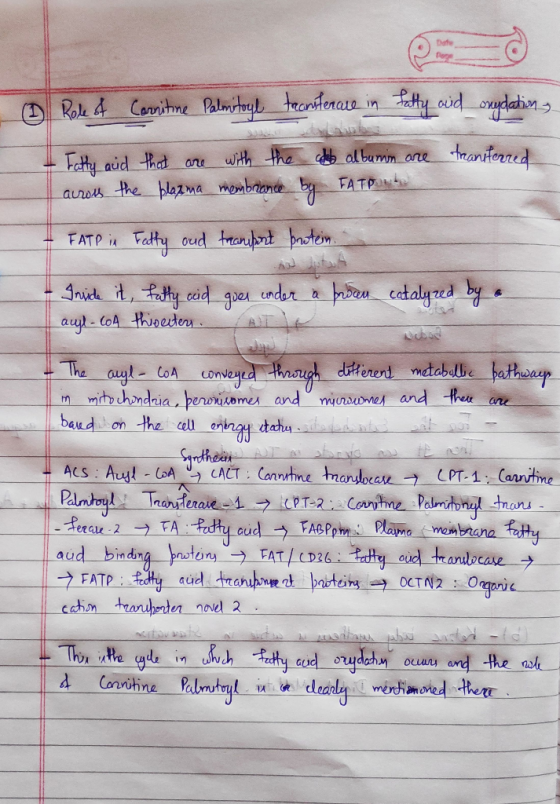
2-fatty acids are released and it is released between meals.It released from the fat deposited in the adipose tissue and there these fatty acids are stored in adipose tissue.
the process is-
-the removal of the fatty acid chains from the glycerol is called as lipolysis and this process is carried out by lipases.
-when the fatty acids are freed from glycerol then it enters into the blood which transport them throughout the body.
-the fatty acids which have long chains they enter into the metabolizing cells.
-then the long chain fatty acid catalyzes the reaction between the fatty acid and ATP because to give a fatty acid adenylate.
-then it reacts with coenzyme A to give a fatty acyl-CoA molecule.
-then it is entered into the mitochondrion and stored there.
this is the complete process.
3-This process occurs in the mitochondria, this process is strictly aerobic.By this process Acetyl-CoA is produced.
The B-oxidation of fatty acid occurs in 3 stages.
-Activation of fatty acid in cytosol.
-Transport of fatty acid into mitochondria.
-beta oxidation in the mitochondrial matrix.
as an example we will take palmitic acid and its beta oxidation process occurs in 7 cycle and it produce 8 acetyl- CoA.
- in each cycle FADH2 and NADH+H is produced and both consists 2 and 3 ATP respectively.in one cycle total no of atp produced is 5.so in 7 cycles total ATP will be=(5 * 7)=35.
-each acetyl Coa which is oxidized in cytric cycle gives 12 ATP,so (8 cycle*12)=96 ATP.
-2 ATP are utilized in the activation of fatty acid.
formula is ,energy gain=energy produced-energy utilized=35 ATP+96 ATP-2 ATP=129 ATP.Thus this process leads to production of large number of ATP.
4-Three compound termed ketone bodies are-acetone,acetoacetic acid,beta hydroxybutyric acid.

5-answer of 5th ques-

Add Answer to:
1. Describe the processes by which fatty acids are transported
in the blood, activated and transported...
An activated fatty acid (acyl-CoA) can be transported into the mitochondria for b-oxidation or remain in...
An activated fatty acid (acyl-CoA) can be transported into the mitochondria for b-oxidation or remain in the cytosol for lipogenesis to produce a triacylglycerol. What regulates the fate of this acyl-CoA? A. the amount of acyl-CoA in the mitochondria B. the amount of acyl-carnitine in the mitochondria C. the amount of NADH in the cytoplasm D. the amount of malonyl CoA in the cytoplasm E. the amount of acetyl-CoA in the cytoplasm
Investigate short-chain (12 carbons or less) fatty acid metabolism: Monitor ketone body formation in the blood...
Investigate short-chain (12 carbons or less) fatty acid metabolism: Monitor ketone body formation in the blood Results: Interestingly, when Jessie was fed a solution containing short-chain fatty acids and again fasted, plasma acetoacetate and γ-hydroxybutyrate concentrations increased. 15. What does this result tell you about Jessie? A. Nothing B. Something, but not clear what C. One of the enzymes of the β-oxidation pathway must be deficient D. There must be a problem with specifically long-chain fatty acid transport, not with...
Fatty acids are activated on the outer membrane of the mitochondria. This reaction involves the addition...
Fatty acids are activated on the outer membrane of the mitochondria. This reaction involves the addition of a CoA group to the fatty acid (to generate an Acyl CoA), and the hydrolysis of ATP to AMP. After fatty acids are activated, they must be linked to carnitine for transport across the inner mitochondrial membrane. Then, how many carbons are oxidized at a time? What molecules are generated by fatty acid oxidation?
Which of the following metabolic changes will occur in a typical human after a meal balanced...
Which of the following metabolic changes will occur in a typical human after a meal balanced in carbohydrates, protein, and fat is consumed? (Select ALL that apply!) Liver glycogen synthesis increases Muscle glycogenolysis (glycogen breakdown) increases Liver gluconeogenesis decreases Insulin levels in the blood decrease Ketone body production in the liver is increased ..... Which of the following metabolic changes will occur in a typical human during 12 hours of fasting? (Select ALL that apply.) Liver glycogen synthesis decreases Liver...
1. In untreated Type 1 diabetes, the hepatocyte's citric acid cycle becomes overwhelmed with acetyl-CoA fr...
 1. In untreated Type 1 diabetes, the hepatocyte's citric acid cycle becomes overwhelmed with acetyl-CoA fr Map excessive fatty acid oxidation. Although the excess acetyl-CoA is not toxic, it must be diverted into the formation of ketone bodies: acetone, acetoacetate, and D-(hydroxybutyrate.
What problem would arise if the excess acetyl-CoA were not converted to ketone bodies?
How does the diversion to ketone bodies solve the problem?
The enzymes converting acetyl-CoA to acetoacetate liberate the CoA to be used in...
1. In untreated Type 1 diabetes, the hepatocyte's citric acid cycle becomes overwhelmed with acetyl-CoA fr Map excessive fatty acid oxidation. Although the excess acetyl-CoA is not toxic, it must be diverted into the formation of ketone bodies: acetone, acetoacetate, and D-(hydroxybutyrate.
What problem would arise if the excess acetyl-CoA were not converted to ketone bodies?
How does the diversion to ketone bodies solve the problem?
The enzymes converting acetyl-CoA to acetoacetate liberate the CoA to be used in...
Which one of the following statements about fatty acids is true? A) When fatty acids are...
Which one of the following statements about fatty acids is true? A) When fatty acids are activated in the cytosol, ATP is converted to ADP B) Fatty acyl groups are covalently linked to carnitine by an enzyme inhibited by malonyl CoA C) Fatty acids are very soluble in water and need no carrier in the blood D) Fatty acids are linked to glycerol phosphate in the fasting state E) Fatty acids can be oxidized to CO2 and H2O in the...
The process of β-oxidation requires fatty acids to be activated by transfer to Coenzyme- A. This...
The process of β-oxidation requires fatty acids to be activated by transfer to Coenzyme- A. This step is dependent on free energy provided by ATP. Briefly describe how breakage of high-energy bonds in ATP is linked to the transfer of fatty acids to Coenzyme A. What critical fatty acid intermediate is formed in this process? How is energy of phosphoanhydride bonds in ATP leveraged to facilitate the formation of the thioester bond between the fatty acid and Coenzyme A moieties?...
7- Oxidation of fatty acids occure in: A. Mitochondria B. Endoplasmic reticulum C. Lysosome D. Cell...
7- Oxidation of fatty acids occure in: A. Mitochondria B. Endoplasmic reticulum C. Lysosome D. Cell Membrane 8- End product of B-oxidation of fatty acid with even number of carbon atoms is: A- a-keto glutarate B- Propionyl CoA C- Acetoacetyl CoA D- Acetyl CoA 9- How many ATP molecules produces from B-oxidation of palmitylCoA? A.109 B. 129 C. 24 D. 38 ● 10- How many ATP molecules produces from one turn of B-oxidation ? A- 109 B. 129 C. 5 ...
D Question 30 Soveral hours after a meal, the brain uses During starvation, the brain uses...
 D Question 30 Soveral hours after a meal, the brain uses During starvation, the brain uses as fuel. glucose from glycogen stored in the brain ketone bodies produced in the heart glucose from olycogen stored in the liver kolone bodies produced in the liver glucose from glycogen stored in the muscles kotone bodo produced in the liver fatty acids from adipose tissue glucose from gluconeogenesis in the liver D Question 31 Question 2 pts Which of the following enzyme pairs...
#37 a. lipase is activat and acetyl CoA c c. both lipase and acetyl CoA carboxylase are activated d. both lipase and acetyl CoA caroboxylase are inhibited ase is activated yl C 36. Which of the fo...
 #37
a. lipase is activat and acetyl CoA c c. both lipase and acetyl CoA carboxylase are activated d. both lipase and acetyl CoA caroboxylase are inhibited ase is activated yl C 36. Which of the following lipoproteins transports cholesterol from cells back to the liver a. VLD b. IDL c. LDL Liver to other cesns HD Extra Credit: Lindlenic 37. Calculate the amount of ATP that results from the complete breakdown of the following 9, 12, 137 fatty acid:...
#37
a. lipase is activat and acetyl CoA c c. both lipase and acetyl CoA carboxylase are activated d. both lipase and acetyl CoA caroboxylase are inhibited ase is activated yl C 36. Which of the following lipoproteins transports cholesterol from cells back to the liver a. VLD b. IDL c. LDL Liver to other cesns HD Extra Credit: Lindlenic 37. Calculate the amount of ATP that results from the complete breakdown of the following 9, 12, 137 fatty acid:...
 1. In untreated Type 1 diabetes, the hepatocyte's citric acid cycle becomes overwhelmed with acetyl-CoA fr Map excessive fatty acid oxidation. Although the excess acetyl-CoA is not toxic, it must be diverted into the formation of ketone bodies: acetone, acetoacetate, and D-(hydroxybutyrate.
What problem would arise if the excess acetyl-CoA were not converted to ketone bodies?
How does the diversion to ketone bodies solve the problem?
The enzymes converting acetyl-CoA to acetoacetate liberate the CoA to be used in...
1. In untreated Type 1 diabetes, the hepatocyte's citric acid cycle becomes overwhelmed with acetyl-CoA fr Map excessive fatty acid oxidation. Although the excess acetyl-CoA is not toxic, it must be diverted into the formation of ketone bodies: acetone, acetoacetate, and D-(hydroxybutyrate.
What problem would arise if the excess acetyl-CoA were not converted to ketone bodies?
How does the diversion to ketone bodies solve the problem?
The enzymes converting acetyl-CoA to acetoacetate liberate the CoA to be used in...
 D Question 30 Soveral hours after a meal, the brain uses During starvation, the brain uses as fuel. glucose from glycogen stored in the brain ketone bodies produced in the heart glucose from olycogen stored in the liver kolone bodies produced in the liver glucose from glycogen stored in the muscles kotone bodo produced in the liver fatty acids from adipose tissue glucose from gluconeogenesis in the liver D Question 31 Question 2 pts Which of the following enzyme pairs...
 #37
a. lipase is activat and acetyl CoA c c. both lipase and acetyl CoA carboxylase are activated d. both lipase and acetyl CoA caroboxylase are inhibited ase is activated yl C 36. Which of the following lipoproteins transports cholesterol from cells back to the liver a. VLD b. IDL c. LDL Liver to other cesns HD Extra Credit: Lindlenic 37. Calculate the amount of ATP that results from the complete breakdown of the following 9, 12, 137 fatty acid:...
#37
a. lipase is activat and acetyl CoA c c. both lipase and acetyl CoA carboxylase are activated d. both lipase and acetyl CoA caroboxylase are inhibited ase is activated yl C 36. Which of the following lipoproteins transports cholesterol from cells back to the liver a. VLD b. IDL c. LDL Liver to other cesns HD Extra Credit: Lindlenic 37. Calculate the amount of ATP that results from the complete breakdown of the following 9, 12, 137 fatty acid:...
Most questions answered within 3 hours.
-
Where is the error in this code sequence?
String s1 = "Hello";
String s2 = "ello";...
asked 10 months ago -
Financial data for Joel de Paris, Inc., for last year
follow:
Joel de Paris, Inc.
Balance...
asked 10 months ago -
Consider this reaction:
Al2(SO4)3 (aq)+ BaCl3
(aq) Al2Cl6 (aq)- +
3BaSO4(s) . What is the...
asked 10 months ago -
Suppose that Savneet is considering increasing her
recent random sample from 20 car rentals to 40...
asked 10 months ago -
Trucks arrive at an unloading terminal at an average rate of 120
per hour.
Trucks arrive...
asked 10 months ago -
Why are methanol and ethanol completely soluble in water while
octanol is not very little soluble....
asked 10 months ago -
A facilities manager at a university reads in a research report
that the mean amount of...
asked 10 months ago -
When the CuSO4 is rehydrated by adding water to the anhydrous
compound, is this an endothermic...
asked 10 months ago -
A ray of sunlight is passing from diamond into crown glass; the
angle of incidence is...
asked 10 months ago -
A block of mass 0.249 kg is placed on top of a light, vertical
spring of...
asked 10 months ago -
how do the kidneys compensate in the presences of acidosis
a) trigger hyperventilate
b) reserve acid...
asked 10 months ago -
Question 501 pts
The rental rate of capital to the firm increases. Which of the
following...
asked 10 months ago