10) Given these two individual demand curves of consumers A and B, what is the equation...
10) Given these two individual demand curves of consumers A and B, what is the equation for the market demand curve? i. P = 100 – 10qA ii. P = 100 - (5/4)qB
A. P = 90 – 10/9Q
B. P = 200 – 11.25Q
C. P = 100 – 11.25Q
D. P = 90 – 0.9Q
E. None of the above
Homework Answers
Market demand curve is obtained by horizontally adding individual demand curve.In this case the intercept (100 ) would remain the same but the slope will change.
New slope=10+5/4=11.25
New market demand=100-11.25Q
Answer-C
Add Answer to:
10) Given these two individual demand curves of consumers A and
B, what is the equation...
There are only two groups of consumers in a particular market. Let the demand curve of...
 There are only two groups of consumers in a particular market. Let the demand curve of consumers in group 1 be given as q = f(p) and the demand curve of consumers in group 2 be given as q g(p), where Q+ and p is the market price of the good. Question: Derive a mathematical expression that shows how the price elasticity of the market demand curve, , is related to the price elasticities of the two groups' demand curves,...
Suppose you have 2 consumers in the market with the following demand curves: x1=40-2p and x2=...
Suppose you have 2 consumers in the market with the following demand curves: x1=40-2p and x2= 50-1/2P a) Draw the inverse demand curve for these two consumers, on the same graph, with x on the horizontal and p on the vertical axis. Do this on the left hand side of the space below, leaving yourself room to add a second graph on the right. Numerically mark both y-intercepts and x-intercepts. b) Next to the original graph of the individual demand...
D Question 15 1 pts Consider a monopolist that has two types of consumers. The first, students have a demand curve give...
 D Question 15 1 pts Consider a monopolist that has two types of consumers. The first, students have a demand curve given by the following: QA-120-2P. The second type of consumer is non-students who have the following demand curve: QB-200-4P. If the monopolist has constant marginal and average cost equal to 10, which of the following is truef the monopolist practices third degree price discrimination? The price charged to student equals 35 and non-students equals 60 The price charged to...
Question 2: Consider two populations of consumers (A and B) Their demand for good X is...
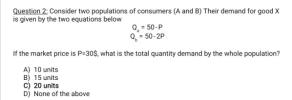 Question 2: Consider two populations of consumers (A and B) Their demand for good X is given by the two equations below Q = 50-P Q = 50-2P If the market price is P=30$, what is the total quantity demand by the whole population? A) 10 units B) 15 units C) 20 units D) None of the above
17) (12 points) Two sellers (seller A and seller B) operate in a market in which...
 17) (12 points) Two sellers (seller A and seller B) operate in a market in which the demand is given by (= 200 - p. Each seller has the same constant MC or AC, which is $100. Suppose that the consumers don't differentiate between the two sellers, and each seller chooses to maximize its profit. For each seller, there are only two options to choose from: (= 40 or (= 50. Assuming that collusion (cartel) is illegal, which will each...
2. Suppose the individual demand for consumer 1 is D1(p)=200-4p and for consumer 2 is D2(p)=125-2.5p. Assume there is only one producer in the economy who supplies S(p). a. Graph the individual demand...
2. Suppose the individual demand for consumer 1 is D1(p)=200-4p and for consumer 2 is D2(p)=125-2.5p. Assume there is only one producer in the economy who supplies S(p). a. Graph the individual demand curves as well as the resulting market demand curve. Mark the intercepts correctly. b. What is the price elasticity of the Market Demand at p=10? c. If supply is given by p = 40, find the amount purchased by each consumer. Illustrate your answer graphically. d. If...
D Question 17 1 pts Consider a monopolist that has two types of consumers. The first, students have a demand curve give...
 D Question 17 1 pts Consider a monopolist that has two types of consumers. The first, students have a demand curve given by the following: QA-120-2P. The second type of consumer are non-students who have the following demand curve: QB-200-4P. If the monopolist has constant marginal and average cost equal to 10, which of the following is true if the monopolist practices third degree price discrimination? Total profit earned equals 2150. Total profit earned equals 2250 Total profnt earned equals...
10. The market demand curve for a good X has two linear parts given by the...
 10. The market demand curve for a good X has two linear parts given by the following function (this is sometimes called a kinked demand curve): 120 - (1/4)X Os X s 120 P = 100 - (1/12)X 120 s X s 1200 where X is the number units purchased each month and P is measured in dollars. The short run supply curve for this good is given by: P-20+ X Р It is not possible to store this good;...
The demand and supply curves for kumquats are given below: QD 12-P P: $/lb. of kumquats...
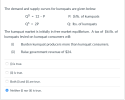 The demand and supply curves for kumquats are given below: QD 12-P P: $/lb. of kumquats Q: lbs. of kumquats The kumquat market is initially in free market equilibrium. A tax of $6/lb. of kumquats levied on kumquat consumers will: () Burden kumquat producers more than kumquat consumers. (ii) Raise government revenue of $24. O (i) is true (ii) is true. Both (i) and (i) are true. Neither (i) nor (ii) is true.
The tables below show the demand curves for the three consumers in a market (D1, D2,...
The tables below show the demand curves for the three consumers in a market (D1, D2, and D3) and the supply curves for the three producers in the market (S1, S2, and S3). First, solve for the market demand curve and the market supply curve by finding the market demand and supply at the prices of $10, $15, $20, and $25. Then find the equilibrium price and quantity in the market. Price D1 D2 D3 10 30 8 27 15...
 There are only two groups of consumers in a particular market. Let the demand curve of consumers in group 1 be given as q = f(p) and the demand curve of consumers in group 2 be given as q g(p), where Q+ and p is the market price of the good. Question: Derive a mathematical expression that shows how the price elasticity of the market demand curve, , is related to the price elasticities of the two groups' demand curves,...
 D Question 15 1 pts Consider a monopolist that has two types of consumers. The first, students have a demand curve given by the following: QA-120-2P. The second type of consumer is non-students who have the following demand curve: QB-200-4P. If the monopolist has constant marginal and average cost equal to 10, which of the following is truef the monopolist practices third degree price discrimination? The price charged to student equals 35 and non-students equals 60 The price charged to...
 Question 2: Consider two populations of consumers (A and B) Their demand for good X is given by the two equations below Q = 50-P Q = 50-2P If the market price is P=30$, what is the total quantity demand by the whole population? A) 10 units B) 15 units C) 20 units D) None of the above
 17) (12 points) Two sellers (seller A and seller B) operate in a market in which the demand is given by (= 200 - p. Each seller has the same constant MC or AC, which is $100. Suppose that the consumers don't differentiate between the two sellers, and each seller chooses to maximize its profit. For each seller, there are only two options to choose from: (= 40 or (= 50. Assuming that collusion (cartel) is illegal, which will each...
 D Question 17 1 pts Consider a monopolist that has two types of consumers. The first, students have a demand curve given by the following: QA-120-2P. The second type of consumer are non-students who have the following demand curve: QB-200-4P. If the monopolist has constant marginal and average cost equal to 10, which of the following is true if the monopolist practices third degree price discrimination? Total profit earned equals 2150. Total profit earned equals 2250 Total profnt earned equals...
 10. The market demand curve for a good X has two linear parts given by the following function (this is sometimes called a kinked demand curve): 120 - (1/4)X Os X s 120 P = 100 - (1/12)X 120 s X s 1200 where X is the number units purchased each month and P is measured in dollars. The short run supply curve for this good is given by: P-20+ X Р It is not possible to store this good;...
 The demand and supply curves for kumquats are given below: QD 12-P P: $/lb. of kumquats Q: lbs. of kumquats The kumquat market is initially in free market equilibrium. A tax of $6/lb. of kumquats levied on kumquat consumers will: () Burden kumquat producers more than kumquat consumers. (ii) Raise government revenue of $24. O (i) is true (ii) is true. Both (i) and (i) are true. Neither (i) nor (ii) is true.
Most questions answered within 3 hours.
-
Where is the error in this code sequence?
String s1 = "Hello";
String s2 = "ello";...
asked 10 months ago -
Financial data for Joel de Paris, Inc., for last year
follow:
Joel de Paris, Inc.
Balance...
asked 10 months ago -
Consider this reaction:
Al2(SO4)3 (aq)+ BaCl3
(aq) Al2Cl6 (aq)- +
3BaSO4(s) . What is the...
asked 10 months ago -
Suppose that Savneet is considering increasing her
recent random sample from 20 car rentals to 40...
asked 10 months ago -
Trucks arrive at an unloading terminal at an average rate of 120
per hour.
Trucks arrive...
asked 10 months ago -
Why are methanol and ethanol completely soluble in water while
octanol is not very little soluble....
asked 10 months ago -
A facilities manager at a university reads in a research report
that the mean amount of...
asked 10 months ago -
When the CuSO4 is rehydrated by adding water to the anhydrous
compound, is this an endothermic...
asked 10 months ago -
A ray of sunlight is passing from diamond into crown glass; the
angle of incidence is...
asked 10 months ago -
A block of mass 0.249 kg is placed on top of a light, vertical
spring of...
asked 10 months ago -
how do the kidneys compensate in the presences of acidosis
a) trigger hyperventilate
b) reserve acid...
asked 10 months ago -
Question 501 pts
The rental rate of capital to the firm increases. Which of the
following...
asked 10 months ago