Chromium forms a tetrahedral complex with Cl- that has a charge of -1. What is the...
Chromium forms a tetrahedral complex with Cl- that has a charge of -1. What is the coordination number and oxidation state of the chromium atom?
coordination number:
oxidation state:
Homework Answers
It is a tetrahedral complex so coordination number is 4.basic
question of coordination compound. 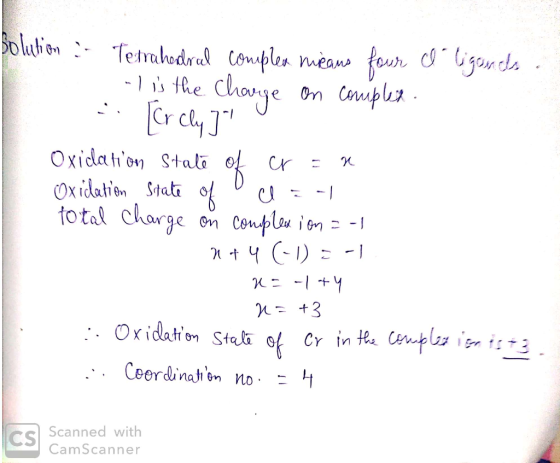
Add Answer to:
Chromium forms a tetrahedral complex with Cl- that has a charge
of -1. What is the...
Copper forms a octahedral complex with Cl− that has a charge of −4. What is the...
Copper forms a octahedral complex with Cl− that has a charge of −4. What is the coordination number and oxidation state of the copper atom? 1. Coordination number: ______ 2. Oxidation state of Cu: ________
Manganese forms a octahedral complex with OH− that has a charge of −3. What is the...
Manganese forms a octahedral complex with OH− that has a charge of −3. What is the coordination number and oxidation state of the manganese atom? 1. coordination number: _______ 2. oxidation state of Mn: _______
1. Consider the coordination compound [Cr Cl(H20)4]C1.2H O. (i) What is the complex in the coordination...
 1. Consider the coordination compound [Cr Cl(H20)4]C1.2H O. (i) What is the complex in the coordination compound and what is the charge in the complex ion? (ii) Identify the ligand(s) in the complex ion. 2. Calculate the number of moles of oxalate ion in 5.0 mL of 1.0 M H2C204 e oxidation number and coordination number of chromium
the following coordination compound: K[CrCl4(en)]. a. Give the charge on the coordination sphere in this compound....
 the following coordination compound: K[CrCl4(en)]. a. Give the charge on the coordination sphere in this compound. b. Compute the OXIDATION NUMBER of the chromium cation in the complex. c. Give the COORDINATION NUMBER of the chromium cation in the complex. d. Sketch the structure of the complex ion.
What is the charge on the anion in the coordination compound K2[Pt(NO2)2Cl2]? The pair of brackets...
What is the charge on the anion in the coordination compound K2[Pt(NO2)2Cl2]? The pair of brackets “[‘” and “]” indicate the presence of a metal complex, and this collection of atoms/ions can be thought of as one molecular species (in this case an anion). Platinum is at the center of the complex with NO2− (through the N) and Cl− forming coordinate bonds with the Pt. Draw the Lewis structures of NO2− (nitro) and Cl−. Circle the electron pair in each...
What are the respective central-metal oxidation state, coordination number, and overall charge for the complex [Co(NH3)5Cl](NO3)2...
What are the respective central-metal oxidation state, coordination number, and overall charge for the complex [Co(NH3)5Cl](NO3)2 SHOW WORK
Complex # of Coordination number Oxidation number Complex Structure ligands geometry NH4Co(NCS)(py): [RhBr(CO)s(NO...
 Complex # of Coordination number Oxidation number Complex Structure ligands geometry NH4Co(NCS)(py): [RhBr(CO)s(NO) K[Fe(CN) [Hgl.] Cu(NH)Cl 3. What are the bond angles for the following geometries: Tetrahedral Linear Square planar_ Octahedral 4. A complex ion contains tungsten(II) bound to 4 water molecules and 2 fluoride ions. Using appropriate conventions write out its formula. 5. A complex ion contains copper(II) bonded to ethylenediamine and two water molecules. Using appropriate conventions write out its formula.
Complex # of Coordination number Oxidation number...
Complex # of Coordination number Oxidation number Complex Structure ligands geometry NH4Co(NCS)(py): [RhBr(CO)s(NO) K[Fe(CN) [Hgl.] Cu(NH)Cl 3. What are the bond angles for the following geometries: Tetrahedral Linear Square planar_ Octahedral 4. A complex ion contains tungsten(II) bound to 4 water molecules and 2 fluoride ions. Using appropriate conventions write out its formula. 5. A complex ion contains copper(II) bonded to ethylenediamine and two water molecules. Using appropriate conventions write out its formula.
Complex # of Coordination number Oxidation number...
4A and B please, very much appreciated! 4a. If Fe2+ forms a complex with enthylenediamine (en),...
 4A and B please, very much appreciated!
4a. If Fe2+ forms a complex with enthylenediamine (en), what will the formula be? Assume Fe2+ has a coordination number of 6. coordination 4b. If Ag+forms a complex with chloride, what will the formula be? Assume Ag+ has a number of 2.
4A and B please, very much appreciated!
4a. If Fe2+ forms a complex with enthylenediamine (en), what will the formula be? Assume Fe2+ has a coordination number of 6. coordination 4b. If Ag+forms a complex with chloride, what will the formula be? Assume Ag+ has a number of 2.
Select ALL of the statements that are correct for chromium oxide: CrO42- Group of answer choices...
Select ALL of the statements that are correct for chromium oxide: CrO42- Group of answer choices Chromium has an oxidation number of +2 Chromium has an oxidation number of +3 Chromium has an oxidation number of +6 Oxygen has an oxidation number of -8 Oxygen has an oxidation number of -4 Oxygen has an oxidation number of -2 Oxygen has an oxidation number of -1 The sum of the overall charge contributions is 0 The sum of the overall charge...
Consider the coordination compound, [CoCl(NH_3)_4(H_2O)]SO_4. Use the definitions in the Introduction to identify the following with...
 Consider the coordination compound, [CoCl(NH_3)_4(H_2O)]SO_4. Use the definitions in the Introduction to identify the following with the formula and charge (if applicable). a. the ligand(s) b. the complex. c. the coordination sphere d. the coordination number of cobalt Write the formula of the complex ion that forms between a. the ligand Cl^- and the platinum(II) ion with a coordination number of four. b. the ligand ethylenediamine (abbreviated "en", and the chromium(III) ion with a coordination number of six. c. the...
 1. Consider the coordination compound [Cr Cl(H20)4]C1.2H O. (i) What is the complex in the coordination compound and what is the charge in the complex ion? (ii) Identify the ligand(s) in the complex ion. 2. Calculate the number of moles of oxalate ion in 5.0 mL of 1.0 M H2C204 e oxidation number and coordination number of chromium
 the following coordination compound: K[CrCl4(en)]. a. Give the charge on the coordination sphere in this compound. b. Compute the OXIDATION NUMBER of the chromium cation in the complex. c. Give the COORDINATION NUMBER of the chromium cation in the complex. d. Sketch the structure of the complex ion.
 Complex # of Coordination number Oxidation number Complex Structure ligands geometry NH4Co(NCS)(py): [RhBr(CO)s(NO) K[Fe(CN) [Hgl.] Cu(NH)Cl 3. What are the bond angles for the following geometries: Tetrahedral Linear Square planar_ Octahedral 4. A complex ion contains tungsten(II) bound to 4 water molecules and 2 fluoride ions. Using appropriate conventions write out its formula. 5. A complex ion contains copper(II) bonded to ethylenediamine and two water molecules. Using appropriate conventions write out its formula.
Complex # of Coordination number Oxidation number...
Complex # of Coordination number Oxidation number Complex Structure ligands geometry NH4Co(NCS)(py): [RhBr(CO)s(NO) K[Fe(CN) [Hgl.] Cu(NH)Cl 3. What are the bond angles for the following geometries: Tetrahedral Linear Square planar_ Octahedral 4. A complex ion contains tungsten(II) bound to 4 water molecules and 2 fluoride ions. Using appropriate conventions write out its formula. 5. A complex ion contains copper(II) bonded to ethylenediamine and two water molecules. Using appropriate conventions write out its formula.
Complex # of Coordination number Oxidation number...
 4A and B please, very much appreciated!
4a. If Fe2+ forms a complex with enthylenediamine (en), what will the formula be? Assume Fe2+ has a coordination number of 6. coordination 4b. If Ag+forms a complex with chloride, what will the formula be? Assume Ag+ has a number of 2.
4A and B please, very much appreciated!
4a. If Fe2+ forms a complex with enthylenediamine (en), what will the formula be? Assume Fe2+ has a coordination number of 6. coordination 4b. If Ag+forms a complex with chloride, what will the formula be? Assume Ag+ has a number of 2.
 Consider the coordination compound, [CoCl(NH_3)_4(H_2O)]SO_4. Use the definitions in the Introduction to identify the following with the formula and charge (if applicable). a. the ligand(s) b. the complex. c. the coordination sphere d. the coordination number of cobalt Write the formula of the complex ion that forms between a. the ligand Cl^- and the platinum(II) ion with a coordination number of four. b. the ligand ethylenediamine (abbreviated "en", and the chromium(III) ion with a coordination number of six. c. the...
Most questions answered within 3 hours.
-
Where is the error in this code sequence?
String s1 = "Hello";
String s2 = "ello";...
asked 10 months ago -
Financial data for Joel de Paris, Inc., for last year
follow:
Joel de Paris, Inc.
Balance...
asked 10 months ago -
Consider this reaction:
Al2(SO4)3 (aq)+ BaCl3
(aq) Al2Cl6 (aq)- +
3BaSO4(s) . What is the...
asked 10 months ago -
Suppose that Savneet is considering increasing her
recent random sample from 20 car rentals to 40...
asked 10 months ago -
Trucks arrive at an unloading terminal at an average rate of 120
per hour.
Trucks arrive...
asked 10 months ago -
Why are methanol and ethanol completely soluble in water while
octanol is not very little soluble....
asked 10 months ago -
A facilities manager at a university reads in a research report
that the mean amount of...
asked 10 months ago -
When the CuSO4 is rehydrated by adding water to the anhydrous
compound, is this an endothermic...
asked 10 months ago -
A ray of sunlight is passing from diamond into crown glass; the
angle of incidence is...
asked 10 months ago -
A block of mass 0.249 kg is placed on top of a light, vertical
spring of...
asked 10 months ago -
how do the kidneys compensate in the presences of acidosis
a) trigger hyperventilate
b) reserve acid...
asked 10 months ago -
Question 501 pts
The rental rate of capital to the firm increases. Which of the
following...
asked 10 months ago