Using induction, show that T(n) = T(n/2) + 1 is O(lg n). Please explain steps, I'm...
Using induction, show that T(n) = T(n/2) + 1 is O(lg n). Please explain steps, I'm trying to learn how to do this. Thank you :)
Homework Answers
`Hey,
Note: Brother if you have any queries related the answer please do comment. I would be very happy to resolve all your queries.
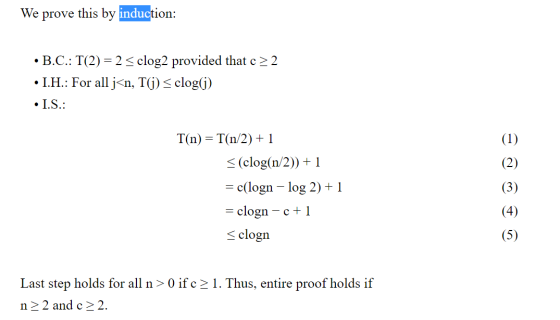
Kindly revert for any queries
Thanks.
Add Answer to:
Using induction, show that T(n) =
T(n/2) + 1 is O(lg n). Please
explain steps, I'm...
PLEASE SHOW THE INDUCTION STEPS ONE BY ONE. please upload a good quality picture with good handwriting thank you Using induction, show that: If Ai, . .. , An are countable for all n є N, then A1 U co...
 PLEASE SHOW THE INDUCTION STEPS ONE BY ONE.
please upload a good quality picture with good handwriting thank
you
Using induction, show that: If Ai, . .. , An are countable for all n є N, then A1 U countable. U An is
Using induction, show that: If Ai, . .. , An are countable for all n є N, then A1 U countable. U An is
PLEASE SHOW THE INDUCTION STEPS ONE BY ONE.
please upload a good quality picture with good handwriting thank
you
Using induction, show that: If Ai, . .. , An are countable for all n є N, then A1 U countable. U An is
Using induction, show that: If Ai, . .. , An are countable for all n є N, then A1 U countable. U An is
T(n)=2T(n/2)+n^2 can you please solve it using subsitution method? which is 1-guess 2-induction goal 3-induction hypothesis...
T(n)=2T(n/2)+n^2 can you please solve it using subsitution method? which is 1-guess 2-induction goal 3-induction hypothesis then proof it
r the recurrence relation o. Consider T(n) = Vn T(Vn) + n a. Why can't you solve this with the master theorem? b. S t involves a constant C, tell me what it is in terms of T(O), T(1), or what...
 r the recurrence relation o. Consider T(n) = Vn T(Vn) + n a. Why can't you solve this with the master theorem? b. S t involves a constant C, tell me what it is in terms of T(O), T(1), or whatever your inequality by induction. Show the base case. Then show the how that T( n)= 0(n lg ig n). First, clearly indicate the inequality that you wish to hen proceed to prove the inductive hypothesis inductive case, and clearly...
Let h0= h1=1 and hn= 2hn-1+hn-2 for n >= 2. Prove that hn <= 2.5n. Please show the induction steps way. Show all s...
Let h0= h1=1 and hn= 2hn-1+hn-2 for n >= 2. Prove that hn <= 2.5n. Please show the induction steps way. Show all steps Thanks!!
Let f(n) = 5n^2. Prove that f(n) = O(n^3). Let f(n) = 7n^2. Prove that f(n)...
Let f(n) = 5n^2. Prove that f(n) = O(n^3). Let f(n) = 7n^2. Prove that f(n) = Ω(n). Let f(n) = 3n. Prove that f(n) =ꙍ (√n). Let f(n) = 3n+2. Prove that f(n) = Θ (n). Let k > 0 and c > 0 be any positive constants. Prove that (n + k)c = O(nc). Prove that lg(n!) = O(n lg n). Let g(n) = log10(n). Prove that g(n) = Θ(lg n). (hint: ???? ? = ???? ?)???? ?...
2) (3 pts) Use mathematical induction to show that when n is an exact power of...
 2) (3 pts) Use mathematical induction to show that when n is an exact power of 2, the solution of the recurrence 2, ifn=2 T(n) =127G)+n, ifn=2.for k > 1 ISI(72) = n lg n.
Consider the recurrence equation defining T(n): T(n)=1 if n-1; T(n)=T(n-1)+2^n Otherwise . Show by induction T(n)=2^(n+1)-1
Consider the recurrence equation defining T(n): T(n)=1 if n-1; T(n)=T(n-1)+2^n Otherwise . Show by induction T(n)=2^(n+1)-1
please show all steps and most important, please explain what's going on here. I'm most confused...
 please show all steps and most important, please explain
what's going on here. I'm most confused about the last step, but my
entire understanding of this problem could use work. thank you in
advance
15) (7 points) Draw the intermediates (A and B) and the product (C) of the cyclopentene using the following reagents (no need to draw the mechanism). For each molecule (A, B and C), draw the stereochemistry of the 2 chiral centers that were formed A C...
please show all steps and most important, please explain
what's going on here. I'm most confused about the last step, but my
entire understanding of this problem could use work. thank you in
advance
15) (7 points) Draw the intermediates (A and B) and the product (C) of the cyclopentene using the following reagents (no need to draw the mechanism). For each molecule (A, B and C), draw the stereochemistry of the 2 chiral centers that were formed A C...
Domain and range transformation: Using math induction T(1)= 1 T(n) = T(n/2) + bnlg n, n...
Domain and range transformation: Using math induction T(1)= 1 T(n) = T(n/2) + bnlg n, n > 1
T(n)=2T(n/2)+lgn, T(1)=0. Can someone help me with this please. I'm getting O(nlgn)
T(n)=2T(n/2)+lgn, T(1)=0. Can someone help me with this please. I'm getting O(nlgn)
 PLEASE SHOW THE INDUCTION STEPS ONE BY ONE.
please upload a good quality picture with good handwriting thank
you
Using induction, show that: If Ai, . .. , An are countable for all n є N, then A1 U countable. U An is
Using induction, show that: If Ai, . .. , An are countable for all n є N, then A1 U countable. U An is
PLEASE SHOW THE INDUCTION STEPS ONE BY ONE.
please upload a good quality picture with good handwriting thank
you
Using induction, show that: If Ai, . .. , An are countable for all n є N, then A1 U countable. U An is
Using induction, show that: If Ai, . .. , An are countable for all n є N, then A1 U countable. U An is
 r the recurrence relation o. Consider T(n) = Vn T(Vn) + n a. Why can't you solve this with the master theorem? b. S t involves a constant C, tell me what it is in terms of T(O), T(1), or whatever your inequality by induction. Show the base case. Then show the how that T( n)= 0(n lg ig n). First, clearly indicate the inequality that you wish to hen proceed to prove the inductive hypothesis inductive case, and clearly...
 2) (3 pts) Use mathematical induction to show that when n is an exact power of 2, the solution of the recurrence 2, ifn=2 T(n) =127G)+n, ifn=2.for k > 1 ISI(72) = n lg n.
 please show all steps and most important, please explain
what's going on here. I'm most confused about the last step, but my
entire understanding of this problem could use work. thank you in
advance
15) (7 points) Draw the intermediates (A and B) and the product (C) of the cyclopentene using the following reagents (no need to draw the mechanism). For each molecule (A, B and C), draw the stereochemistry of the 2 chiral centers that were formed A C...
please show all steps and most important, please explain
what's going on here. I'm most confused about the last step, but my
entire understanding of this problem could use work. thank you in
advance
15) (7 points) Draw the intermediates (A and B) and the product (C) of the cyclopentene using the following reagents (no need to draw the mechanism). For each molecule (A, B and C), draw the stereochemistry of the 2 chiral centers that were formed A C...
Most questions answered within 3 hours.
-
Where is the error in this code sequence?
String s1 = "Hello";
String s2 = "ello";...
asked 10 months ago -
Financial data for Joel de Paris, Inc., for last year
follow:
Joel de Paris, Inc.
Balance...
asked 10 months ago -
Consider this reaction:
Al2(SO4)3 (aq)+ BaCl3
(aq) Al2Cl6 (aq)- +
3BaSO4(s) . What is the...
asked 10 months ago -
Suppose that Savneet is considering increasing her
recent random sample from 20 car rentals to 40...
asked 10 months ago -
Trucks arrive at an unloading terminal at an average rate of 120
per hour.
Trucks arrive...
asked 10 months ago -
Why are methanol and ethanol completely soluble in water while
octanol is not very little soluble....
asked 10 months ago -
A facilities manager at a university reads in a research report
that the mean amount of...
asked 10 months ago -
When the CuSO4 is rehydrated by adding water to the anhydrous
compound, is this an endothermic...
asked 10 months ago -
A ray of sunlight is passing from diamond into crown glass; the
angle of incidence is...
asked 10 months ago -
A block of mass 0.249 kg is placed on top of a light, vertical
spring of...
asked 10 months ago -
how do the kidneys compensate in the presences of acidosis
a) trigger hyperventilate
b) reserve acid...
asked 10 months ago -
Question 501 pts
The rental rate of capital to the firm increases. Which of the
following...
asked 10 months ago