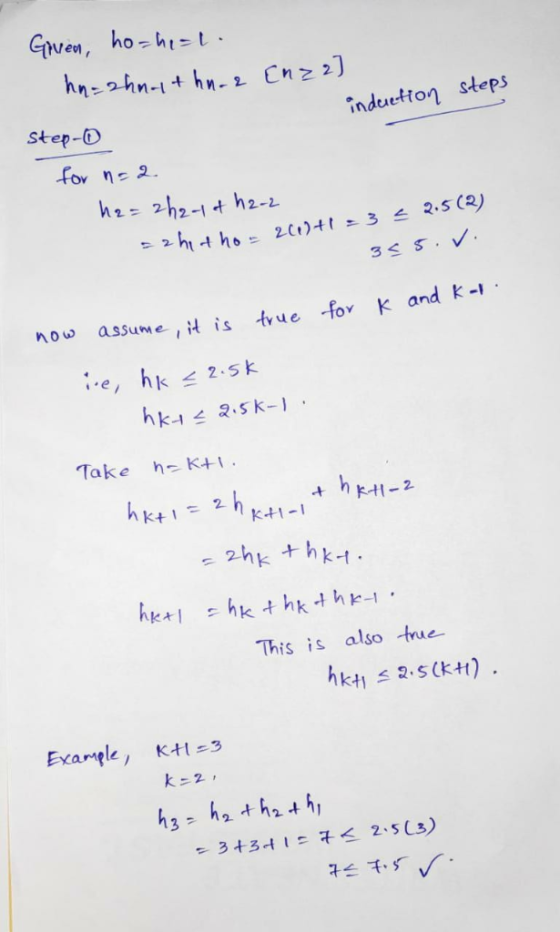
Let h0= h1=1 and hn= 2hn-1+hn-2 for n >= 2. Prove that hn <= 2.5n. Please show the induction steps way. Show all s...
Let h0= h1=1 and hn= 2hn-1+hn-2 for n >= 2. Prove that hn <= 2.5n. Please show the induction steps way. Show all steps Thanks!!
Homework Answers
Add Answer to:
Let h0= h1=1 and hn= 2hn-1+hn-2 for n >= 2. Prove that hn <= 2.5n. Please show the induction steps way. Show all s...
(a) Use mathematical induction to prove that for all integers n > 6, 3" <n! Show...
 (a) Use mathematical induction to prove that for all integers n > 6, 3" <n! Show all your work. (b) Let S be the subset of the set of ordered pairs of integers defined recursively by: Basis Step: (0,0) ES, Recursive Step: If (a, b) ES, then (a +2,5+3) ES and (a +3,+2) ES. Use structural induction to prove that 5 (a + b), whenever (a, b) E S. Show all your work.
Please answer ALL parts and please show ALL work. 1. Prove that if 5 | na...
 Please answer ALL parts and please show ALL work.
1. Prove that if 5 | na then 5 n. 2. Use mathematical induction to prove that 8i(31 – 3) = (2n - 2)4n(n + 1). 3. Let a1 = 29, 02 = 103 and for n > 3, an = 7an-1 – 10an-2. Find a closed formula for an. (Show your work).
Please answer ALL parts and please show ALL work.
1. Prove that if 5 | na then 5 n. 2. Use mathematical induction to prove that 8i(31 – 3) = (2n - 2)4n(n + 1). 3. Let a1 = 29, 02 = 103 and for n > 3, an = 7an-1 – 10an-2. Find a closed formula for an. (Show your work).
1. Prove the following statement by mathematical induction. For all positive integers n. 2++ n+1) =...
 1. Prove the following statement by mathematical induction. For all positive integers n. 2++ n+1) = 2. Prove the following statement by mathematical induction. For all nonnegative integers n, 3 divides 22n-1. 3. Prove the following statement by mathematical induction. For all integers n 27,3" <n!
all three questions please. thank you Prove that for all n N, O <In < 1....
 all three questions please. thank you
Prove that for all n N, O <In < 1. Prove by induction that for all n EN, ER EQ. Prove that in} is convergent and find its limit l. The goal of this exercise is to prove that [0, 1] nQ is not closed. Let In} be a recursive sequence defined by In+1 = -) for n > 1, and x = 1. Prove that for all ne N, 0 <In < 1....
all three questions please. thank you
Prove that for all n N, O <In < 1. Prove by induction that for all n EN, ER EQ. Prove that in} is convergent and find its limit l. The goal of this exercise is to prove that [0, 1] nQ is not closed. Let In} be a recursive sequence defined by In+1 = -) for n > 1, and x = 1. Prove that for all ne N, 0 <In < 1....
PLEASE SHOW THE INDUCTION STEPS ONE BY ONE. please upload a good quality picture with good handwriting thank you Using induction, show that: If Ai, . .. , An are countable for all n є N, then A1 U co...
 PLEASE SHOW THE INDUCTION STEPS ONE BY ONE.
please upload a good quality picture with good handwriting thank
you
Using induction, show that: If Ai, . .. , An are countable for all n є N, then A1 U countable. U An is
Using induction, show that: If Ai, . .. , An are countable for all n є N, then A1 U countable. U An is
PLEASE SHOW THE INDUCTION STEPS ONE BY ONE.
please upload a good quality picture with good handwriting thank
you
Using induction, show that: If Ai, . .. , An are countable for all n є N, then A1 U countable. U An is
Using induction, show that: If Ai, . .. , An are countable for all n є N, then A1 U countable. U An is
Let f(n) = 5n^2. Prove that f(n) = O(n^3). Let f(n) = 7n^2. Prove that f(n)...
Let f(n) = 5n^2. Prove that f(n) = O(n^3). Let f(n) = 7n^2. Prove that f(n) = Ω(n). Let f(n) = 3n. Prove that f(n) =ꙍ (√n). Let f(n) = 3n+2. Prove that f(n) = Θ (n). Let k > 0 and c > 0 be any positive constants. Prove that (n + k)c = O(nc). Prove that lg(n!) = O(n lg n). Let g(n) = log10(n). Prove that g(n) = Θ(lg n). (hint: ???? ? = ???? ?)???? ?...
Using induction, show that T(n) = T(n/2) + 1 is O(lg n). Please explain steps, I'm...
Using induction, show that T(n) = T(n/2) + 1 is O(lg n). Please explain steps, I'm trying to learn how to do this. Thank you :)
1. (40pts) Let 8 >0 and hn: (8,2 - 8] -R be given by cos(n) hn...
 1. (40pts) Let 8 >0 and hn: (8,2 - 8] -R be given by cos(n) hn (x) 72 Use Dirichlet's Test to show that the series hn converges uniformly on (8,27 - 8). That is, please solve the following problems: la. (10 pts) Let 9n (x) = . * € (8,27 - 8). Show that In - g uniformly, where g(x) = 0, for all 2 € (5,2 - 8) and 9n+1 () S (x). for all n e N...
Discrete math show all work please Use mathematical induction to prove that the statements are true...
 Discrete math show all work please
Use mathematical induction to prove that the statements are true for every positive integer n. n[xn - (x - 2)] 1 + [x2 - (x - 1)] + [x:3 - (x - 1)] + ... + x n - (x - 1)] = 2 where x is any integer = 1
Discrete math show all work please
Use mathematical induction to prove that the statements are true for every positive integer n. n[xn - (x - 2)] 1 + [x2 - (x - 1)] + [x:3 - (x - 1)] + ... + x n - (x - 1)] = 2 where x is any integer = 1
Prove using mathematical induction that for every positive integer n, = 1/i(i+1) = n/n+1. 2) Suppose...
 Prove using mathematical induction that for every positive integer n, = 1/i(i+1) = n/n+1. 2) Suppose r is a real number other than 1. Prove using mathematical induction that for every nonnegative integer n, = 1-r^n+1/1-r. 3) Prove using mathematical induction that for every nonnegative integer n, 1 + i+i! = (n+1)!. 4) Prove using mathematical induction that for every integer n>4, n!>2^n. 5) Prove using mathematical induction that for every positive integer n, 7 + 5 + 3 +.......
 (a) Use mathematical induction to prove that for all integers n > 6, 3" <n! Show all your work. (b) Let S be the subset of the set of ordered pairs of integers defined recursively by: Basis Step: (0,0) ES, Recursive Step: If (a, b) ES, then (a +2,5+3) ES and (a +3,+2) ES. Use structural induction to prove that 5 (a + b), whenever (a, b) E S. Show all your work.
 Please answer ALL parts and please show ALL work.
1. Prove that if 5 | na then 5 n. 2. Use mathematical induction to prove that 8i(31 – 3) = (2n - 2)4n(n + 1). 3. Let a1 = 29, 02 = 103 and for n > 3, an = 7an-1 – 10an-2. Find a closed formula for an. (Show your work).
Please answer ALL parts and please show ALL work.
1. Prove that if 5 | na then 5 n. 2. Use mathematical induction to prove that 8i(31 – 3) = (2n - 2)4n(n + 1). 3. Let a1 = 29, 02 = 103 and for n > 3, an = 7an-1 – 10an-2. Find a closed formula for an. (Show your work).
 1. Prove the following statement by mathematical induction. For all positive integers n. 2++ n+1) = 2. Prove the following statement by mathematical induction. For all nonnegative integers n, 3 divides 22n-1. 3. Prove the following statement by mathematical induction. For all integers n 27,3" <n!
 all three questions please. thank you
Prove that for all n N, O <In < 1. Prove by induction that for all n EN, ER EQ. Prove that in} is convergent and find its limit l. The goal of this exercise is to prove that [0, 1] nQ is not closed. Let In} be a recursive sequence defined by In+1 = -) for n > 1, and x = 1. Prove that for all ne N, 0 <In < 1....
all three questions please. thank you
Prove that for all n N, O <In < 1. Prove by induction that for all n EN, ER EQ. Prove that in} is convergent and find its limit l. The goal of this exercise is to prove that [0, 1] nQ is not closed. Let In} be a recursive sequence defined by In+1 = -) for n > 1, and x = 1. Prove that for all ne N, 0 <In < 1....
 PLEASE SHOW THE INDUCTION STEPS ONE BY ONE.
please upload a good quality picture with good handwriting thank
you
Using induction, show that: If Ai, . .. , An are countable for all n є N, then A1 U countable. U An is
Using induction, show that: If Ai, . .. , An are countable for all n є N, then A1 U countable. U An is
PLEASE SHOW THE INDUCTION STEPS ONE BY ONE.
please upload a good quality picture with good handwriting thank
you
Using induction, show that: If Ai, . .. , An are countable for all n є N, then A1 U countable. U An is
Using induction, show that: If Ai, . .. , An are countable for all n є N, then A1 U countable. U An is
 1. (40pts) Let 8 >0 and hn: (8,2 - 8] -R be given by cos(n) hn (x) 72 Use Dirichlet's Test to show that the series hn converges uniformly on (8,27 - 8). That is, please solve the following problems: la. (10 pts) Let 9n (x) = . * € (8,27 - 8). Show that In - g uniformly, where g(x) = 0, for all 2 € (5,2 - 8) and 9n+1 () S (x). for all n e N...
 Discrete math show all work please
Use mathematical induction to prove that the statements are true for every positive integer n. n[xn - (x - 2)] 1 + [x2 - (x - 1)] + [x:3 - (x - 1)] + ... + x n - (x - 1)] = 2 where x is any integer = 1
Discrete math show all work please
Use mathematical induction to prove that the statements are true for every positive integer n. n[xn - (x - 2)] 1 + [x2 - (x - 1)] + [x:3 - (x - 1)] + ... + x n - (x - 1)] = 2 where x is any integer = 1
 Prove using mathematical induction that for every positive integer n, = 1/i(i+1) = n/n+1. 2) Suppose r is a real number other than 1. Prove using mathematical induction that for every nonnegative integer n, = 1-r^n+1/1-r. 3) Prove using mathematical induction that for every nonnegative integer n, 1 + i+i! = (n+1)!. 4) Prove using mathematical induction that for every integer n>4, n!>2^n. 5) Prove using mathematical induction that for every positive integer n, 7 + 5 + 3 +.......
Most questions answered within 3 hours.
-
Where is the error in this code sequence?
String s1 = "Hello";
String s2 = "ello";...
asked 11 months ago -
Financial data for Joel de Paris, Inc., for last year
follow:
Joel de Paris, Inc.
Balance...
asked 11 months ago -
Consider this reaction:
Al2(SO4)3 (aq)+ BaCl3
(aq) Al2Cl6 (aq)- +
3BaSO4(s) . What is the...
asked 11 months ago -
Suppose that Savneet is considering increasing her
recent random sample from 20 car rentals to 40...
asked 11 months ago -
Trucks arrive at an unloading terminal at an average rate of 120
per hour.
Trucks arrive...
asked 11 months ago -
Why are methanol and ethanol completely soluble in water while
octanol is not very little soluble....
asked 11 months ago -
A facilities manager at a university reads in a research report
that the mean amount of...
asked 11 months ago -
When the CuSO4 is rehydrated by adding water to the anhydrous
compound, is this an endothermic...
asked 11 months ago -
A ray of sunlight is passing from diamond into crown glass; the
angle of incidence is...
asked 11 months ago -
A block of mass 0.249 kg is placed on top of a light, vertical
spring of...
asked 11 months ago -
how do the kidneys compensate in the presences of acidosis
a) trigger hyperventilate
b) reserve acid...
asked 11 months ago -
Question 501 pts
The rental rate of capital to the firm increases. Which of the
following...
asked 11 months ago