Describe the distribution of lipids in a biological membrane. What determines their distribution and why is...
Describe the distribution of lipids in a biological membrane. What determines their distribution and why is it maintained?
Homework Answers
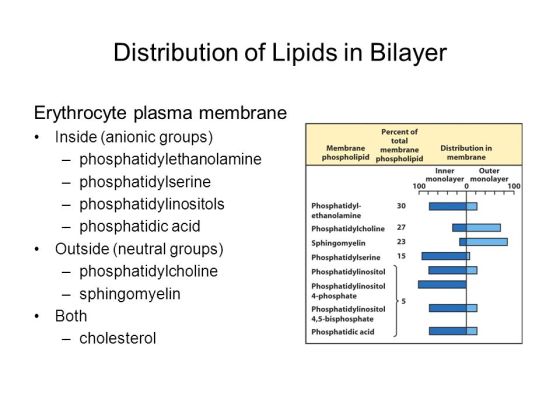
Answer :- Distribution of lipids in lipds in erythrocytes membranes are as shoen in chart below:- it is essential to maintain lipid distribution because biological molecule is hydrophilic or hydrophobic , to transport biological molecule inside cell it is important to maintain lipid distribution in biological membranes.
Add Answer to:
Describe the distribution of lipids in a biological membrane.
What determines their distribution and why is...
Is the composition of lipids in biological membrane identical on both leaflets? If not mention what...
Is the composition of lipids in biological membrane identical on both leaflets? If not mention what the asymmetries are and how can they arise? *
Lipids Describe the building-block molecules, structure, and biological importance of fats, phospholipids, and steroids. Why are...
Lipids Describe the building-block molecules, structure, and biological importance of fats, phospholipids, and steroids. Why are lipids classed together? Do lipids have monomers? Distinguish between saturated and unsaturated fats. Distinguish between cis and trans fat molecules. What are some of the health risks associated with trans fats? Describe how phospholipids orient to form membranes. Which part of a phospholipid is hydrophobic? Which part is hydrophilic? What are the three classes of lipids? List two important biological functions of a steroid....
Describe the properties of membrane lipids that make a membrane fluid. Give at least 3 specific...
Describe the properties of membrane lipids that make a membrane fluid. Give at least 3 specific examples.
Membrane lipids have fatty acid tails and, like triacylglycerols, their properties are governed by the properties...
Membrane lipids have fatty acid tails and, like triacylglycerols, their properties are governed by the properties of these tails. Based on what we saw with dietary lipids, which membrane would have more fluid characteristics – the one with more saturated fatty acids or the one with more unsaturated fatty acids? Explain your reasoning. Look at the structure of cholesterol. Cholesterol is a necessary component of biological membranes. What do you think cholesterol would do to the structure of a membrane...
WINILIT OF the following statements is true about biological membranes? Integral membrane proteins are composed exclusively...
 WINILIT OF the following statements is true about biological membranes? Integral membrane proteins are composed exclusively of alpha-helices Lipid bilayers are easily permeable to various ions Both proteins and lipids readily undergo transverse diffusion ("flip-flopping") from the inside to the outside leaflet of the membrane O Membrane lipids self-assemble via non-covalent interactions to form lipid bilayers O Polar head groups in membrane phospholipids are always negatively charged
1. Define membrane potential. 2. Describe how membrane potential is established. What physical feature of the...
 1. Define membrane potential. 2. Describe how membrane potential is established. What physical feature of the plasma membrane is essential for the establishment of membrane potential? 3. Describe how membrane potential is maintained. 4. Write a number that represents resting membrane potential. 5. If a gated sodium ion channel is opened, membrane potential is changed. Tell the direction of the change. 6. If a gated potassium ion channel is opened, membrane potential is changed. Tell the direction of the change.
Part A What molecule would move through a biological membrane most rapidly by direct diffusion, and...
 Part A What molecule would move through a biological membrane most rapidly by direct diffusion, and why? messenger RNA, because it is polar a deoxyribonucleotide, because it contains sugar units O carbon dioxide, because it is small and nonpolar O a large protein, because it can be embedded into the membrane Methionine, because it is an amino acid Submit Request Answer vide Feedback
2. What are the biological molecules involved in the human diet? Why are triacylglycerols not polymers?...
 2. What are the biological molecules involved in the human diet? Why are triacylglycerols not polymers? 3. Define digestion. Show three examples of extracellular digestion. Include in your description the location of the digestion, the enzyme(s) involved, and the product of the digestion. 4. How do monosaccharides, amino acids, peptides, lipids, and triacylglycerols enter the cells in the intestine?
5. Entropy Discussion (10 pts) a. Describe an irreversible biological process that occurs in nature. b....
 5. Entropy Discussion (10 pts) a. Describe an irreversible biological process that occurs in nature. b. Describe a biological process in nature that is nearly reversible. c. Describe a natural process that involves an increase in entropy. d. Use examples to argue for the view that "entropy is like an executive who instantly determines what will happen, whereas energy is like a bookkeeper telling us how little we can afford".
Carbon dioxide and oxygen are molecules that can move freely across a plasma membrane. What determines...
Carbon dioxide and oxygen are molecules that can move freely across a plasma membrane. What determines the direction that carbon dioxide and oxygen molecules move? A. orientation of cholesterol in the plasma membrane B. concentration gradient across the plasma membrane C. confi guration of phospholipids in the plasma membrane D. location of receptors on the surface of the plasma membrane
 WINILIT OF the following statements is true about biological membranes? Integral membrane proteins are composed exclusively of alpha-helices Lipid bilayers are easily permeable to various ions Both proteins and lipids readily undergo transverse diffusion ("flip-flopping") from the inside to the outside leaflet of the membrane O Membrane lipids self-assemble via non-covalent interactions to form lipid bilayers O Polar head groups in membrane phospholipids are always negatively charged
 1. Define membrane potential. 2. Describe how membrane potential is established. What physical feature of the plasma membrane is essential for the establishment of membrane potential? 3. Describe how membrane potential is maintained. 4. Write a number that represents resting membrane potential. 5. If a gated sodium ion channel is opened, membrane potential is changed. Tell the direction of the change. 6. If a gated potassium ion channel is opened, membrane potential is changed. Tell the direction of the change.
 Part A What molecule would move through a biological membrane most rapidly by direct diffusion, and why? messenger RNA, because it is polar a deoxyribonucleotide, because it contains sugar units O carbon dioxide, because it is small and nonpolar O a large protein, because it can be embedded into the membrane Methionine, because it is an amino acid Submit Request Answer vide Feedback
 2. What are the biological molecules involved in the human diet? Why are triacylglycerols not polymers? 3. Define digestion. Show three examples of extracellular digestion. Include in your description the location of the digestion, the enzyme(s) involved, and the product of the digestion. 4. How do monosaccharides, amino acids, peptides, lipids, and triacylglycerols enter the cells in the intestine?
 5. Entropy Discussion (10 pts) a. Describe an irreversible biological process that occurs in nature. b. Describe a biological process in nature that is nearly reversible. c. Describe a natural process that involves an increase in entropy. d. Use examples to argue for the view that "entropy is like an executive who instantly determines what will happen, whereas energy is like a bookkeeper telling us how little we can afford".
Most questions answered within 3 hours.
-
Where is the error in this code sequence?
String s1 = "Hello";
String s2 = "ello";...
asked 11 months ago -
Financial data for Joel de Paris, Inc., for last year
follow:
Joel de Paris, Inc.
Balance...
asked 11 months ago -
Consider this reaction:
Al2(SO4)3 (aq)+ BaCl3
(aq) Al2Cl6 (aq)- +
3BaSO4(s) . What is the...
asked 11 months ago -
Suppose that Savneet is considering increasing her
recent random sample from 20 car rentals to 40...
asked 11 months ago -
Trucks arrive at an unloading terminal at an average rate of 120
per hour.
Trucks arrive...
asked 11 months ago -
Why are methanol and ethanol completely soluble in water while
octanol is not very little soluble....
asked 11 months ago -
A facilities manager at a university reads in a research report
that the mean amount of...
asked 11 months ago -
When the CuSO4 is rehydrated by adding water to the anhydrous
compound, is this an endothermic...
asked 11 months ago -
A ray of sunlight is passing from diamond into crown glass; the
angle of incidence is...
asked 11 months ago -
A block of mass 0.249 kg is placed on top of a light, vertical
spring of...
asked 11 months ago -
how do the kidneys compensate in the presences of acidosis
a) trigger hyperventilate
b) reserve acid...
asked 11 months ago -
Question 501 pts
The rental rate of capital to the firm increases. Which of the
following...
asked 11 months ago