find the unit impulse response of y(k) - 0.6y(k-1) - 0.16y(k-2) = 5f(k) ?
find the unit impulse response of
y(k) - 0.6y(k-1) - 0.16y(k-2) = 5f(k) ?
Homework Answers
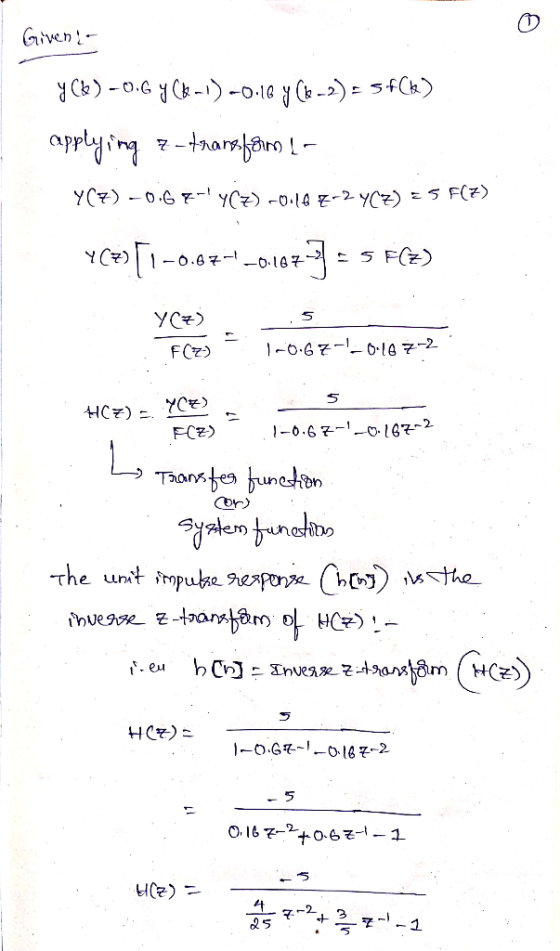
Givent Y(&)-0.67Ck.-1) -0.16 y(K-2) = 5fCk) the unit impulse response of the system (H(z)) : lieu isput FCk)=8(k) - Lunit impulse . 84)-06 86 –) -0-14 % ) : 550k) . applying 2-toans fami- ^(7) ~087'YZ) -0.18 7-24(7)587) Y(7)[1-0-67-1-0-16 -1) = 5 8C7) .. H(a) = como elemente
We were unable to transcribe this image
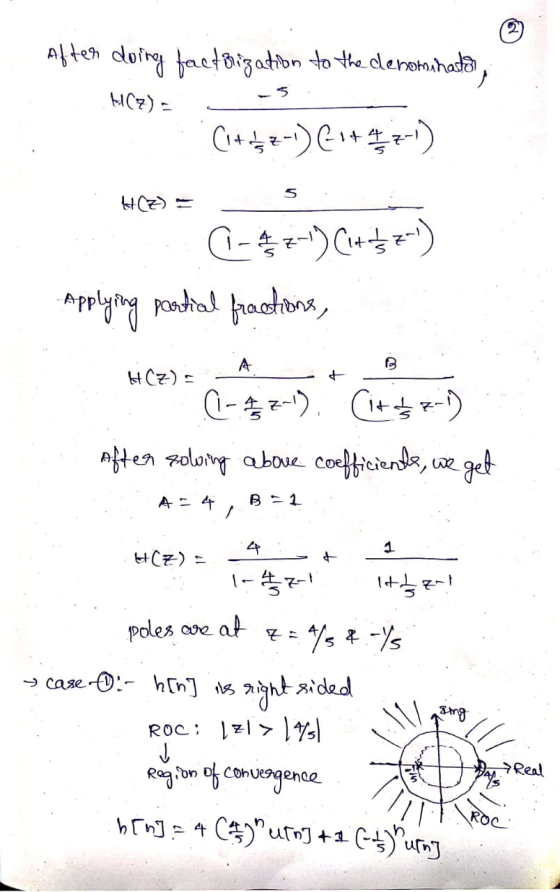
After doing factorization to the denominator , H(7) = - .. Citazz-1) (1747-1) HCZ) = 5 C--) (1+z) Applying partial fractions, Hz): À + B (-12-"). (1+=) Aften solving above coefficients, we get A = 4, B=2 HCZ) = 4 + 1 - 1 4 3 2 1 1ttz! poles are at z = 4/3 & -/s → case :- h[n] is right sided ROC: 171 > 1451 Rogion of convergence. D as bing4) " urny +36-5)Yuring ROC
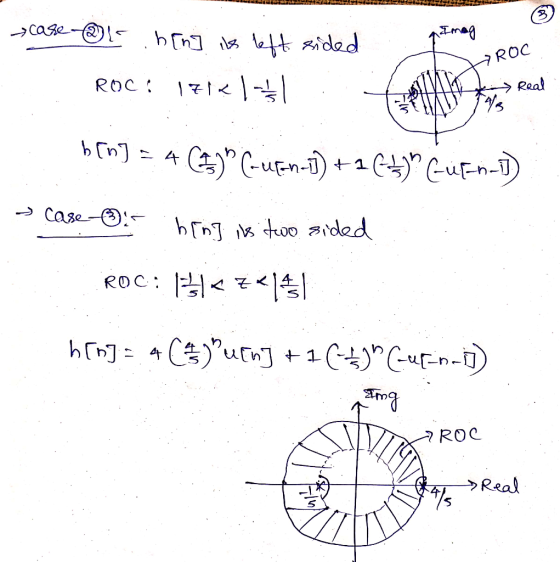
care- l hing is left sided ROC ROC: 1714 15l fumate b[n] = 4 C)" (-uf-n-1) +16+)(uf-n-I) Case ir hrn] is two sided ROC: 1}}<z«141 hangaa (9)Pucn] +16+) C-uf-n-) img TIDAROC ft 941 Real
Givent Y(&)-0.67Ck.-1) -0.16 y(K-2) = 5fCk) the unit impulse response of the system (H(z)) : lieu isput FCk)=8(k) - Lunit impulse . 84)-06 86 –) -0-14 % ) : 550k) . applying 2-toans fami- ^(7) ~087'YZ) -0.18 7-24(7)587) Y(7)[1-0-67-1-0-16 -1) = 5 8C7) .. H(a) = como elemente
Add Answer to:
find the unit impulse response of
y(k) - 0.6y(k-1) - 0.16y(k-2) = 5f(k) ?
find the unit impulse response, h[k] of a system specified by the following equation (E^2 -...
find the unit impulse response, h[k] of a system specified by the following equation (E^2 - 6E +9)y[k] = Ef[k]
Question 6 (3 points) Find the unit impulse response of the following discrete-time system y[k +...
 Question 6 (3 points) Find the unit impulse response of the following discrete-time system y[k + 1] + 2y[k] = f[k]
Determine the unit impulse response h[n] for a system in Example 3.11 specified by the equation...
 Determine the unit impulse response h[n] for a system in Example 3.11 specified by the equation y[n] -0.6y[n - 1] -0.16y[n - 2) = 5x[n]
6. Find h[k], the unit impulse response of the systems described by the following equations: a)...
 6. Find h[k], the unit impulse response of the systems described by the following equations: a) y[k] + 3y[k – 1] + 2y[k – 2] = f[k] +3f[k – 1] +3f[k – 2] b) yk + 2 + 2y k + 1] + yſk] =2fk + 2] – fk + 1] c) y[k] - yſk – 1] + 0.5y[k – 2] = f[k] + 2f[k – 1]
5. Find the unit impulse response of a system specified by the equation (D2 5D 6)y(t)...
 5. Find the unit impulse response of a system specified by the equation (D2 5D 6)y(t) (D2 7D 11)x(t)
4- Find unit impulse response for: y(t) + 4у(t) + 3y(t)-x(t) + 5x(t) 5- Find the...
 4- Find unit impulse response for: y(t) + 4у(t) + 3y(t)-x(t) + 5x(t) 5- Find the total response for: ý(t) 13(t) 22y(t)-(t) +5x(t) x(t) e-Stu(t) With the initial condition y(0) 2 and y(0)-3 Identify the natural and forced response of the system. 6- Find the total response for: y(t) +2y(t) 17y(t) 4x(t) 8x(t) x(t) = e-Hu(t)
Draw the first 10 samples of the system unit impulse response y[n] = y[n-1] + x[n]...
Draw the first 10 samples of the system unit impulse response y[n] = y[n-1] + x[n] + 2x[n-1]
Calculate the output y[k] of LTID system whose input, x[k], and impulse response, h[k], are as...
 Calculate the output y[k] of LTID system whose input, x[k], and impulse response, h[k], are as follows; x[k] = (0.4)"u[k] h[k] = (0.8)"u[k - 1)
Question 1 (10 pts): Consider the continuous-time LTI system S whose unit impulse response h is given by Le., h consists of a unit impulse at time 0 followed by a unit impulse at time (a) (2pts)...
 Question 1 (10 pts): Consider the continuous-time LTI system S whose unit impulse response h is given by Le., h consists of a unit impulse at time 0 followed by a unit impulse at time (a) (2pts) Obtain and plot the unit step response of S. (b) (2pts) Is S stable? Is it causal? Explain Two unrelated questions (c) (2pts) Is the ideal low-pass continuous-time filter (frequency response H(w) for H()0 otherwise) causal? Explain (d) (4 pts) Is the discrete-time...
Consider the difference equation y(n) = -0.6y(n-1) - x(n-1) for n>=0 and y(-1) = 0 1....
Consider the difference equation y(n) = -0.6y(n-1) - x(n-1) for n>=0 and y(-1) = 0 1. WITHOUT using Laplace or Z-Transform, determine the unit-impulse response h(n) starting from h(0).
 Question 6 (3 points) Find the unit impulse response of the following discrete-time system y[k + 1] + 2y[k] = f[k]
 Determine the unit impulse response h[n] for a system in Example 3.11 specified by the equation y[n] -0.6y[n - 1] -0.16y[n - 2) = 5x[n]
 6. Find h[k], the unit impulse response of the systems described by the following equations: a) y[k] + 3y[k – 1] + 2y[k – 2] = f[k] +3f[k – 1] +3f[k – 2] b) yk + 2 + 2y k + 1] + yſk] =2fk + 2] – fk + 1] c) y[k] - yſk – 1] + 0.5y[k – 2] = f[k] + 2f[k – 1]
 5. Find the unit impulse response of a system specified by the equation (D2 5D 6)y(t) (D2 7D 11)x(t)
 4- Find unit impulse response for: y(t) + 4у(t) + 3y(t)-x(t) + 5x(t) 5- Find the total response for: ý(t) 13(t) 22y(t)-(t) +5x(t) x(t) e-Stu(t) With the initial condition y(0) 2 and y(0)-3 Identify the natural and forced response of the system. 6- Find the total response for: y(t) +2y(t) 17y(t) 4x(t) 8x(t) x(t) = e-Hu(t)
 Calculate the output y[k] of LTID system whose input, x[k], and impulse response, h[k], are as follows; x[k] = (0.4)"u[k] h[k] = (0.8)"u[k - 1)
 Question 1 (10 pts): Consider the continuous-time LTI system S whose unit impulse response h is given by Le., h consists of a unit impulse at time 0 followed by a unit impulse at time (a) (2pts) Obtain and plot the unit step response of S. (b) (2pts) Is S stable? Is it causal? Explain Two unrelated questions (c) (2pts) Is the ideal low-pass continuous-time filter (frequency response H(w) for H()0 otherwise) causal? Explain (d) (4 pts) Is the discrete-time...
Most questions answered within 3 hours.
-
Where is the error in this code sequence?
String s1 = "Hello";
String s2 = "ello";...
asked 11 months ago -
Financial data for Joel de Paris, Inc., for last year
follow:
Joel de Paris, Inc.
Balance...
asked 11 months ago -
Consider this reaction:
Al2(SO4)3 (aq)+ BaCl3
(aq) Al2Cl6 (aq)- +
3BaSO4(s) . What is the...
asked 11 months ago -
Suppose that Savneet is considering increasing her
recent random sample from 20 car rentals to 40...
asked 11 months ago -
Trucks arrive at an unloading terminal at an average rate of 120
per hour.
Trucks arrive...
asked 11 months ago -
Why are methanol and ethanol completely soluble in water while
octanol is not very little soluble....
asked 11 months ago -
A facilities manager at a university reads in a research report
that the mean amount of...
asked 11 months ago -
When the CuSO4 is rehydrated by adding water to the anhydrous
compound, is this an endothermic...
asked 11 months ago -
A ray of sunlight is passing from diamond into crown glass; the
angle of incidence is...
asked 11 months ago -
A block of mass 0.249 kg is placed on top of a light, vertical
spring of...
asked 11 months ago -
how do the kidneys compensate in the presences of acidosis
a) trigger hyperventilate
b) reserve acid...
asked 11 months ago -
Question 501 pts
The rental rate of capital to the firm increases. Which of the
following...
asked 11 months ago