Explain why Lung smokers, Lung normal and Lung metastatic appear different?
- Explain why Lung smokers, Lung normal and Lung metastatic appear different?
Homework Answers
These three cases are different in its characteristics & hence has different appearance. Tobacco smoke contains several chemicals that can hurt the respiratory system. The chemicals cause inflammation in lungs which results in ecxess mucus production & due to this, smokers have a high chance of getting affected by pneumonia, bronchitis, etc. The most dangerous chemical in tobacco is nicotine which immobilise cilia. The cellular structure of the organ is altered by the chemicals. After quitting smoking, the cilia starts regeneration and the lungs starts to heal and regain its general structure. In some weeks, the lungs becomes functional as it's supposed to be. On the other hand, Metastatic lungs are those lungs affected by tumors (cancerous) which does not originated in the lungs but from another organ.
hope the answer helps.
Add Answer to:
Explain why Lung smokers,
Lung normal and Lung metastatic appear different?
In a region, 31% of people are smokers, 19% of smokers develop lung cancer and 2%...
In a region, 31% of people are smokers, 19% of smokers develop lung cancer and 2% of non-smokers develop lung cancer. What is the probability that a person chosen at random willdevelop lung cancer; i.e. what percentage of this region will suffer from lung cancer?
For women living in the southeast, the incidence of lung cancer in smokers is 10%, and...
For women living in the southeast, the incidence of lung cancer in smokers is 10%, and 0.5% for non-smokers. What is the relative risk of lung cancer in these women. The relative risk in women in the northeast is found to be 10. Explain what this means for women in the southeast.
The death rate per 100,000 for lung cancer is 7 among non-smokers and 71 among smokers....
The death rate per 100,000 for lung cancer is 7 among non-smokers and 71 among smokers. The death rate per 100,000 for coronary thrombosis is 422 among non-smokers and 599 among smokers. The prevalence of smoking in the population is 55%. 1) What is the relative risk of dying for lung cancer and coronary thrombosis for a smoker compared to a non-smoker? 2) Among smokers, what is the etiologic fraction of lung cancer and coronary thrombosis due to smoking? 3) ...
The death rate per 100,000 for lung cancer is 7 among non-smokers and 71 among smokers....
The death rate per 100,000 for lung cancer is 7 among non-smokers and 71 among smokers. The death rate per 100,000 for coronary thrombosis is 422 among non-smokers and 599 among smokers. The prevalence of smoking in the population is 55%. Determine the following: 1. On the basis of the relative risk and etiologic fractions associated with smoking for lung cancer and coronary thrombosis, which of the following statements is most likely to be correct? A. Smoking seems much more...
The death rate per 100,000 for lung cancer is 7 among non-smokers and 71 among smokers....
The death rate per 100,000 for lung cancer is 7 among non-smokers and 71 among smokers. The death rate per 100,000 for coronary thrombosis is 422 among non-smokers and 599 among smokers. The prevalence of smoking in the population is 55%. Determine the following: a. What is the population etiologic fraction of lung cancer due to smoking? b. What is the population etiologic fraction of coronary thrombosis due to smoking?
The death rate per 100,000 for lung cancer is 7 among non-smokers and 71 among smokers....
The death rate per 100,000 for lung cancer is 7 among non-smokers and 71 among smokers. The death rate per 100,000 for coronary thrombosis is 422 among non-smokers and 599 among smokers. The prevalence of smoking in the population is 55%. Determine the following: a. What is the etiologic fraction of disease due to smoking among individuals with lung cancer? b. What is the etiologic fraction of disease due to smoking among individuals with coronary thrombosis?
The death rate per 100,000 for lung cancer is 7 among non-smokers and 71 among smokers....
The death rate per 100,000 for lung cancer is 7 among non-smokers and 71 among smokers. The death rate per 100,000 for coronary thrombosis is 422 among non-smokers and 599 among smokers. The prevalence of smoking in the population is 55%. Determine the following: What is the relative risk of dying for a smoker compared to a non-smoker?
3) Imagine I randomly select a group of smokers and a group of nonsmokers. I then measure lung di...
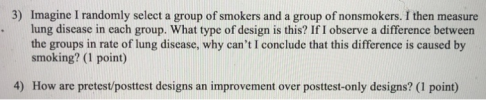 3) Imagine I randomly select a group of smokers and a group of nonsmokers. I then measure lung disease in each group. What type of design is this? If I observe a difference betweern the groups in rate of lung disease, why can't I conclude that this difference is caused by smoking? (1 point) 4) How are pretest/posttest designs an improvement over posttest-only designs? (1 point)
3) Imagine I randomly select a group of smokers and a group of nonsmokers....
3) Imagine I randomly select a group of smokers and a group of nonsmokers. I then measure lung disease in each group. What type of design is this? If I observe a difference betweern the groups in rate of lung disease, why can't I conclude that this difference is caused by smoking? (1 point) 4) How are pretest/posttest designs an improvement over posttest-only designs? (1 point)
3) Imagine I randomly select a group of smokers and a group of nonsmokers....
You finally received funding to study the incidence of lung cancer development between smokers and non-smokers....
You finally received funding to study the incidence of lung cancer development between smokers and non-smokers. (1) What study design would be the most appropriate for this study? Justify the choice of design, and what are the strengths and limitations of your chosen design?
According to the American Lung Association, 90% of adult smokers started smoking before turning 21 years...
According to the American Lung Association, 90% of adult smokers started smoking before turning 21 years old. a.) Compute the mean and standard deviation of the random variable X, the number of smokers who started before turning 21 years old in 200 trials of the probability experiment. b.) Interpret the mean c.) Would it be unusual to observe 185 smokers who started smoking before turning 21 years old in a random sample of 200 adult smokers? Why?
 3) Imagine I randomly select a group of smokers and a group of nonsmokers. I then measure lung disease in each group. What type of design is this? If I observe a difference betweern the groups in rate of lung disease, why can't I conclude that this difference is caused by smoking? (1 point) 4) How are pretest/posttest designs an improvement over posttest-only designs? (1 point)
3) Imagine I randomly select a group of smokers and a group of nonsmokers....
3) Imagine I randomly select a group of smokers and a group of nonsmokers. I then measure lung disease in each group. What type of design is this? If I observe a difference betweern the groups in rate of lung disease, why can't I conclude that this difference is caused by smoking? (1 point) 4) How are pretest/posttest designs an improvement over posttest-only designs? (1 point)
3) Imagine I randomly select a group of smokers and a group of nonsmokers....
Most questions answered within 3 hours.
-
Where is the error in this code sequence?
String s1 = "Hello";
String s2 = "ello";...
asked 10 months ago -
Financial data for Joel de Paris, Inc., for last year
follow:
Joel de Paris, Inc.
Balance...
asked 10 months ago -
Consider this reaction:
Al2(SO4)3 (aq)+ BaCl3
(aq) Al2Cl6 (aq)- +
3BaSO4(s) . What is the...
asked 10 months ago -
Suppose that Savneet is considering increasing her
recent random sample from 20 car rentals to 40...
asked 10 months ago -
Trucks arrive at an unloading terminal at an average rate of 120
per hour.
Trucks arrive...
asked 10 months ago -
Why are methanol and ethanol completely soluble in water while
octanol is not very little soluble....
asked 10 months ago -
A facilities manager at a university reads in a research report
that the mean amount of...
asked 10 months ago -
When the CuSO4 is rehydrated by adding water to the anhydrous
compound, is this an endothermic...
asked 10 months ago -
A ray of sunlight is passing from diamond into crown glass; the
angle of incidence is...
asked 10 months ago -
A block of mass 0.249 kg is placed on top of a light, vertical
spring of...
asked 10 months ago -
how do the kidneys compensate in the presences of acidosis
a) trigger hyperventilate
b) reserve acid...
asked 10 months ago -
Question 501 pts
The rental rate of capital to the firm increases. Which of the
following...
asked 10 months ago