Jordan and Cambodia produce tile and fertilizer. If all resources were invested in only one commodity,...
Jordan and Cambodia produce tile and fertilizer. If all resources were invested in only one commodity, Jordan could produce 1.5 million tiles each month or 7 million tons of fertilizer. Cambodia could produce 2 million tiles or 3 million tons of fertilizer. What is the opportunity cost of producing one more tile in Jordan?
Homework Answers
Answer
the opportunity cost of producing one more unit=Maximum production of other good /maximum production of the good
the opportunity cost of producing one more tile in Jordan =7/1.5
=4.66666667 fertilizer
=4.67 fertilizer
the opportunity cost of producing one more tile in Jordan is 4.67 fertilizer
The opportunity cost of producing one more tile in Jordan is the number of tons of fertilizer that Jordan has to give up to produce that additional tile.
To find the opportunity cost, we compare the tile production capability of Jordan with the fertilizer production capability of Jordan:
Jordan can produce 1.5 million tiles per month or 7 million tons of fertilizer.
Cambodia can produce 2 million tiles or 3 million tons of fertilizer.
To produce one more tile, Jordan has to give up the production of 1/1.5 million (approximately 0.00067) tons of fertilizer.
So, the opportunity cost of producing one more tile in Jordan is approximately 0.00067 tons of fertilizer
The opportunity cost of producing one more tile in Jordan is the quantity of fertilizer that Jordan must forgo to produce that additional tile. To find this, we need to compare the production possibilities of tiles and fertilizer in Jordan.
Let's assume that Jordan decides to produce only tiles. In this case, Jordan can produce 1.5 million tiles per month. Now, if Jordan decided to produce fertilizer instead, it could produce 7 million tons of fertilizer.
So, the opportunity cost of producing one more tile in Jordan is the quantity of fertilizer that Jordan could have produced instead. Therefore, the opportunity cost is 7 million tons of fertilizer.
Add Answer to:
Jordan and Cambodia produce tile and fertilizer. If all
resources were invested in only one commodity,...
1. With given resources and technology, a country can produce either 100 million cars or 50...
1. With given resources and technology, a country can produce either 100 million cars or 50 million tons of paper. What is the opportunity cost of producing one ton of paper? a.) 500,000 cars b.) 100 million cars c.) 2 million cars d.) None 2. With its given resources and technology, an economy can produce either 100 units of good Y or 50 units of good X. For each of the following combinations of goods indicate whether the combination is...
Assume that Company A and Company B produce only two products, motor cars and commercial trucks...
Assume that Company A and Company B produce only two products, motor cars and commercial trucks using all their resources in a perfectly competitive market. The table below shows how much of each product they could in one day if they spent the whole day doing just that task. For example, Company A could produce 32 cars or 7 trucks in one day. Company A Company B Cars (x) 32 35 Tracks (y) 7 21 In case of trade and...
Question Help Suppose Italy and Spain produce only cloth and wine. Assume that each country uses only labor to prod...
 Question Help Suppose Italy and Spain produce only cloth and wine. Assume that each country uses only labor to produce each good, and that the cloth and wine made in Italy and Spain are exactly alike. The table below shows how much each country can produce of each good with one hour of labor. Output per Hour of Labor Cloth Wine Italy Spain According to the table, the opportunity cost to Italy of producing one more unit of cloth is...
Question 1: Germany and India only produce two goods. They have the same fixed resources, are...
Question 1: Germany and India only produce two goods. They have the same fixed resources, are equally efficient, and both countries have constant opportunity costs between two the goods. In one month, Germany can produce 200,000 automobiles or 60,000 hand-held computers. India can produce 150,000 automobiles or 50,000 hand-held computers. A. Graph the given information. B. What is the opportunity cost for Germany to produce automobiles? C. What is the opportunity cost for India to produce automobiles? D. What is...
7. (LO 6) The data below show the total production (in millions) of the only two...
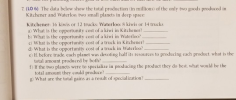 7. (LO 6) The data below show the total production (in millions) of the only two goods produced in Kitchener and Waterloo, two small planets in deep space Kitchener: 16 kiwis or 12 trucks: Waterloo: 8 kiwis or 14 trucks a) What is the opportunity cost of a kiwi in Kitchener? b) What is the opportunity cost of a kiwi in Waterloo? c) What is the opportunity cost of a truck in Kitchener? d) What is the opportunity cost of...
1. a) The government is contemplating introducing one of two alternative taxes: a tax on commodity...
 1. a) The government is contemplating introducing one of two alternative taxes: a tax on commodity x (that would double the price of x, expressed in terms of the numeraire good, y) and a lump sum tax. Assume that the government knows the preferences (i.e., the indifference mapy of a representative taxpayer and his/her indifference curves have the usual convex shape. Suppose that government could predict how much tax revenue it could raise if it introduced the commodity tax. With...
Assume three 2. Critical Thinking: Assume three trade partners: the U.S., China, and Brazil. The following...
 Assume three
2. Critical Thinking: Assume three trade partners: the U.S., China, and Brazil. The following information represents 2019 production estimates gathered from Index Mundi and World Atlas. The U.S. can produce 347 million tons of com, 117 million tons of soybeans, and 20 million tons of chicken meat. China can produce 254 million tons of com, 12 million tons of soybeans, and 16 million tons of chicken meat. Brazil can produce 101 million tons of com, 96 million tons...
Assume three
2. Critical Thinking: Assume three trade partners: the U.S., China, and Brazil. The following information represents 2019 production estimates gathered from Index Mundi and World Atlas. The U.S. can produce 347 million tons of com, 117 million tons of soybeans, and 20 million tons of chicken meat. China can produce 254 million tons of com, 12 million tons of soybeans, and 16 million tons of chicken meat. Brazil can produce 101 million tons of com, 96 million tons...
Question 1 Question 3 At one time, mest of the watches produced in Germany were sold...
 Question 1 Question 3 At one time, mest of the watches produced in Germany were sold in Germany. Today, hewever, Germany both experts and imports watches, How could comparative advantage explain these data? The law of diminishing returns states that as additional increments of resources those additional increments_ the marginal bene it from Select the correct answer below Select the correct answer below: It cannot: comparative advantage predicts that a country either exports a product or imports it, not both...
Only need the first question to be answered QUESTION 17 Zimbabwe and South Africa are trading...
 Only need the first question to be answered
QUESTION 17 Zimbabwe and South Africa are trading partners. Both produce metal ores (including lithium) and delivery trucks. (Note: The numbers below are fake, but the direction of trade is real!) (Please label your answers using A, B, C, and D.) A) (1 point) As each country increases its production of metal ores, what happens to the opportunity cost of producing metal ores in terms of delivery trucks? B) (3 points) Now...
Only need the first question to be answered
QUESTION 17 Zimbabwe and South Africa are trading partners. Both produce metal ores (including lithium) and delivery trucks. (Note: The numbers below are fake, but the direction of trade is real!) (Please label your answers using A, B, C, and D.) A) (1 point) As each country increases its production of metal ores, what happens to the opportunity cost of producing metal ores in terms of delivery trucks? B) (3 points) Now...
2. Kent, Jasmine, and Hilary produce hoodies and slippers using only their labour. The table provides...
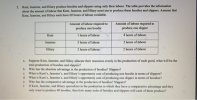 2. Kent, Jasmine, and Hilary produce hoodies and slippers using only their labour. The table provides the information about the amount of labour that Kent, Jasmine, and Hilary must use to produce these hoodies and slippers. Assume that Kent, Jasmine, and Hilary each have 60 hours of labour available. Amount of labour required to produce one hoodie Amount of labour required to produce one slipper 4 hours of labour Kent 1 hours of labour Jasmine 5 hours of labour 3...
 Question Help Suppose Italy and Spain produce only cloth and wine. Assume that each country uses only labor to produce each good, and that the cloth and wine made in Italy and Spain are exactly alike. The table below shows how much each country can produce of each good with one hour of labor. Output per Hour of Labor Cloth Wine Italy Spain According to the table, the opportunity cost to Italy of producing one more unit of cloth is...
 7. (LO 6) The data below show the total production (in millions) of the only two goods produced in Kitchener and Waterloo, two small planets in deep space Kitchener: 16 kiwis or 12 trucks: Waterloo: 8 kiwis or 14 trucks a) What is the opportunity cost of a kiwi in Kitchener? b) What is the opportunity cost of a kiwi in Waterloo? c) What is the opportunity cost of a truck in Kitchener? d) What is the opportunity cost of...
 1. a) The government is contemplating introducing one of two alternative taxes: a tax on commodity x (that would double the price of x, expressed in terms of the numeraire good, y) and a lump sum tax. Assume that the government knows the preferences (i.e., the indifference mapy of a representative taxpayer and his/her indifference curves have the usual convex shape. Suppose that government could predict how much tax revenue it could raise if it introduced the commodity tax. With...
 Assume three
2. Critical Thinking: Assume three trade partners: the U.S., China, and Brazil. The following information represents 2019 production estimates gathered from Index Mundi and World Atlas. The U.S. can produce 347 million tons of com, 117 million tons of soybeans, and 20 million tons of chicken meat. China can produce 254 million tons of com, 12 million tons of soybeans, and 16 million tons of chicken meat. Brazil can produce 101 million tons of com, 96 million tons...
Assume three
2. Critical Thinking: Assume three trade partners: the U.S., China, and Brazil. The following information represents 2019 production estimates gathered from Index Mundi and World Atlas. The U.S. can produce 347 million tons of com, 117 million tons of soybeans, and 20 million tons of chicken meat. China can produce 254 million tons of com, 12 million tons of soybeans, and 16 million tons of chicken meat. Brazil can produce 101 million tons of com, 96 million tons...
 Question 1 Question 3 At one time, mest of the watches produced in Germany were sold in Germany. Today, hewever, Germany both experts and imports watches, How could comparative advantage explain these data? The law of diminishing returns states that as additional increments of resources those additional increments_ the marginal bene it from Select the correct answer below Select the correct answer below: It cannot: comparative advantage predicts that a country either exports a product or imports it, not both...
 Only need the first question to be answered
QUESTION 17 Zimbabwe and South Africa are trading partners. Both produce metal ores (including lithium) and delivery trucks. (Note: The numbers below are fake, but the direction of trade is real!) (Please label your answers using A, B, C, and D.) A) (1 point) As each country increases its production of metal ores, what happens to the opportunity cost of producing metal ores in terms of delivery trucks? B) (3 points) Now...
Only need the first question to be answered
QUESTION 17 Zimbabwe and South Africa are trading partners. Both produce metal ores (including lithium) and delivery trucks. (Note: The numbers below are fake, but the direction of trade is real!) (Please label your answers using A, B, C, and D.) A) (1 point) As each country increases its production of metal ores, what happens to the opportunity cost of producing metal ores in terms of delivery trucks? B) (3 points) Now...
 2. Kent, Jasmine, and Hilary produce hoodies and slippers using only their labour. The table provides the information about the amount of labour that Kent, Jasmine, and Hilary must use to produce these hoodies and slippers. Assume that Kent, Jasmine, and Hilary each have 60 hours of labour available. Amount of labour required to produce one hoodie Amount of labour required to produce one slipper 4 hours of labour Kent 1 hours of labour Jasmine 5 hours of labour 3...
Most questions answered within 3 hours.
-
Where is the error in this code sequence?
String s1 = "Hello";
String s2 = "ello";...
asked 11 months ago -
Financial data for Joel de Paris, Inc., for last year
follow:
Joel de Paris, Inc.
Balance...
asked 11 months ago -
Consider this reaction:
Al2(SO4)3 (aq)+ BaCl3
(aq) Al2Cl6 (aq)- +
3BaSO4(s) . What is the...
asked 11 months ago -
Suppose that Savneet is considering increasing her
recent random sample from 20 car rentals to 40...
asked 11 months ago -
Trucks arrive at an unloading terminal at an average rate of 120
per hour.
Trucks arrive...
asked 11 months ago -
Why are methanol and ethanol completely soluble in water while
octanol is not very little soluble....
asked 11 months ago -
A facilities manager at a university reads in a research report
that the mean amount of...
asked 11 months ago -
When the CuSO4 is rehydrated by adding water to the anhydrous
compound, is this an endothermic...
asked 11 months ago -
A ray of sunlight is passing from diamond into crown glass; the
angle of incidence is...
asked 11 months ago -
A block of mass 0.249 kg is placed on top of a light, vertical
spring of...
asked 11 months ago -
how do the kidneys compensate in the presences of acidosis
a) trigger hyperventilate
b) reserve acid...
asked 11 months ago -
Question 501 pts
The rental rate of capital to the firm increases. Which of the
following...
asked 11 months ago