How many kilojoules of heat will be released when exactly 1 mole of aluminum, Al, is...
How many kilojoules of heat will be released when exactly 1 mole of aluminum, Al, is burned to form Al2O3(s) at standard state conditions?
Homework Answers

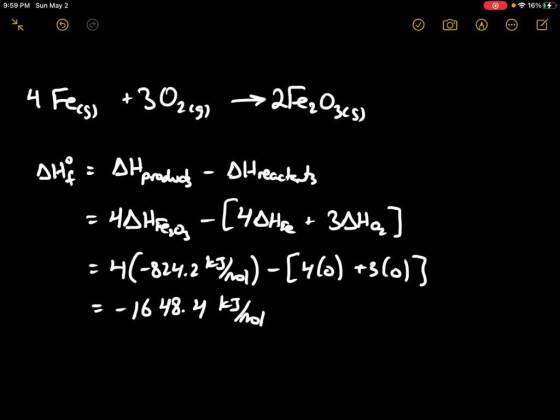
The standard enthalpy of formation (ΔHf°) of Al2O3(s) is the heat released when 1 mole of Al2O3 is formed from its elements in their standard states at standard state conditions.
The balanced chemical equation for the formation of Al2O3 from Al is: 4 Al(s) + 3 O2(g) → 2 Al2O3(s)
The standard enthalpy of formation of Al2O3 is -1675 kJ/mol.
Since the stoichiometric coefficient of Al is 4 in the balanced equation, we need to find the heat released when 4 moles of Al react to form 2 moles of Al2O3.
Heat released for 4 moles of Al reacting to form 2 moles of Al2O3: = (2 moles of Al2O3 / 4 moles of Al) * (-1675 kJ/mol) = -837.5 kJ/mol
Therefore, when exactly 1 mole of aluminum (Al) is burned to form Al2O3(s) at standard state conditions, 837.5 kilojoules (kJ) of heat will be released.
Add Answer to:
How many kilojoules of heat will be released when exactly 1 mole
of aluminum, Al, is...
How many kilojoules of heat are produced when 2.89 mol of Fe2O3 react? 2Al(s) + Fe2O3(s)...
How many kilojoules of heat are produced when 2.89 mol of Fe2O3 react? 2Al(s) + Fe2O3(s) → 2Fe(s) + Al2O3(s) heat of reaction = –851.5 kJ
How much heat, in kilojoules, is released when nitrogen and hydrogen react to form 70.5 grams...
How much heat, in kilojoules, is released when nitrogen and hydrogen react to form 70.5 grams of ammonia?
When one mole of uranium-235 undergoes fission, how much energy is released in kilojoules?
When one mole of uranium-235 undergoes fission, how much energy is released in kilojoules?
Calculate how many kilojoules of heat will be released from burning the 155 g of C6H6...
Calculate how many kilojoules of heat will be released from burning the 155 g of C6H6 mentioned in the previous problem (use textbook appendix II. B.). Also, write a couple of sentences explaining if it is this heat that contributes to global climate change or if it is something else about combustion reactions. PREVIOUS PROBLEM: Write and balance the chemical equation for the combustion of benzene (C6H6). Also calculate how many grams of carbon dioxide will form from the reaction...
1. Balance the following reaction: Al(s) + F2 ---> AlF3 How many grams of aluminum fluoride...
1. Balance the following reaction: Al(s) + F2 ---> AlF3 How many grams of aluminum fluoride would be produced from 40.84 g of aluminum (use the balanced equation above)? The molar masses are: Al, 26.981; F, 18.998, g per mole, respectively. Leave the answer as a fraction but state how many significant figures it has. (PS: Please show all the works! Thank you!)
Calculate the amount of heat released in the combustion of 10.9 grams of Al with 3.5...
Calculate the amount of heat released in the combustion of 10.9 grams of Al with 3.5 grams of O2 to form Al2O3(s) at 25°C and 1 atm. ΔHfAl2O3(s) = −1676 kJ/mol HINT: What does ΔHfAl2O3(s) mean? Enter a positive number since released implies a negative number already. Enter to 1 decimal place in kJ.
Marked out of 1.00 Aluminum reacts with oxygen to form aluminum oxide according to the following...
Marked out of 1.00 Aluminum reacts with oxygen to form aluminum oxide according to the following unbalanced equation: Al(s) + O2 (g) → Al2O3 (s) If 5.0 moles of A react with excess oxygen, how many moles of Al2O3 can be produced? Select one: a. 1.0 mole b. 2.0 mole c. 3.0 mole d. 2.5 mole e. 10.0 mole Clear my choice Question 11 Not yet answered
Iron oxide reacts with aluminum in an exothermic reaction. Fe2O3(s) + 2 Al(s) → 2...
 Iron oxide reacts with aluminum in an exothermic reaction. Fe2O3(s) + 2Al(s) → 2Fe(s) + Al2O3(s) The reaction of 5.00g Fe2O3 with excess Al(s) evolves 26.6 kJ of energy in the form of heat. Calculate the enthalpy change per mole of Fe2O3 reacted.
Compare the quantities of heat released per mole of iron formed when oxides of Fe3O4 and...
Compare the quantities of heat released per mole of iron formed when oxides of Fe3O4 and Fe2O3 react with aluminium. 3Fe3O4 + 8Al -> 4Al2O3 +9Fe Delta Heat = -3347.6KJ Fezo3 +2Al -> Al2O3 +2Fe Delta Heat = -851.4KJ
Determine how many kilojoules are released when 84.8 gg of methanol reacts via the following reaction:...
Determine how many kilojoules are released when 84.8 gg of methanol reacts via the following reaction: 2CH3OH(l)+3O2(g)→2CO2(g)+4H2O(l),ΔH=−726kJ Determine how many kilojoules are absorbed when 316 gg of Ca(OH)2Ca(OH)2 reacts via the following reaction: Ca(OH)2(s)→CaO(s)+H2O(l),ΔH=+65.3kJ
 Iron oxide reacts with aluminum in an exothermic reaction. Fe2O3(s) + 2Al(s) → 2Fe(s) + Al2O3(s) The reaction of 5.00g Fe2O3 with excess Al(s) evolves 26.6 kJ of energy in the form of heat. Calculate the enthalpy change per mole of Fe2O3 reacted.
Most questions answered within 3 hours.
-
Where is the error in this code sequence?
String s1 = "Hello";
String s2 = "ello";...
asked 11 months ago -
Financial data for Joel de Paris, Inc., for last year
follow:
Joel de Paris, Inc.
Balance...
asked 11 months ago -
Consider this reaction:
Al2(SO4)3 (aq)+ BaCl3
(aq) Al2Cl6 (aq)- +
3BaSO4(s) . What is the...
asked 11 months ago -
Suppose that Savneet is considering increasing her
recent random sample from 20 car rentals to 40...
asked 11 months ago -
Trucks arrive at an unloading terminal at an average rate of 120
per hour.
Trucks arrive...
asked 11 months ago -
Why are methanol and ethanol completely soluble in water while
octanol is not very little soluble....
asked 11 months ago -
A facilities manager at a university reads in a research report
that the mean amount of...
asked 11 months ago -
When the CuSO4 is rehydrated by adding water to the anhydrous
compound, is this an endothermic...
asked 11 months ago -
A ray of sunlight is passing from diamond into crown glass; the
angle of incidence is...
asked 11 months ago -
A block of mass 0.249 kg is placed on top of a light, vertical
spring of...
asked 11 months ago -
how do the kidneys compensate in the presences of acidosis
a) trigger hyperventilate
b) reserve acid...
asked 11 months ago -
Question 501 pts
The rental rate of capital to the firm increases. Which of the
following...
asked 11 months ago