Patient’s orthopedic surgeon would like to perform spinal fusion for on-going lumbar pain due to herniated...
Patient’s orthopedic surgeon would like to perform spinal fusion for on-going lumbar pain due to herniated discs. The MCO wants to ensure that the treatment will be effective.
Which service management tool(s) would the MCO use to sensure that the requested treatment will be effective? List 3
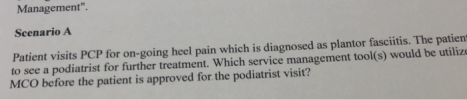
Patient visits PCP for on-going heel pain which is diagnosed as plantor fasciitis. The patient requests to see a podiatrist for further treatment. I NEED AN ANSWER PLEASE ASAP
Which service management tool(s) would be utilized by the MCO before the patient is approved for the podiatrist visit?
A patient was thrown from a horse during riding practice. Patient experienced a severe head injury and requires the services of multiple healthcare providers at various locations throughout the state.
Which service management tool(s) would be utilized by the MCO for this scenario to ensure that the patient receivescost-effectivee and efficient care?
Homework Answers
Lumbar disc herniation is common spinal disorder. In small percentage of the patient surgical decompression is required. Lumbar discectomy constitutes the most easiest spine surgery globally, even catastrophic event can occur. Other important tips include timely performance of correct interpretation of scan data, magnetic response imaging.
To ensure that the requested spinal fusion treatment for on-going lumbar pain due to herniated discs will be effective, the Managed Care Organization (MCO) would use the following service management tools:
a) Prior Authorization: The MCO would require the orthopedic surgeon to obtain prior authorization for the spinal fusion procedure. This process involves submitting detailed information about the patient's condition, medical history, and the proposed treatment plan to the MCO for review. The MCO will assess the medical necessity and effectiveness of the procedure before granting approval.
b) Utilization Review: The MCO would conduct a utilization review to evaluate the appropriateness and efficiency of the spinal fusion procedure. This review involves assessing whether the treatment aligns with evidence-based guidelines and whether it is the most suitable option for the patient's condition.
c) Case Management: For complex cases like spinal fusion, the MCO may assign a case manager to oversee the patient's care. The case manager will work with the patient, the orthopedic surgeon, and other healthcare providers to ensure that the treatment plan is coordinated, monitored, and effective in addressing the patient's lumbar pain.
For the patient with on-going heel pain diagnosed as plantar fasciitis who requests to see a podiatrist for further treatment, the MCO would utilize the following service management tool:
a) Referral Management: The MCO would use a referral management system to ensure that the patient is approved to see the podiatrist. The primary care physician (PCP) would need to submit a referral request to the MCO, providing justification for the need to see a specialist. The MCO will review the request to determine whether the visit to the podiatrist is medically necessary and appropriate.
For the patient who experienced a severe head injury from a horse riding accident and requires the services of multiple healthcare providers at various locations throughout the state, the MCO would utilize the following service management tools:
a) Care Coordination: The MCO would employ care coordination to ensure that the patient receives seamless and coordinated care from different healthcare providers. The MCO's care coordination team would work closely with the patient, case managers, and all involved providers to facilitate communication, share medical information, and manage appointments and treatments efficiently.
b) Network Management: The MCO would manage its network of healthcare providers strategically to ensure that the patient has access to cost-effective and efficient care. This involves contracting with high-quality providers at different locations throughout the state, so the patient can receive the necessary services without unnecessary travel or delays.
c) Case Management: For a complex and severe injury like a head injury, the MCO may assign a dedicated case manager who specializes in trauma care. The case manager will assess the patient's needs, develop a comprehensive care plan, and oversee the patient's treatment journey to ensure that it is both cost-effective and efficient while meeting the patient's health goals.
Add Answer to:
Patient’s orthopedic surgeon would like to perform spinal fusion
for on-going lumbar pain due to herniated...
Walldgement. Scenario A Patient visits PCP for on-going heel pain which is diagnosed as plantor fasciitis....
 Walldgement. Scenario A Patient visits PCP for on-going heel pain which is diagnosed as plantor fasciitis. The patient to see a podiatrist for further treatment. Which service management tool(s) would be utiliz MCO before the patient is approved for the podiatrist visit? Management". Scenario A Patient visits PCP for on-going heel pain which is diagnosed as plantor fasciitis. The patient requests to see a podiatrist for further treatment. Which service management tool(s) would be utilized by the MCO before the...
 Walldgement. Scenario A Patient visits PCP for on-going heel pain which is diagnosed as plantor fasciitis. The patient to see a podiatrist for further treatment. Which service management tool(s) would be utiliz MCO before the patient is approved for the podiatrist visit? Management". Scenario A Patient visits PCP for on-going heel pain which is diagnosed as plantor fasciitis. The patient requests to see a podiatrist for further treatment. Which service management tool(s) would be utilized by the MCO before the...
Most questions answered within 3 hours.
-
Where is the error in this code sequence?
String s1 = "Hello";
String s2 = "ello";...
asked 10 months ago -
Financial data for Joel de Paris, Inc., for last year
follow:
Joel de Paris, Inc.
Balance...
asked 10 months ago -
Consider this reaction:
Al2(SO4)3 (aq)+ BaCl3
(aq) Al2Cl6 (aq)- +
3BaSO4(s) . What is the...
asked 10 months ago -
Suppose that Savneet is considering increasing her
recent random sample from 20 car rentals to 40...
asked 10 months ago -
Trucks arrive at an unloading terminal at an average rate of 120
per hour.
Trucks arrive...
asked 10 months ago -
Why are methanol and ethanol completely soluble in water while
octanol is not very little soluble....
asked 10 months ago -
A facilities manager at a university reads in a research report
that the mean amount of...
asked 10 months ago -
When the CuSO4 is rehydrated by adding water to the anhydrous
compound, is this an endothermic...
asked 10 months ago -
A ray of sunlight is passing from diamond into crown glass; the
angle of incidence is...
asked 10 months ago -
A block of mass 0.249 kg is placed on top of a light, vertical
spring of...
asked 10 months ago -
how do the kidneys compensate in the presences of acidosis
a) trigger hyperventilate
b) reserve acid...
asked 10 months ago -
Question 501 pts
The rental rate of capital to the firm increases. Which of the
following...
asked 10 months ago