Draw the two Lewis structures for the thiocyanate anion [SCN]-. Using the HSAB (hard soft acids...
Draw the two Lewis structures for the thiocyanate anion [SCN]-. Using the HSAB (hard soft acids and bases) concept, predict the binding mode of the [SCN]- ligand in complexes with the metal ions Hg2+ and Zn2+.
Homework Answers
Request Answer!
We need at least 10 more requests to produce the answer.
0 / 10 have requested this problem solution
The more requests, the faster the answer.
Add Answer to:
Draw the two Lewis structures for the thiocyanate anion [SCN]-.
Using the HSAB (hard soft acids...
Explain based on the HSAB concept (“hard and soft acids and bases”) why NaCl is very...
Explain based on the HSAB concept (“hard and soft acids and bases”) why NaCl is very soluble in water, where as AgCl is not.
Using the 'hard'/'soft' classification of acids and bases, determine whether Keq > 1 or keq <...
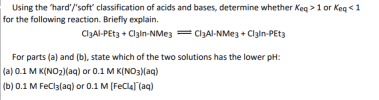 Using the 'hard'/'soft' classification of acids and bases, determine whether Keq > 1 or keq < 1 for the following reaction. Briefly explain. Cl3Al-PEt3 + Clzin-NMe3 = Cl3Al-NMe3 + Cl3In-PEt3 For parts (a) and (b), state which of the two solutions has the lower pH: (a) 0.1 M K(NO2)(aq) or 0.1 M K(NO3)(aq) (b) 0.1 M FeCl3(aq) or 0.1 M (FeCl4] (aq)
SHORT ANSWER: 1.) Explain “Hard versus Soft” acid-base behavior. 2.) Explain, in terms of ΔS &...
SHORT ANSWER: 1.) Explain “Hard versus Soft” acid-base behavior. 2.) Explain, in terms of ΔS & ΔG, why imperfections occur in crystals & be able to describe at least two of the four main types of defects, with a drawing of each. 3.) Describe how electron transfer occurs in either the outer sphere or the inner sphere redox reaction mechanism (choose one OR the other). 4.) Explain how to synthesize the cis and trans isomer of a square planar complex,...
SHORT ANSWER: 1.) Explain “Hard versus Soft” acid-base behavior. 2.) Explain, in terms of ΔS & ΔG, why imperfections occur in crystals & be able to describe at least two of the four main types...
SHORT ANSWER: 1.) Explain “Hard versus Soft” acid-base behavior. 2.) Explain, in terms of ΔS & ΔG, why imperfections occur in crystals & be able to describe at least two of the four main types of defects, with a drawing of each. 3.) Describe how electron transfer occurs in either the outer sphere or the inner sphere redox reaction mechanism (choose one OR the other). 4.) Explain how to synthesize the cis and trans isomer of a square planar complex,...
Using a partial Lewis dot structure like the one shown above, draw two more possible structures...
 Using a partial Lewis dot structure like the one shown above,
draw two more possible structures for the radical cation below and
circle the missing electron.
Fragmentation of Alkanes loss of e wadol C6H14 radical cation = (M+. The scheme above shows the formation of the hexane radical cation from the neutral hexane molecule by bombarding the molecule with high energy electrons which results in the loss of an electron from the molecule. The species that is missing one electron...
Using a partial Lewis dot structure like the one shown above,
draw two more possible structures for the radical cation below and
circle the missing electron.
Fragmentation of Alkanes loss of e wadol C6H14 radical cation = (M+. The scheme above shows the formation of the hexane radical cation from the neutral hexane molecule by bombarding the molecule with high energy electrons which results in the loss of an electron from the molecule. The species that is missing one electron...
 Using the 'hard'/'soft' classification of acids and bases, determine whether Keq > 1 or keq < 1 for the following reaction. Briefly explain. Cl3Al-PEt3 + Clzin-NMe3 = Cl3Al-NMe3 + Cl3In-PEt3 For parts (a) and (b), state which of the two solutions has the lower pH: (a) 0.1 M K(NO2)(aq) or 0.1 M K(NO3)(aq) (b) 0.1 M FeCl3(aq) or 0.1 M (FeCl4] (aq)
 Using a partial Lewis dot structure like the one shown above,
draw two more possible structures for the radical cation below and
circle the missing electron.
Fragmentation of Alkanes loss of e wadol C6H14 radical cation = (M+. The scheme above shows the formation of the hexane radical cation from the neutral hexane molecule by bombarding the molecule with high energy electrons which results in the loss of an electron from the molecule. The species that is missing one electron...
Using a partial Lewis dot structure like the one shown above,
draw two more possible structures for the radical cation below and
circle the missing electron.
Fragmentation of Alkanes loss of e wadol C6H14 radical cation = (M+. The scheme above shows the formation of the hexane radical cation from the neutral hexane molecule by bombarding the molecule with high energy electrons which results in the loss of an electron from the molecule. The species that is missing one electron...
Most questions answered within 3 hours.
-
Where is the error in this code sequence?
String s1 = "Hello";
String s2 = "ello";...
asked 10 months ago -
Financial data for Joel de Paris, Inc., for last year
follow:
Joel de Paris, Inc.
Balance...
asked 10 months ago -
Consider this reaction:
Al2(SO4)3 (aq)+ BaCl3
(aq) Al2Cl6 (aq)- +
3BaSO4(s) . What is the...
asked 10 months ago -
Suppose that Savneet is considering increasing her
recent random sample from 20 car rentals to 40...
asked 10 months ago -
Trucks arrive at an unloading terminal at an average rate of 120
per hour.
Trucks arrive...
asked 10 months ago -
Why are methanol and ethanol completely soluble in water while
octanol is not very little soluble....
asked 10 months ago -
A facilities manager at a university reads in a research report
that the mean amount of...
asked 10 months ago -
When the CuSO4 is rehydrated by adding water to the anhydrous
compound, is this an endothermic...
asked 10 months ago -
A ray of sunlight is passing from diamond into crown glass; the
angle of incidence is...
asked 10 months ago -
A block of mass 0.249 kg is placed on top of a light, vertical
spring of...
asked 10 months ago -
how do the kidneys compensate in the presences of acidosis
a) trigger hyperventilate
b) reserve acid...
asked 10 months ago -
Question 501 pts
The rental rate of capital to the firm increases. Which of the
following...
asked 10 months ago