Three objects of equal mass m1 = m2 = m3 = 2.65 kg are located on...
Three objects of equal mass
m1 = m2 = m3 = 2.65 kg
are located on the vertices of an equilateral triangle of length
d = 3.75 m.
A fourth mass
m4 = 15.5 kg
is at the center of the triangle. What is the net gravitational force on the mass
m1 that is at the origin? Express your answer in vector form.
Homework Answers

Add Answer to:
Three objects of equal mass
m1 = m2 = m3 = 2.65 kg
are located on...
----------- ---------- m1 - - - - m3 Suppose three planets, each with a mass of...
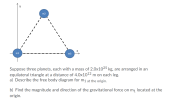 ----------- ---------- m1 - - - - m3 Suppose three planets, each with a mass of 2.0x1025 kg, are arranged in an equilateral triangle at a distance of 4.0x10¹² m on each leg. a) Describe the free body diagram for m1 at the origin. b) Find the magnitude and direction of the gravitational force on my located at the origin.
Three particles of masses m1=1.2 kg, m2=2.5kg, and m3=3.4kg form an equilateral triangle of edge...
Three particles of masses m1=1.2 kg, m2=2.5kg, and m3=3.4kg form an equilateral triangle of edge length a=140 cm. Where is the center of mass of this system?
the mass and coordinates of three objects are given below: m1 = 6.0 kg at (0.0,...
the mass and coordinates of three objects are given below: m1 = 6.0 kg at (0.0, 0.0) m, m2 = 1.3 kg at (0.0, 4.2) m, and m3 = 4.0 kg at (3.1, 0.0) m. determine where we should place a fourth object with a mass m4 = 7.5 kg so that the center of gravity of the four-object arrangement will be at (0.0, 0.0) m.
Three uniform spheres of masses m1 = 2.50 kg, m2 = 4.00 kg, and m3 =...
Three uniform spheres of masses m1 = 2.50 kg, m2 = 4.00 kg, and m3 = 8.00 kg are placed at the corners of a right triangle (see figure below). Calculate the resultant gravitational force on the object of mass m2, assuming the spheres are isolated from the rest of the Universe.
M1 is a spherical mass (41.8 kg) at the origin. M2 is also a spherical mass...
 M1 is a spherical mass (41.8 kg) at the origin. M2 is also a spherical mass (19.9 kg) and is located on the x-axis at x = 52.8 m At what value of x would a third mass with a 19.0 kg mass experience no net gravitational force due to M1 and M2
M1 is a spherical mass (27.0 kg) at the origin. M2 is also a spherical mass...
M1 is a spherical mass (27.0 kg) at the origin. M2 is also a spherical mass (12.4 kg) and is located on the x-axis at x = 90.6 m. At what value of x would a third mass with a 12.0 kg mass experience no net gravitational force due to M1 and M2?
Three lead balls of mass m1 = 14 kg, m2 = 26 kg, and m3 =...
Three lead balls of mass m1 = 14 kg, m2 = 26 kg, and m3 = 8.7 kg are arranged as shown in the figure below. Find the total gravitational force exerted by balls 1 and 2 on ball 3. Be sure to give the magnitude and the direction of this force. magnitude _______ N direction __________
Three objects with masses m1= 2 kg, m2= 4 kg, and m3=6 kg are attached by...
Three objects with masses m1= 2 kg, m2= 4 kg, and m3=6 kg are attached by strings on an incline. The coefficent of kinetic friction is 0.15. A force of 100N is applied on m3 and pulls the objects up the incline with a gradient of 30 degrees. Determine the tension T1, T2, and the acceleration of the system
1. In the figure below, three point particles are fixed in place in the xy plane. The three partiles sit on the corners...
 1. In the figure below, three point particles are fixed in place in the xy plane. The three partiles sit on the corners of an equilateral triangle with sides of length a = 2.50 mm. Particle 1 has a mass m1 = 12.0 kg, particle 2 has a mass m2 = 18.0 kg, and particle 3 has a mass m3 = 15.0 kg. m --- -- 1 m3 (a) What is the magnitude and direction of the net gravitational force...
if mass m1=0.02 kg is at (0,0) mass m2=0.03 kg is at (3,0) mass m3=0.04 kg...
if mass m1=0.02 kg is at (0,0) mass m2=0.03 kg is at (3,0) mass m3=0.04 kg is at (2,2) what is the center of mass?
 ----------- ---------- m1 - - - - m3 Suppose three planets, each with a mass of 2.0x1025 kg, are arranged in an equilateral triangle at a distance of 4.0x10¹² m on each leg. a) Describe the free body diagram for m1 at the origin. b) Find the magnitude and direction of the gravitational force on my located at the origin.
 M1 is a spherical mass (41.8 kg) at the origin. M2 is also a spherical mass (19.9 kg) and is located on the x-axis at x = 52.8 m At what value of x would a third mass with a 19.0 kg mass experience no net gravitational force due to M1 and M2
 1. In the figure below, three point particles are fixed in place in the xy plane. The three partiles sit on the corners of an equilateral triangle with sides of length a = 2.50 mm. Particle 1 has a mass m1 = 12.0 kg, particle 2 has a mass m2 = 18.0 kg, and particle 3 has a mass m3 = 15.0 kg. m --- -- 1 m3 (a) What is the magnitude and direction of the net gravitational force...
Most questions answered within 3 hours.
-
Where is the error in this code sequence?
String s1 = "Hello";
String s2 = "ello";...
asked 10 months ago -
Financial data for Joel de Paris, Inc., for last year
follow:
Joel de Paris, Inc.
Balance...
asked 10 months ago -
Consider this reaction:
Al2(SO4)3 (aq)+ BaCl3
(aq) Al2Cl6 (aq)- +
3BaSO4(s) . What is the...
asked 10 months ago -
Suppose that Savneet is considering increasing her
recent random sample from 20 car rentals to 40...
asked 10 months ago -
Trucks arrive at an unloading terminal at an average rate of 120
per hour.
Trucks arrive...
asked 10 months ago -
Why are methanol and ethanol completely soluble in water while
octanol is not very little soluble....
asked 10 months ago -
A facilities manager at a university reads in a research report
that the mean amount of...
asked 10 months ago -
When the CuSO4 is rehydrated by adding water to the anhydrous
compound, is this an endothermic...
asked 10 months ago -
A ray of sunlight is passing from diamond into crown glass; the
angle of incidence is...
asked 10 months ago -
A block of mass 0.249 kg is placed on top of a light, vertical
spring of...
asked 10 months ago -
how do the kidneys compensate in the presences of acidosis
a) trigger hyperventilate
b) reserve acid...
asked 10 months ago -
Question 501 pts
The rental rate of capital to the firm increases. Which of the
following...
asked 10 months ago