1. How does a PTB domain differ from and SH2 domain? 2. Which signaling pathway evokes...
1. How does a PTB domain differ from and SH2 domain?
2. Which signaling pathway evokes most of the transformation phenotypes induced by the Ras oncoprotein?
3. Briefly explain how the AKT kinase gets recruited to the plasma membrane in response to PI3K signaling
4. How does the PTEN phosphatase negatively regulated AKT kinase?
Homework Answers
1. A PTB domain is a phospho-tyrosine binding domain and a SH2 domain is Src homology region 2 domain. Both of these domains are present in many proteins and they are mainly involved in mediating protein-protein interactions. These domains are majorly present in tyrosine kinase receptors. Initially, it was identified that both of them identify phosphorylated tyrosine in receptor tyrosine kinases. But later it was seen that only SH2 domains bind to their targets strictly depending on tyrosine phosphorylation. While PTB domains can bind to their non-phosphorylated targets in a constitutive manner.
2. The RAF signalling pathway evokes most of the transformation phenotypes induced by the Ras oncoprotein. RAF is a very important effector molecule. The RAF then transduces the signal via MEK and ERK and finally leads to the synthesis of a large number of transcription factors that is responsible for the cell to proliferate. And proliferation is considered to be the major transformation phenotype of the RAS oncoprotein.
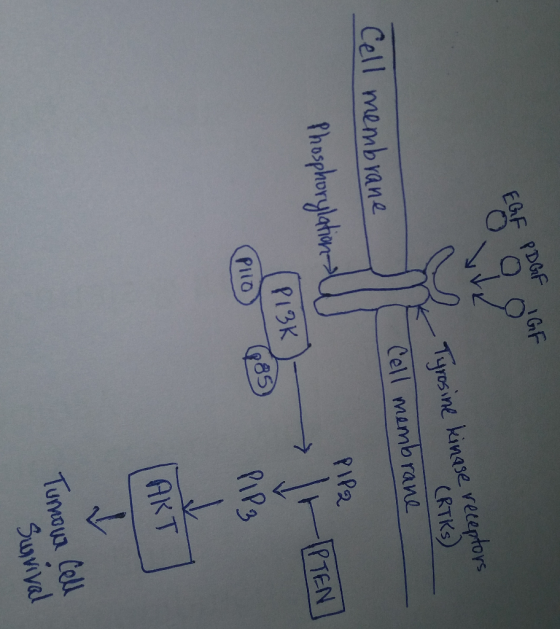
3. The signalling begins with the attachment of the ligand to the tyrosine kinase receptor. This leads to conformational changes in the receptor, dimerisation of the receptor and finally the phosphorylation of the tyrosine residue in the receptor domains. Following this activation, the receptor then recruits PI3K which then phosphorylates PIP2 to PIP3. Once PIP3 is formed, it recruits AKT to the plasma membrane and then the rest of the signal transduction continues.
4. PTEN is the main protein which is involved in the negative regulation of the PIK3-AKT pathway. This protein has a phosphatase activity and it converts PIP3 to PIP2. As a result AKT does not get recruited and the pathway gets inhibited.
The following diagram illustrates questions 3 and 4.
Add Answer to:
1. How does a PTB domain differ from and SH2 domain?
2. Which signaling pathway evokes...
Classes 7-8 Cytoplasmic Growth Signaling Be able to describe Ras structure and function. What kind of...
 Classes 7-8 Cytoplasmic Growth Signaling Be able to describe Ras structure and function. What kind of protein is it? How is it regulated (Fig. 5.30)? How many forms of Ras do humans express? Be able to describe how Ras interacts with multiple downstream partners. What mechanisms render ras oncogenic? Also, how does Ras become oncogenic in the absence of ras mutations? Be able to describe how Ras interacts with the growth factor receptor signaling machinery. How did fly genetics help...
Place the following events in Receptor Tyrosine Kinase signaling in order from the point when the...
Place the following events in Receptor Tyrosine Kinase signaling in order from the point when the RTK binds it ligand. A.) An SH2 domain proteins is recruited to phosphotyrosine residues B.) cytoplasmic tails of the RTKs cross-phosphorylate C.) RAS-GEF catalyzes GTP exchange on RAS D.) Receptors dimerize in the plasma membrane
Data List 1. Neural Growth Factor (NGF) is a secreted protein 2. P-STAT has a DNA...
 Data List 1. Neural Growth Factor (NGF) is a secreted protein 2. P-STAT has a DNA binding site 3. Erk lives in the cytosol 4. P-Erk lives in the nucleus 5. Ras (which is a completely different protein than Ras-GEF) is a GTPase switch so on with GTP and off with GDP 6. Ras-GDP is located at the plasma membrane 7. TrkA has an amino acid that can have a phosphate group added to it (a phosphorylation site) 8. TrkA...
1. According to the paper, what does lactate dehydrogenase (LDH) do and what does it allow...
 1. According to the paper, what does lactate dehydrogenase
(LDH) do and what does it allow to happen within the myofiber? (5
points)
2. According to the paper, what is the major disadvantage of
relying on glycolysis during high-intensity exercise? (5
points)
3. Using Figure 1 in the paper, briefly describe the different
sources of ATP production at 50% versus 90% AND explain whether you
believe this depiction of ATP production applies to a Type IIX
myofiber in a human....
1. According to the paper, what does lactate dehydrogenase
(LDH) do and what does it allow to happen within the myofiber? (5
points)
2. According to the paper, what is the major disadvantage of
relying on glycolysis during high-intensity exercise? (5
points)
3. Using Figure 1 in the paper, briefly describe the different
sources of ATP production at 50% versus 90% AND explain whether you
believe this depiction of ATP production applies to a Type IIX
myofiber in a human....
 Classes 7-8 Cytoplasmic Growth Signaling Be able to describe Ras structure and function. What kind of protein is it? How is it regulated (Fig. 5.30)? How many forms of Ras do humans express? Be able to describe how Ras interacts with multiple downstream partners. What mechanisms render ras oncogenic? Also, how does Ras become oncogenic in the absence of ras mutations? Be able to describe how Ras interacts with the growth factor receptor signaling machinery. How did fly genetics help...
 Data List 1. Neural Growth Factor (NGF) is a secreted protein 2. P-STAT has a DNA binding site 3. Erk lives in the cytosol 4. P-Erk lives in the nucleus 5. Ras (which is a completely different protein than Ras-GEF) is a GTPase switch so on with GTP and off with GDP 6. Ras-GDP is located at the plasma membrane 7. TrkA has an amino acid that can have a phosphate group added to it (a phosphorylation site) 8. TrkA...
 1. According to the paper, what does lactate dehydrogenase
(LDH) do and what does it allow to happen within the myofiber? (5
points)
2. According to the paper, what is the major disadvantage of
relying on glycolysis during high-intensity exercise? (5
points)
3. Using Figure 1 in the paper, briefly describe the different
sources of ATP production at 50% versus 90% AND explain whether you
believe this depiction of ATP production applies to a Type IIX
myofiber in a human....
1. According to the paper, what does lactate dehydrogenase
(LDH) do and what does it allow to happen within the myofiber? (5
points)
2. According to the paper, what is the major disadvantage of
relying on glycolysis during high-intensity exercise? (5
points)
3. Using Figure 1 in the paper, briefly describe the different
sources of ATP production at 50% versus 90% AND explain whether you
believe this depiction of ATP production applies to a Type IIX
myofiber in a human....
Most questions answered within 3 hours.
-
Where is the error in this code sequence?
String s1 = "Hello";
String s2 = "ello";...
asked 11 months ago -
Financial data for Joel de Paris, Inc., for last year
follow:
Joel de Paris, Inc.
Balance...
asked 11 months ago -
Consider this reaction:
Al2(SO4)3 (aq)+ BaCl3
(aq) Al2Cl6 (aq)- +
3BaSO4(s) . What is the...
asked 11 months ago -
Suppose that Savneet is considering increasing her
recent random sample from 20 car rentals to 40...
asked 11 months ago -
Trucks arrive at an unloading terminal at an average rate of 120
per hour.
Trucks arrive...
asked 11 months ago -
Why are methanol and ethanol completely soluble in water while
octanol is not very little soluble....
asked 11 months ago -
A facilities manager at a university reads in a research report
that the mean amount of...
asked 11 months ago -
When the CuSO4 is rehydrated by adding water to the anhydrous
compound, is this an endothermic...
asked 11 months ago -
A ray of sunlight is passing from diamond into crown glass; the
angle of incidence is...
asked 11 months ago -
A block of mass 0.249 kg is placed on top of a light, vertical
spring of...
asked 11 months ago -
how do the kidneys compensate in the presences of acidosis
a) trigger hyperventilate
b) reserve acid...
asked 11 months ago -
Question 501 pts
The rental rate of capital to the firm increases. Which of the
following...
asked 11 months ago