create netlogo robot maz game
Homework Answers
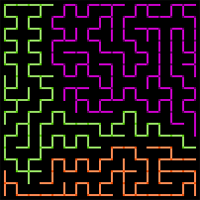
This model builds single-path or multi-path mazes with no cross-overs.
With one walker, the maze is traversable, and any point on the maze can be reached from any other point.
If more than one "walker" is active, then multiple mazes are drawn nestled in each other. Each individual maze is traversable, but the different mazes are not connected.
HOW IT WORKS
A recursive subroutine is used to implement the maze-drawing. Each walker starts at a random location, then wanders the field. With every step, the location is pushed onto the stack. When a dead-end is reached, the walker pops back to the previous turn location, and continues, until no open space remains.
To implement multiple walkers, allow the "curvyness" to be controlled, and reduce stack length for straight runs, the maze procedure has become somewhat complicated, and its basic operation hard to discern. Here is a simplified version to illustrate the basic operation:
to go
ask turtles
[ empty-stack
push
build-maze
die
]
end
to build-maze
ifelse any-open-routes
[ push-location-to-stack
draw-while-moving-to-open-route
build-maze
]
[ if stack-not-empty
[ pop-from-stack
build-maze
]
]
end
HOW TO USE IT
Click "Setup and Build-Maze" to get things started.
Click Setup to see how the maze looks before it starts
drawing
Then click Build-Maze to start the maze drawing
OR, click ...forever varying. This will setup and build the maze defined by the sliders, then randomize things and build a different maze, forever. Fun to watch.
Walkers controls the number of walkers drawing the maze.
Path-width controls the width of the path, in patches.
It's an integer diameter, with a center patch, so it is always
odd.
Gap controls the gap between paths.
Curviness controls the tendency to go in a straight line.
If curvyness is 0, the walker will not turn unless a wall is hit.
If curvyness is 1, the walker will randomly choose a direction from
the 3 directions available.
Random-Orientation controls the initial direction of the walkers. If off, walkers all start out going up.
One-color controls walker coloring. If off, the walkers are assigned random colors from an attractive palette. If on, the selected pen-color is used for all walkers.
Pen-color, Gap-Color are self-explanitory.
THINGS TO NOTICE
How does the number of walkers affect how long it takes to fill
the maze?
Why do you think that is?
How does the number of walkers affect the way the maze looks?
Usually we think of the path drawn by the walkers as the maze path, and the background as the "walls" of the maze. But what happens if the width is narrow, and the gap is wide? What qualities does the maze have if we think of the drawn path as "walls" and the gaps as "corridors"? Is this maze traversable?
THINGS TO TRY
Try different numbers of walkers
Try different path-width and gap sizes
Change screen-edge-x and -y to 50 (or some other largish size),
patch size to 2, walkers 10 or more. While the maze is building,
slide the curviness slider back and forth, to create curvy areas
and straight areas inside the maze.
Try a maze with a gap of 0.
Try a large maze with gap 0, width 1, and many walkers. The maze
looks like the irregular edges of a country or city map.
EXTENDING THE MODEL
Create a subroutine to have a turtle (mouse?) traverse the maze(s). For a single-patch path-width and gap, this is fairly easy, but might be harder for other gaps and widths.
Would a non-recursive routine work better, faster, etc? Would a non-recursive method be easier, or harder to implement?
NETLOGO FEATURES
This model takes advantage of netlogo's support for
recursion.
One challenge of implementing multiple walkers was the tendency of
the walkers to step on each other. Since the model uses recursion,
using "without-interruption" was not an option, as that would make
the first walker complete the maze by itself, on it's first "turn".
Early versions of the model used several tactics, including
ethernet-style collision avoidance (if other turtles near, wait a
while). The problem was that marking the space as taken was among
the last things the walker did, so that another walker could also
mistake the space for available. The solution turned out to be
simple: The moment a walker determines that a space is open, it
marks the space, then does the additional steps required to draw
the path to the space. This seems to have eliminated the problem of
walker collisions.
create a new game for individuals with visual impairments. The game should incorporate as many of...
create a new game for individuals with visual impairments. The game should incorporate as many of the other sensory systems as possible. You will demonstrate the playing of the game (you will have other classmates assist in playing the game), blindfolding the participants to simulate visual impairment. 3-5 games please
Create your own simple Games Fair game. The game must have a non-uniform probability distribution...
Create your own simple Games Fair game. The game must have a non-uniform probability distribution and 4 or more outcomes. Clearly describe the rules of the game and the points associated with each outcome. Create the points based on an expected value that will allow the game to profit.
Create a JavaFX game: Guess the Number create a random # between 1 and 1000 Ask...
Create a JavaFX game: Guess the Number create a random # between 1 and 1000 Ask user for a guess; possible answers TOO LOW TOO HIGH WINNER! print guess to screen if the user wins, write the random number, and all the guesses to a file. If the user doesn't guess in 10 turns, display the number. NOTES: You may want to implement: Restart option Best Guess statistic (game 1 took 8 tries, game 2 took 5 - 5 is...
Create a simple commented C++ HANGMAN game using CLASSES using the following specifications: - The game...
Create a simple commented C++ HANGMAN game using CLASSES using the following specifications: - The game must keep track of the player misses - It must ONLY use 10 three letter words - It does NOT need a graphical implementation
A robot is standing at the origin (0,0) of a square grid. The robot is programmed...
 A robot is standing at the origin (0,0) of a square grid. The robot is programmed to move exactly one unit at a time, in one of three directions: up, down, and right. The robot will never move left. For example, starting at (0,0), the robot will move either • one unit up, to (0,1), one unit down, to (0,-1), or • one unit right, to (1,0). . The robot is programmed to make exactly 5 moves, and then stop....
Create a class named Game using the following UML class diagram. GAME -gameName : string +Game()...
Create a class named Game using the following UML class diagram. GAME -gameName : string +Game() +setGameName(in name : string) : void +getGameName() : string +displayMessage() : void This class has 2 member variables namely playerName and playerScore. The class contain following member functions: Constructor, set function, get functions, display function. Code write in 3 files: Game.h header file, funtion.cpp file and main.cpp file. The output should be: Player John has scored 50 points.
C++ Homework: This will be the first in a series of assignments to create a game...
C++ Homework: This will be the first in a series of assignments to create a game called Zilch. In this assignment, you will create the basic structure of the program and demonstrate the ability to create programs with multiple files. It should serve as a refresher in the basics of C++ programming, especially in the handling of arrays. The initial assignments only establish a rough outline of the game. We will be adding the rules that make the game more...
Write the missing class in order to create the addictively popular game,
Write the missing class in order to create the addictively popular game,
C: In C, create a simple Procedural Oriented Blackjack Game.
C: In C, create a simple Procedural Oriented Blackjack Game.
I have to create a game for my stats class and my card game is that...
I have to create a game for my stats class and my card game is that each play, every player is given 4 cards and their goal is to match the suits. for every pair they win $2, for every 3 its $5, and for all four of the same suit its $10. What are the odds of winning 1 pair, 2 pairs, 3, and all 4? thank you :)
 A robot is standing at the origin (0,0) of a square grid. The robot is programmed to move exactly one unit at a time, in one of three directions: up, down, and right. The robot will never move left. For example, starting at (0,0), the robot will move either • one unit up, to (0,1), one unit down, to (0,-1), or • one unit right, to (1,0). . The robot is programmed to make exactly 5 moves, and then stop....
Most questions answered within 3 hours.
-
Where is the error in this code sequence?
String s1 = "Hello";
String s2 = "ello";...
asked 10 months ago -
Financial data for Joel de Paris, Inc., for last year
follow:
Joel de Paris, Inc.
Balance...
asked 10 months ago -
Consider this reaction:
Al2(SO4)3 (aq)+ BaCl3
(aq) Al2Cl6 (aq)- +
3BaSO4(s) . What is the...
asked 10 months ago -
Suppose that Savneet is considering increasing her
recent random sample from 20 car rentals to 40...
asked 10 months ago -
Trucks arrive at an unloading terminal at an average rate of 120
per hour.
Trucks arrive...
asked 10 months ago -
Why are methanol and ethanol completely soluble in water while
octanol is not very little soluble....
asked 10 months ago -
A facilities manager at a university reads in a research report
that the mean amount of...
asked 10 months ago -
When the CuSO4 is rehydrated by adding water to the anhydrous
compound, is this an endothermic...
asked 10 months ago -
A ray of sunlight is passing from diamond into crown glass; the
angle of incidence is...
asked 10 months ago -
A block of mass 0.249 kg is placed on top of a light, vertical
spring of...
asked 10 months ago -
how do the kidneys compensate in the presences of acidosis
a) trigger hyperventilate
b) reserve acid...
asked 10 months ago -
Question 501 pts
The rental rate of capital to the firm increases. Which of the
following...
asked 10 months ago