The dimerization of butadiene, , to form 1,5-cyclooctadiene is a second-order process that occurs when the...
The dimerization of butadiene, , to form 1,5-cyclooctadiene is a second-order process that occurs when the diene is heated. In an experiment, a sample of 0.0083 mol of was heated in a 1.0-L flask. After 660. seconds, 15% of the butadiene had dimerized. Calculate the rate constant for this reaction. Rate constant =
Homework Answers
we have:
[A]o = 0.0083 M
15% has dimerized. So, remaining is 85 %
[A] = 85 % of 0.0083 M = 0.007055 M
t = 660.0 s
use integrated rate law for 2nd order reaction
1/[A] = 1/[A]o + k*t
1/(0.007055) = 1/(0.0083) + k* 660.0
1.417*10^2 = 1.205*10^2 +k*6.6*10^2
k*6.6*10^2 = 21.26
k = 3.221*10^-2 M-1.s-1
Answer: 3.22*10^-2 M-1.s-1
Add Answer to:
The dimerization of butadiene, , to form 1,5-cyclooctadiene is a
second-order process that occurs when the...
7. The gas-phase conversion of 1,3-butadiene to 1,5-cyclooctadiene, 2C4H6 → C3H12 was studied, providing data for...
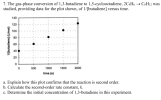 7. The gas-phase conversion of 1,3-butadiene to 1,5-cyclooctadiene, 2C4H6 → C3H12 was studied, providing data for the plot shown, of 1/[butadiene] versus time. 1/[butadiene] (L/mol) 0 500 1000 time (s) 1500 2000 a. Explain how this plot confirms that the reaction is second order. b. Calculate the second-order rate constant, k. c. Determine the initial concentration of 1,3-butadiene in this experiment.
The decomposition of 1,3-butadiene represents a second order process. 2 1,3-butadiene - (2,2)-15-Cyclooctadiene Answer the following...
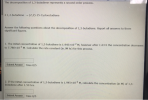 The decomposition of 1,3-butadiene represents a second order process. 2 1,3-butadiene - (2,2)-15-Cyclooctadiene Answer the following questions about the decomposition of 1,3-butadiene. Report all answers to three significant figures. 1. The initial concentration of 1,3-butadiene is 1.945x10⁻² M, however after 1.63 h the concentration decreases to 7.780x10- M. Calculate the rate constant (in /M hr) for this process. Submit Answer Tries 0/5 2. If the initial concentration of 1,3-butadiene is 1.945x10M, calculate the concentration (in M) of 1,3- butadiene after...
Butadiene (C4H6)reacts with itself to form a dimer with the formula C8H12. The reaction is second...
Butadiene (C4H6)reacts with itself to form a dimer with the formula C8H12. The reaction is second order in C4H6. Assume the rate constant at a particular temperature is 4.0×10⁻²M−1s−1 and the initial concentration of C4H6 is 0.0230 MM. What is its molarity after a reaction time of 1.30 hh? What is the time (in hours) when the C4H6 concentration reaches a value of 0.0023 M?
1a. At 573 K, gaseous NO2 decomposes, forming NO(g) and O2. If a vessel containing NO2(g)...
1a. At 573 K, gaseous NO2 decomposes, forming NO(g) and O2. If a vessel containing NO2(g) has an initial concentration of 0.056 mol/L, how long will it take for 75% of the NO2(g) to decompose? The decomposition of NO2(g) is second-order in the reactant, and the rate constant for this reaction, at 573 K, is 1.1 L/mol · s. = ___ s 1b. The decomposition of ammonia on a metal surface to form N2 and H2 is a zero-order reaction....
The initial concentration of N O 2 in the second-order reaction 2N O 2 →2NO+ O...
The initial concentration of N O 2 in the second-order reaction 2N O 2 →2NO+ O 2 is 0.621 mol/L . After 20 seconds, the concentration of N O 2 is 0.583 mol/L . W hat is the rate constant for the reaction?
Dinitrogen tetroxide decomposes to form nitrogen dioxide in a second-order reaction: N2O4(g) → 2NO2(g) At 400.0...
Dinitrogen tetroxide decomposes to form nitrogen dioxide in a second-order reaction: N2O4(g) → 2NO2(g) At 400.0 K, the rate constant for this reaction has been measured to be 2.9 × 10⁸ L/(mol • s). Suppose 0.222 mol of N2O4(g) is placed in a sealed 41.7-L container at 400.0 K and allowed to react. What is the total pressure inside the vessel after 32.9 ns has elapsed? (R = 0.0821 (L • atm)/(K • mol)) a. 0.183 atm b. 0.175 atm...
1. A second-order reaction of the type A + A → P was carried out...
1. A second-order reaction of the type A + A → P was carried out in a solution with the initial concentration [A]0 = 0.58 mol L-1. After 20.5 s the concentration of A had fallen to [A]t = 0.12 mol L-1. What is the rate constant k for this reaction in units of liter per mol per second (L mol-1 s-1) ? 2. A compound with vaporization enthalpy of ΔHvap = 68.0 kJ for every 2 molesof liquid...
At 36°C, the decomposition of hydrogen iodide into hydrogen and iodine is a second-order reaction. The...
 At 36°C, the decomposition of hydrogen iodide into hydrogen and iodine is a second-order reaction. The rate constant for the reaction at 36°C is 0.080 L*mol-1*5-1. How long does it take an initial concentration of 0.120 mol/L to reduce to one-fifth the initial concentration? Enter your answer as a time in seconds with one decimal place. A: 177.1 B: 235.6 C: 313.3 D: 416.7 E: 554.2 F: 737.0 G: 980.3 H: 1303.8 Submit Answer Tries 0/3
PLEASE HELP WITH ENTIRE... 2: Consider the dimerization of C4H6: 2 C4H6 --> C8H12 for which...
PLEASE HELP WITH ENTIRE... 2: Consider the dimerization of C4H6: 2 C4H6 --> C8H12 for which the following data re collected: time (sec) [C4H6] (M) 0 1.00x10⁻² 1600 5.04x10⁻³ 3200 3.37x10⁻³ 4800 2.53x10⁻³ 6200 2.08x10⁻³ A: Using empirical kinetics methods, determine the order of the reaction rate law. a 2nd order b 1st order c 0th order d The order can not be determined from this data. B: Based on the data above, calculate the concentration of C4H6 at 7,885...
A gas decomposes to form O2 and two other products, in a first-order reaction, with rate...
A gas decomposes to form O2 and two other products, in a first-order reaction, with rate constant k = 6.95 x 10 –4/s at 40oC. If the initial gas concentration = 4.80 x 10 –2 mol/L, what is the concentration (M) after 250 seconds have passed?
 7. The gas-phase conversion of 1,3-butadiene to 1,5-cyclooctadiene, 2C4H6 → C3H12 was studied, providing data for the plot shown, of 1/[butadiene] versus time. 1/[butadiene] (L/mol) 0 500 1000 time (s) 1500 2000 a. Explain how this plot confirms that the reaction is second order. b. Calculate the second-order rate constant, k. c. Determine the initial concentration of 1,3-butadiene in this experiment.
 The decomposition of 1,3-butadiene represents a second order process. 2 1,3-butadiene - (2,2)-15-Cyclooctadiene Answer the following questions about the decomposition of 1,3-butadiene. Report all answers to three significant figures. 1. The initial concentration of 1,3-butadiene is 1.945x10⁻² M, however after 1.63 h the concentration decreases to 7.780x10- M. Calculate the rate constant (in /M hr) for this process. Submit Answer Tries 0/5 2. If the initial concentration of 1,3-butadiene is 1.945x10M, calculate the concentration (in M) of 1,3- butadiene after...
 At 36°C, the decomposition of hydrogen iodide into hydrogen and iodine is a second-order reaction. The rate constant for the reaction at 36°C is 0.080 L*mol-1*5-1. How long does it take an initial concentration of 0.120 mol/L to reduce to one-fifth the initial concentration? Enter your answer as a time in seconds with one decimal place. A: 177.1 B: 235.6 C: 313.3 D: 416.7 E: 554.2 F: 737.0 G: 980.3 H: 1303.8 Submit Answer Tries 0/3
Most questions answered within 3 hours.
-
Where is the error in this code sequence?
String s1 = "Hello";
String s2 = "ello";...
asked 10 months ago -
Financial data for Joel de Paris, Inc., for last year
follow:
Joel de Paris, Inc.
Balance...
asked 10 months ago -
Consider this reaction:
Al2(SO4)3 (aq)+ BaCl3
(aq) Al2Cl6 (aq)- +
3BaSO4(s) . What is the...
asked 10 months ago -
Suppose that Savneet is considering increasing her
recent random sample from 20 car rentals to 40...
asked 10 months ago -
Trucks arrive at an unloading terminal at an average rate of 120
per hour.
Trucks arrive...
asked 10 months ago -
Why are methanol and ethanol completely soluble in water while
octanol is not very little soluble....
asked 10 months ago -
A facilities manager at a university reads in a research report
that the mean amount of...
asked 10 months ago -
When the CuSO4 is rehydrated by adding water to the anhydrous
compound, is this an endothermic...
asked 10 months ago -
A ray of sunlight is passing from diamond into crown glass; the
angle of incidence is...
asked 10 months ago -
A block of mass 0.249 kg is placed on top of a light, vertical
spring of...
asked 10 months ago -
how do the kidneys compensate in the presences of acidosis
a) trigger hyperventilate
b) reserve acid...
asked 10 months ago -
Question 501 pts
The rental rate of capital to the firm increases. Which of the
following...
asked 10 months ago