PLEASE HELP WITH ENTIRE... 2: Consider the dimerization of C4H6: 2 C4H6 --> C8H12 for which...
PLEASE HELP WITH ENTIRE...
2:
Consider the dimerization of C4H6:
2 C4H6 --> C8H12
for which the following data re collected:
| time (sec) | [C4H6] (M) |
| 0 | 1.00x10⁻² |
| 1600 | 5.04x10⁻³ |
| 3200 | 3.37x10⁻³ |
| 4800 | 2.53x10⁻³ |
| 6200 | 2.08x10⁻³ |
A:
Using empirical kinetics methods, determine the order of the reaction rate law.
| a |
2nd order |
|
| b |
1st order |
|
| c |
0th order |
|
| d |
The order can not be determined from this data. |
B:
Based on the data above, calculate the concentration of
C4H6 at 7,885 seconds.
concentration of C4H6 = ___ x 10-3 M
3:
Consider the following data for the catalytic decomposition of NH3:
| NH3 (M) | rate (M/hour) |
| 1.0 x 10⁻³ | 1.5 x 10⁻⁶ |
| 2.0 x 10⁻³ | 1.5 x 10⁻⁶ |
| 3.0 x 10⁻³ | 1.5 x 10⁻⁶ |
This reaction is ___ in NH3.
| a. |
2nd |
b. |
1st |
c. |
0th |
d. |
can not be determined |
4:
-
Consider the following initial rate data for the reaction
A + B --> C
run [A]0 [B]0 rate (M/s) 1 0.450 0.100 0.0602 2 0.225 0.100 0.0301 3 0.225 0.275 0.2344 The rate law suggested by this data is ___ .
a rate = [A][B]
b rate = [A][B]2
c rate = [A]2[B]
d rate = [A]2[B]2
5:
Consider the following concentration data taken every 10 seconds for a particular reaction which will be used for this and the next three problems):
A --> products
| time (sec) | [A] (M) | time (sec) | [A] (M) |
| 0 | 1.000 | 100 | 0.610 |
| 10 | 0.940 | 110 | 0.587 |
| 20 | 0.887 | 120 | 0.566 |
| 30 | 0.839 | 130 | 0.546 |
| 40 | 0.796 | 140 | 0.527 |
| 50 | 0.758 | 150 | 0.510 |
| 60 | 0.723 | 160 | 0.494 |
| 70 | 0.691 | 170 | 0.479 |
| 80 | 0.661 | 180 | 0.465 |
| 90 | 0.635 | 190 | 0.451 |
| 100 | 0.610 | 200 | 0.439 |
A:
What is the half-life of the reaction when the concentration of [A] is 1.000 M?
| a |
About 105 seconds |
|
| b |
About 45 seconds |
|
| c |
About 175 seconds |
|
| d |
About 155 seconds |
B:
Based on the data above, the half-life ____ as the initial concentration decreased, implying that the reaction is ___ order with respect to A.
| a |
decreased, 0th |
|
| b |
remained constant, 1st |
|
| c |
The question cannot be answered using the given data. |
|
| d |
increased, 2nd |
C:
Based on the data above, the rate constant for this reaction has a value of ___.
| a. |
0.004 sec-1 |
|
| b |
0.0064 M-1 sec-1 |
|
| c |
The question cannot be answered using the data provided. |
|
| d |
0.0027 M sec-1 |
6:
Consider the reaction:
CO(g) + NO2(g) ⟶ CO2(g) + NO(g)
for which the rate law for the reaction is
rate = k[NO2][CO]
How with the rate be affected if the total pressure is increased from 0.450 atm to 0.900 atm?
7:
The half-life for the first order decay of 32P by beta particle emission is 14.29 days. How many days will it take for 90% of the 32P to decay in a sample?
8:
For a given reaction, the rate constant doubles with the temperature increases from 22.5 oC to 38.7 oC. What is the activation energy (Ea) for the reaction?
Ea = ___ kJ/mol
9:
Consider this data for this and the following problem:
For the gas-phase dissociation reaction A --> B + C, The following data is collected at 298 K:
| time (sec) | total pressure (atm) |
| 0 | 1.000 |
| 1000 | 1.359 |
| 3000 | 1.627 |
| 5000 | 1.737 |
| 9000 | 1.834 |
PART A:
- Determine the partial pressure of A at each time.
- Make a graph of ln(PA) and 1/PA vs time in order to determine the order of the reaction and the rate constant.
The rate law for this reaction is given by...
PART B:
Based on the data above, calculate the total pressure at 8,263 seconds.
10:
At 473 K, for the reversible elementary reaction
2 NOCL-->K1 2 NO + CL2
<--K-1
k1=7.8×10⁻² M-1 s-1 and k−1=4.7×10² M-2 s-1. A sample of NOCl is placed in a container and heated to 473 K. When the system comes to equilibrium, [NOCl] is found to be 0.11 mol/L .What is the equilibrium concentration of [NO]?
Hint: Equilibrium is achieved when the forward reaction rate is equal to the reverse reaction rate.
[NO] = ___ M
Homework Answers


Add Answer to:
PLEASE HELP WITH ENTIRE...
2:
Consider the dimerization of C4H6:
2 C4H6 -->
C8H12
for which...
1: Consider the following set of data ccollected for a reaction of the form A -->...
1: Consider the following set of data ccollected for a reaction of the form A --> products. time (seconds) [A] (M) 0 1.000 10 0.641 20 0.472 30 0.373 40 0.309 50 0.263 A: What is the average rate of the reaction for the first 10 seconds? rate = ___ M/s B: What is the average rate of the reaction between 30 and 40 seconds? rate = ___ M/s 2: Consider the dimerization of C4H6: 2 C4H6 --> C8H12 for...
Butadiene (C4H6) reacts with itself to form a dimer with the formula C8H12. The reaction is...
Butadiene (C4H6) reacts with itself to form a dimer with the formula C8H12. The reaction is second order in C4H6. Assume the rate constant at a particular temperature is 4.0×10⁻²M−1s−1 and the initial concentration of C4H6 is 0.0250 M. A)What is its molarity after a reaction time of 1.10 h? B)What is the time (in hours) when the C4H6 concentration reaches a value of 0.0025 M?
Butadiene (C4H6) reacts with itself to form a dimer with the formula (C8H12). The reaction is...
Butadiene (C4H6) reacts with itself to form a dimer with the formula (C8H12). The reaction is second order in C4H6. If the rate constant at a particular temperature is 4.0×10⁻²M−1s−1. PART A) hat is the half-life (in minutes) of this reaction when the initial C4H6 concentration is 1.50×10⁻² M ? Express your answer using two significant figures. PART B) How many minutes does it take for the concentration of C4H6 to drop from 1.20×10⁻² M to 6.00×10⁻³ M ?
Butadiene (C4H6)reacts with itself to form a dimer with the formula C8H12. The reaction is second...
Butadiene (C4H6)reacts with itself to form a dimer with the formula C8H12. The reaction is second order in C4H6. Assume the rate constant at a particular temperature is 4.0×10⁻²M−1s−1 and the initial concentration of C4H6 is 0.0230 MM. What is its molarity after a reaction time of 1.30 hh? What is the time (in hours) when the C4H6 concentration reaches a value of 0.0023 M?
Butadiene reacts to form its dimer according to the equation 2 C 4H6(g) --> C8H12(g) The...
Butadiene reacts to form its dimer according to the equation 2 C 4H6(g) --> C8H12(g) The following data were collected for this reaction at a given temperature: [C4H6] Time ( 1 s) 0.01000 0 0.00625 1000 0.00476 1800 0.00370 2800 0.00313 3600 0.00270 4400 0.00241 5200 0.00208 6200 (a) Determine is the order of this reaction? Write the rate law expression. Justify your answer. Sketch a graph as part of your explanation. (b) Determine the value of the rate...
with steps please A study of the rate of dimerization of C4H6 gave the data shown...
 with steps please
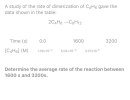
A study of the rate of dimerization of C4H6 gave the data shown in the table: 2C4H6 –C3H12 3200 Time (s) [C4H6] (M) 0.0 1.00x10⁻² 1600 5.04x10⁻³ 3.37x10⁻³ Determine the average rate of the reaction between 1600 s and 3200s.
with steps please
A study of the rate of dimerization of C4H6 gave the data shown in the table: 2C4H6 –C3H12 3200 Time (s) [C4H6] (M) 0.0 1.00x10⁻² 1600 5.04x10⁻³ 3.37x10⁻³ Determine the average rate of the reaction between 1600 s and 3200s.
I need help with both questions!!!! 3. Consider the second order reaction A → products. The...
 I
need help with both questions!!!!
3. Consider the second order reaction A → products. The rate constant for the reaction at 25 deg C is 0.350 M's? If the initial concentration of A is 0.800 M, what is the concentration after 4 seconds? a) .165 M b) .197 M c) .377 M d) .400 M e) .454 M 4. A student records the concentration of 12 as a function of time and prepares the graphs shown below. What can...
I
need help with both questions!!!!
3. Consider the second order reaction A → products. The rate constant for the reaction at 25 deg C is 0.350 M's? If the initial concentration of A is 0.800 M, what is the concentration after 4 seconds? a) .165 M b) .197 M c) .377 M d) .400 M e) .454 M 4. A student records the concentration of 12 as a function of time and prepares the graphs shown below. What can...
please help Answer the questions in the blue book in order. You must show all working for full credit. R- 0.08206...
 please help
Answer the questions in the blue book in order. You must show all working for full credit. R- 0.08206 Latm/mol.K 1. Initial rate data at 25.0 °C for the reaction: NH4+ (aq) + NO2 (aq) ----> N2(g) + H20 (1) are shown below: Expt. [NH4+lo [NO2 lo Initial rate/Ms 0.24 0.12 0.12 0.10 0.10 0.15 7.2 x 10⁻⁶ 3.6 x 10⁻⁶ iii) 5.4 x 10⁻⁶ Determine the rate law from the data and calculate the rate constant k...
please help
Answer the questions in the blue book in order. You must show all working for full credit. R- 0.08206 Latm/mol.K 1. Initial rate data at 25.0 °C for the reaction: NH4+ (aq) + NO2 (aq) ----> N2(g) + H20 (1) are shown below: Expt. [NH4+lo [NO2 lo Initial rate/Ms 0.24 0.12 0.12 0.10 0.10 0.15 7.2 x 10⁻⁶ 3.6 x 10⁻⁶ iii) 5.4 x 10⁻⁶ Determine the rate law from the data and calculate the rate constant k...
Integrated Rate Laws 1. The rate law expression for the reaction of sucrose in water C12H22O11 ...
Integrated Rate Laws 1. The rate law expression for the reaction of sucrose in water C12H22O11 + H2O ---> 2 C6H12O6 Is rate = k[C12H22O11]. a. What is the order with respect to each reactant? b. What is the overall order of the reaction? c. After 2.57 hours, 6.00g/L of C12H22O11 has decreased to 5.40g/L. Express these concentrations in units of M. d. What is the value and units for k given the information in part c? e. Knowing the...
4. A study of the rate of dimerization of C4H6 gave the data shown in the...
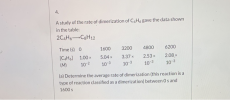 4. A study of the rate of dimerization of C4H6 gave the data shown in the table: 2C4H6-C8H12 3200 6200 Time (s) 0 [C.Hol 1.00 (M) 1600 5.04 4800 2.53 3.37 x 2.08. 10-2 10-3 10-3 10-3 10-3 (a) Determine the average rate of dimerization (this reaction is a type of reaction classified as a dimerization) between 0s and 1600 s
 with steps please
A study of the rate of dimerization of C4H6 gave the data shown in the table: 2C4H6 –C3H12 3200 Time (s) [C4H6] (M) 0.0 1.00x10⁻² 1600 5.04x10⁻³ 3.37x10⁻³ Determine the average rate of the reaction between 1600 s and 3200s.
with steps please
A study of the rate of dimerization of C4H6 gave the data shown in the table: 2C4H6 –C3H12 3200 Time (s) [C4H6] (M) 0.0 1.00x10⁻² 1600 5.04x10⁻³ 3.37x10⁻³ Determine the average rate of the reaction between 1600 s and 3200s.
 I
need help with both questions!!!!
3. Consider the second order reaction A → products. The rate constant for the reaction at 25 deg C is 0.350 M's? If the initial concentration of A is 0.800 M, what is the concentration after 4 seconds? a) .165 M b) .197 M c) .377 M d) .400 M e) .454 M 4. A student records the concentration of 12 as a function of time and prepares the graphs shown below. What can...
I
need help with both questions!!!!
3. Consider the second order reaction A → products. The rate constant for the reaction at 25 deg C is 0.350 M's? If the initial concentration of A is 0.800 M, what is the concentration after 4 seconds? a) .165 M b) .197 M c) .377 M d) .400 M e) .454 M 4. A student records the concentration of 12 as a function of time and prepares the graphs shown below. What can...
 please help
Answer the questions in the blue book in order. You must show all working for full credit. R- 0.08206 Latm/mol.K 1. Initial rate data at 25.0 °C for the reaction: NH4+ (aq) + NO2 (aq) ----> N2(g) + H20 (1) are shown below: Expt. [NH4+lo [NO2 lo Initial rate/Ms 0.24 0.12 0.12 0.10 0.10 0.15 7.2 x 10⁻⁶ 3.6 x 10⁻⁶ iii) 5.4 x 10⁻⁶ Determine the rate law from the data and calculate the rate constant k...
please help
Answer the questions in the blue book in order. You must show all working for full credit. R- 0.08206 Latm/mol.K 1. Initial rate data at 25.0 °C for the reaction: NH4+ (aq) + NO2 (aq) ----> N2(g) + H20 (1) are shown below: Expt. [NH4+lo [NO2 lo Initial rate/Ms 0.24 0.12 0.12 0.10 0.10 0.15 7.2 x 10⁻⁶ 3.6 x 10⁻⁶ iii) 5.4 x 10⁻⁶ Determine the rate law from the data and calculate the rate constant k...
 4. A study of the rate of dimerization of C4H6 gave the data shown in the table: 2C4H6-C8H12 3200 6200 Time (s) 0 [C.Hol 1.00 (M) 1600 5.04 4800 2.53 3.37 x 2.08. 10-2 10-3 10-3 10-3 10-3 (a) Determine the average rate of dimerization (this reaction is a type of reaction classified as a dimerization) between 0s and 1600 s
Most questions answered within 3 hours.
-
Where is the error in this code sequence?
String s1 = "Hello";
String s2 = "ello";...
asked 11 months ago -
Financial data for Joel de Paris, Inc., for last year
follow:
Joel de Paris, Inc.
Balance...
asked 11 months ago -
Consider this reaction:
Al2(SO4)3 (aq)+ BaCl3
(aq) Al2Cl6 (aq)- +
3BaSO4(s) . What is the...
asked 11 months ago -
Suppose that Savneet is considering increasing her
recent random sample from 20 car rentals to 40...
asked 11 months ago -
Trucks arrive at an unloading terminal at an average rate of 120
per hour.
Trucks arrive...
asked 11 months ago -
Why are methanol and ethanol completely soluble in water while
octanol is not very little soluble....
asked 11 months ago -
A facilities manager at a university reads in a research report
that the mean amount of...
asked 11 months ago -
When the CuSO4 is rehydrated by adding water to the anhydrous
compound, is this an endothermic...
asked 11 months ago -
A ray of sunlight is passing from diamond into crown glass; the
angle of incidence is...
asked 11 months ago -
A block of mass 0.249 kg is placed on top of a light, vertical
spring of...
asked 11 months ago -
how do the kidneys compensate in the presences of acidosis
a) trigger hyperventilate
b) reserve acid...
asked 11 months ago -
Question 501 pts
The rental rate of capital to the firm increases. Which of the
following...
asked 11 months ago