6-12 Use Coulomb's method to determine the magnitude and direction of the total lateral force against...
6-12 Use Coulomb's method to determine the magnitude and direction of the total lateral force against the retaining wall of problem 6-5. Assume the friction angle between the wall and the soil to be 2/3*phi. Make one trial only, using an assumed failure surface at an angle of 60 degrees from horizontal.
Problem 6-5 is: Use Rankine's method to determine the magnitude and location of the resultant active force against a retaining wall 6 m high. There is a water table 2.5 m below the top of the wall and the backfill supports a uniform surcharge of 30 kN/m2. The backfill material is sand with a friction angle, phi, of 35°, a unit weight above the water table of 18.7 kN/m3, and a saturated unit weight of 21.2 kN/m3
Homework Answers


Add Answer to:
6-12 Use Coulomb's method to determine the magnitude and
direction of the total lateral force against...
please answer 2 and 3 i would really appreciate it :) 2. The 4 m tall...
 please answer 2 and 3
i would really appreciate it :)
2. The 4 m tall concrete retaining shown in Figure 2 has the following properties: Backfill (Coarse sand): Ym = moist unit weight = 19.2 kN/m d' = effective friction angle = 40° The groundwater table will remain far below the wall, and the wall friction angle is 20°. Assume the backfill is not sloped and the wall has no batter. The wall moves sufficiently to develop the active...
please answer 2 and 3
i would really appreciate it :)
2. The 4 m tall concrete retaining shown in Figure 2 has the following properties: Backfill (Coarse sand): Ym = moist unit weight = 19.2 kN/m d' = effective friction angle = 40° The groundwater table will remain far below the wall, and the wall friction angle is 20°. Assume the backfill is not sloped and the wall has no batter. The wall moves sufficiently to develop the active...
its problem 17.6 on foundation engineering ninth edition by Braja M.Das 17.6 ung Coulomb's earth pressures....
 its problem 17.6 on foundation engineering ninth edition by
Braja M.Das
17.6 ung Coulomb's earth pressures. It is required to design a cantilever retaining wall to retain a 5.0 m high sandy backfill. The consultant suggests the dimensions and soil properties shown in Figure P17.6 and requires that the wall be checked for stability with respect to sliding and overturning based on the active earth pressures determined using 0.5 mm 110° EDT Sand y = 18.5 kN/m3 6' = 36°...
its problem 17.6 on foundation engineering ninth edition by
Braja M.Das
17.6 ung Coulomb's earth pressures. It is required to design a cantilever retaining wall to retain a 5.0 m high sandy backfill. The consultant suggests the dimensions and soil properties shown in Figure P17.6 and requires that the wall be checked for stability with respect to sliding and overturning based on the active earth pressures determined using 0.5 mm 110° EDT Sand y = 18.5 kN/m3 6' = 36°...
A 4m high, vertical retaining wall supports Silty SAND backfill with a horizontal surface. There is...
A 4m high, vertical retaining wall supports Silty SAND backfill with a horizontal surface. There is a hydrostatic horizontal water table at 1 m below the ground surface. The soil has bulk unit weight = 20 kN/m3, effective cohesion=5 kPa, and friction angle= 30o. What is the value of the water force on the wall? At what distance above the base of the wall does it act?
A smooth vertical retaining wall, 3m high, pushes against a granular backfill whose angle of internal...
A smooth vertical retaining wall, 3m high, pushes against a granular backfill whose angle of internal friction is 30o. The backfill is sloped at 10 o. Assume the unit weight of the backfill is 17.6 kN/m3, determine the passive resistance Pp using the trial wedge method. Compare the results using Rankine’s method and comment on any differences.
1 Calculate the factor of safety against overturning and sliding for the concrete retaining wall ...
 1 Calculate the factor of safety against overturning and sliding for the concrete retaining wall shown in the figure below, without taking into consideration the passive earth pressure. (50 Points) Assume that 115 lbs/cf unit weight of soil: unit weight of concrete: 150 lbs/cf angle of internal friction: 30 coefficient of friction: 0.350 0° B: 14 5' 2" Ha 14 2.5 Compaction (Soils engineering uses the symbol ys for dry density and uses the term dry unit weight. In the...
Problem 5 You are to examine the retaining wall shown on Figure 2. Assume that the wall height (H...
 Problem 5 You are to examine the retaining wall shown on Figure 2. Assume that the wall height (H) is equal to 12 feet, and the base width (B) is 7 feet. The wall will be approximately 200 feet long (into the page). The backfill material behind the wall is a poorly-graded sand with silt (ŚP-SM) that has an average total unit weight of 1 19 pounds per cubic foot (pcf) and an average water content of 12%. As indicated,...
15 t/m' (6) Use Culmann's graphical method to find the magnitude of the total earth pressure...
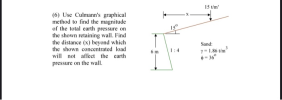 15 t/m' (6) Use Culmann's graphical method to find the magnitude of the total earth pressure on the shown retaining wall. Find the distance (x) beyond which the shown concentrated load will not affect the earth pressure on the wall. Sand: 6 m 1:4 y 1.86 um?
a) What is the factor of safety against overturning? b) What is the distance from A...
 a) What is the factor of safety against
overturning?
b) What is the distance from A the normal for N acts? Is
100% of the base in contact with the soil based on this
information?
c) If the foundation soil is sand and the interface
friction angle is 37 degrees, what is the factor of safety against
sliding
d) What is the factor of safety against bearing capacity
failure (use Meyerhoffs Method) if the ultimate capacity of the
foundation soil...
a) What is the factor of safety against
overturning?
b) What is the distance from A the normal for N acts? Is
100% of the base in contact with the soil based on this
information?
c) If the foundation soil is sand and the interface
friction angle is 37 degrees, what is the factor of safety against
sliding
d) What is the factor of safety against bearing capacity
failure (use Meyerhoffs Method) if the ultimate capacity of the
foundation soil...
help please A square footing is founded at 3-ft depth below ground surface as shown in...
 help please
A square footing is founded at 3-ft depth below ground surface as shown in Fig1, The factored axial load acting on the square footing is 140 kips, Determine the size of the footing (B x B) if the Factor of Safety (F.S.) is 3.0. Ground surface ЗА B-? Silty Sand Fig.1 A 68-ft long pre-stressed concrete pile with square cross section (14 inch) is driven into the soil profile shown in Fig. 2. Compute the ultimate compressive load...
help please
A square footing is founded at 3-ft depth below ground surface as shown in Fig1, The factored axial load acting on the square footing is 140 kips, Determine the size of the footing (B x B) if the Factor of Safety (F.S.) is 3.0. Ground surface ЗА B-? Silty Sand Fig.1 A 68-ft long pre-stressed concrete pile with square cross section (14 inch) is driven into the soil profile shown in Fig. 2. Compute the ultimate compressive load...
Question 2 (a) A 4 m high masonry retaining wall of width 1.8 is built to...
 Question 2 (a) A 4 m high masonry retaining wall of width 1.8 is built to retain a 2-layered soil profile shown in Figure 2 on Bonham Road on Hong Kong Island with a surface sucharge of 20 kPa. The soil parameters are given in the figure. During raining season, ground water rises to interface between Soil 1 and Soil 2. Assume that there is no friction between the vertical wall and the soils. The sliding friction angle between the...
 please answer 2 and 3
i would really appreciate it :)
2. The 4 m tall concrete retaining shown in Figure 2 has the following properties: Backfill (Coarse sand): Ym = moist unit weight = 19.2 kN/m d' = effective friction angle = 40° The groundwater table will remain far below the wall, and the wall friction angle is 20°. Assume the backfill is not sloped and the wall has no batter. The wall moves sufficiently to develop the active...
please answer 2 and 3
i would really appreciate it :)
2. The 4 m tall concrete retaining shown in Figure 2 has the following properties: Backfill (Coarse sand): Ym = moist unit weight = 19.2 kN/m d' = effective friction angle = 40° The groundwater table will remain far below the wall, and the wall friction angle is 20°. Assume the backfill is not sloped and the wall has no batter. The wall moves sufficiently to develop the active...
 its problem 17.6 on foundation engineering ninth edition by
Braja M.Das
17.6 ung Coulomb's earth pressures. It is required to design a cantilever retaining wall to retain a 5.0 m high sandy backfill. The consultant suggests the dimensions and soil properties shown in Figure P17.6 and requires that the wall be checked for stability with respect to sliding and overturning based on the active earth pressures determined using 0.5 mm 110° EDT Sand y = 18.5 kN/m3 6' = 36°...
its problem 17.6 on foundation engineering ninth edition by
Braja M.Das
17.6 ung Coulomb's earth pressures. It is required to design a cantilever retaining wall to retain a 5.0 m high sandy backfill. The consultant suggests the dimensions and soil properties shown in Figure P17.6 and requires that the wall be checked for stability with respect to sliding and overturning based on the active earth pressures determined using 0.5 mm 110° EDT Sand y = 18.5 kN/m3 6' = 36°...
 1 Calculate the factor of safety against overturning and sliding for the concrete retaining wall shown in the figure below, without taking into consideration the passive earth pressure. (50 Points) Assume that 115 lbs/cf unit weight of soil: unit weight of concrete: 150 lbs/cf angle of internal friction: 30 coefficient of friction: 0.350 0° B: 14 5' 2" Ha 14 2.5 Compaction (Soils engineering uses the symbol ys for dry density and uses the term dry unit weight. In the...
 Problem 5 You are to examine the retaining wall shown on Figure 2. Assume that the wall height (H) is equal to 12 feet, and the base width (B) is 7 feet. The wall will be approximately 200 feet long (into the page). The backfill material behind the wall is a poorly-graded sand with silt (ŚP-SM) that has an average total unit weight of 1 19 pounds per cubic foot (pcf) and an average water content of 12%. As indicated,...
 15 t/m' (6) Use Culmann's graphical method to find the magnitude of the total earth pressure on the shown retaining wall. Find the distance (x) beyond which the shown concentrated load will not affect the earth pressure on the wall. Sand: 6 m 1:4 y 1.86 um?
 a) What is the factor of safety against
overturning?
b) What is the distance from A the normal for N acts? Is
100% of the base in contact with the soil based on this
information?
c) If the foundation soil is sand and the interface
friction angle is 37 degrees, what is the factor of safety against
sliding
d) What is the factor of safety against bearing capacity
failure (use Meyerhoffs Method) if the ultimate capacity of the
foundation soil...
a) What is the factor of safety against
overturning?
b) What is the distance from A the normal for N acts? Is
100% of the base in contact with the soil based on this
information?
c) If the foundation soil is sand and the interface
friction angle is 37 degrees, what is the factor of safety against
sliding
d) What is the factor of safety against bearing capacity
failure (use Meyerhoffs Method) if the ultimate capacity of the
foundation soil...
 help please
A square footing is founded at 3-ft depth below ground surface as shown in Fig1, The factored axial load acting on the square footing is 140 kips, Determine the size of the footing (B x B) if the Factor of Safety (F.S.) is 3.0. Ground surface ЗА B-? Silty Sand Fig.1 A 68-ft long pre-stressed concrete pile with square cross section (14 inch) is driven into the soil profile shown in Fig. 2. Compute the ultimate compressive load...
help please
A square footing is founded at 3-ft depth below ground surface as shown in Fig1, The factored axial load acting on the square footing is 140 kips, Determine the size of the footing (B x B) if the Factor of Safety (F.S.) is 3.0. Ground surface ЗА B-? Silty Sand Fig.1 A 68-ft long pre-stressed concrete pile with square cross section (14 inch) is driven into the soil profile shown in Fig. 2. Compute the ultimate compressive load...
 Question 2 (a) A 4 m high masonry retaining wall of width 1.8 is built to retain a 2-layered soil profile shown in Figure 2 on Bonham Road on Hong Kong Island with a surface sucharge of 20 kPa. The soil parameters are given in the figure. During raining season, ground water rises to interface between Soil 1 and Soil 2. Assume that there is no friction between the vertical wall and the soils. The sliding friction angle between the...
Most questions answered within 3 hours.
-
Where is the error in this code sequence?
String s1 = "Hello";
String s2 = "ello";...
asked 10 months ago -
Financial data for Joel de Paris, Inc., for last year
follow:
Joel de Paris, Inc.
Balance...
asked 10 months ago -
Consider this reaction:
Al2(SO4)3 (aq)+ BaCl3
(aq) Al2Cl6 (aq)- +
3BaSO4(s) . What is the...
asked 10 months ago -
Suppose that Savneet is considering increasing her
recent random sample from 20 car rentals to 40...
asked 10 months ago -
Trucks arrive at an unloading terminal at an average rate of 120
per hour.
Trucks arrive...
asked 10 months ago -
Why are methanol and ethanol completely soluble in water while
octanol is not very little soluble....
asked 10 months ago -
A facilities manager at a university reads in a research report
that the mean amount of...
asked 10 months ago -
When the CuSO4 is rehydrated by adding water to the anhydrous
compound, is this an endothermic...
asked 10 months ago -
A ray of sunlight is passing from diamond into crown glass; the
angle of incidence is...
asked 10 months ago -
A block of mass 0.249 kg is placed on top of a light, vertical
spring of...
asked 10 months ago -
how do the kidneys compensate in the presences of acidosis
a) trigger hyperventilate
b) reserve acid...
asked 10 months ago -
Question 501 pts
The rental rate of capital to the firm increases. Which of the
following...
asked 10 months ago