Fatty acid β-oxidation resembles several steps in citric acid cycle. Point out the steps and enzymes...
Fatty acid β-oxidation resembles several steps in citric acid cycle. Point out the steps and enzymes in both pathways and how they match each other. How about the utilization of cofactors for the oxidation steps?
Homework Answers
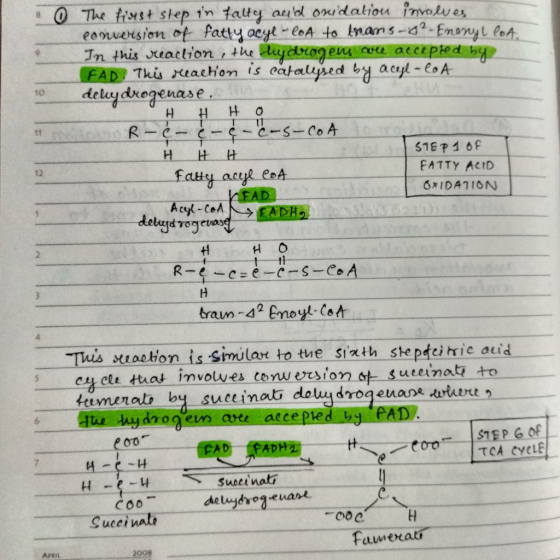
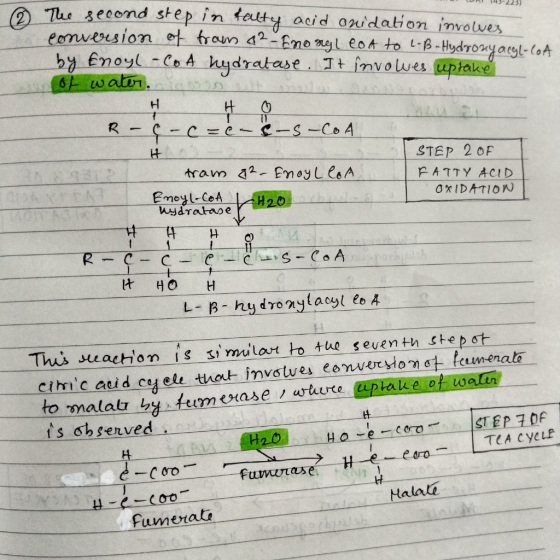
Fatty acid β-oxidation resembles three steps in the citric acid cycle.
- Step 1 of the fatty acid oxidation resembles Step 6 of the citric acid cycle
- Step 2 of the fatty acid oxidation resembles Step 7 of the citric acid cycle
- Step 3 of the fatty acid oxidation resembles Step 8 of the citric acid cycle

Add Answer to:
Fatty acid β-oxidation resembles several steps in citric acid
cycle. Point out the steps and enzymes...
explain in details: Of the four oxidation steps in the Citric Acid Cycle, one is obviously...
explain in details: Of the four oxidation steps in the Citric Acid Cycle, one is obviously different. Explain what is unique in this oxidation step from other three oxidation steps in terms of cofactors, localization, and connection to other metabolic pathways?
Propionyl-CoA, the end product of β-oxidation of odd-chain fatty acids can enter the citric acid cycle...
Propionyl-CoA, the end product of β-oxidation of odd-chain fatty acids can enter the citric acid cycle after being converted to ________.
β-Oxidation is the major pathway for fatty acid oxidation in mammals. However, other fatty acid oxidation...
β-Oxidation is the major pathway for fatty acid oxidation in mammals. However, other fatty acid oxidation pathways exist. Sort the following phrases based on whether they describe β-oxidation, α-oxidation, or ω -oxidation of fatty acids. two carbon atoms are removed from the carboxyl end of a fatty acid occurs in the endoplasmic reticulum occurs when an alkyl group is present on the Beta carbon of a fatty acid the alpha carbon atom is hydroxylated results in a fatty acid with...
β°idation is the major pathway for fatty acid oxidation in mammals. However, other fatty acid oxidation...
 β°idation is the major pathway for fatty acid oxidation in mammals. However, other fatty acid oxidation pathways exist. Sort the following phrases based on whether they describe ß-oxidation, ar-oxidation, or ω-oxidation of fatty acids. B-Oxidation α-Oxidation ω-Oxidation the β carbon is oxidized in animal cells, takes place in peroxisomes, but not mitochondria occurs in the endoplasmic reticulum two carbon atoms are removed from the carboxyl end of a fatty acid occurs when an alkyl group is present on the β...
The process of β-oxidation requires fatty acids to be activated by transfer to Coenzyme- A. This...
The process of β-oxidation requires fatty acids to be activated by transfer to Coenzyme- A. This step is dependent on free energy provided by ATP. Briefly describe how breakage of high-energy bonds in ATP is linked to the transfer of fatty acids to Coenzyme A. What critical fatty acid intermediate is formed in this process? How is energy of phosphoanhydride bonds in ATP leveraged to facilitate the formation of the thioester bond between the fatty acid and Coenzyme A moieties?...
Fatty acid synthesis and β-oxidation do not occur simultaneously in a cell. Explain why preventing simultaneous...
Fatty acid synthesis and β-oxidation do not occur simultaneously in a cell. Explain why preventing simultaneous synthesis and oxidation is necessary and how its achieved. In your answer, be sure to describe the specific regulatory mechanisms involved. In your answer, you must also compare and contrast the pathways (include locations, enzymes, starting products and ending products).
5. As indicated in the KEGG pathways for fatty acid degradation and biosynthesis which pathway does NOT use acetyl-CoA as a substrate? A. citric acid cycle B. butanoate metabolism C. fatty acid b...
 5. As indicated in the KEGG pathways for fatty acid degradation and biosynthesis which pathway does NOT use acetyl-CoA as a substrate? A. citric acid cycle B. butanoate metabolism C. fatty acid biosynthesis D. glycolysis 6. Which statement is consistent with the comparison of fatty acid biosynthesis in humans and in Helicobacter pylori 2017? A. Both organisms use the same multifunctional enzyme B. Humans use separate proteins to catalyze each step, while H. pylori 2017 uses one multifunctional enzyme to...
6. Citric Acid Cycle Draw the complete Citric Acid Cycle pathway, include: (a) Total number of...
 6. Citric Acid Cycle Draw the complete Citric Acid Cycle pathway, include: (a) Total number of steps in Citric Acid Cycle? (b) Specify the type of reaction in each step? (c) Name the enzymes in each step? (d) How many redox reactions are present in Citric Acid Cycle?
37. If citric acid cycle enzymes are being inhibited, excess acetyl-CoA cannot be processed in the...
37. If citric acid cycle enzymes are being inhibited, excess acetyl-CoA cannot be processed in the citric acid cycle. This excess acetyl-CoA could be utilized to form A. pyruvate. B. oxaloacetate (OAA). C. fatty acids. A and B all of the above
Look up the entire 4 step β-oxidation process for a fatty acid. a. (16) Show the reactions and enzymes used to degrade stearic acid by 2 carbons. b. (4) List all of the products from this set of...
 Look up the entire 4 step β-oxidation process for a fatty acid. a. (16) Show the reactions and enzymes used to degrade stearic acid by 2 carbons. b. (4) List all of the products from this set of reactions. c. (4) List all of the products if you were to oxidize the entire fatty acid. I.
Look up the entire 4 step β-oxidation process for a fatty acid. a. (16) Show the reactions and enzymes used to degrade stearic acid...
Look up the entire 4 step β-oxidation process for a fatty acid. a. (16) Show the reactions and enzymes used to degrade stearic acid by 2 carbons. b. (4) List all of the products from this set of reactions. c. (4) List all of the products if you were to oxidize the entire fatty acid. I.
Look up the entire 4 step β-oxidation process for a fatty acid. a. (16) Show the reactions and enzymes used to degrade stearic acid...
 β°idation is the major pathway for fatty acid oxidation in mammals. However, other fatty acid oxidation pathways exist. Sort the following phrases based on whether they describe ß-oxidation, ar-oxidation, or ω-oxidation of fatty acids. B-Oxidation α-Oxidation ω-Oxidation the β carbon is oxidized in animal cells, takes place in peroxisomes, but not mitochondria occurs in the endoplasmic reticulum two carbon atoms are removed from the carboxyl end of a fatty acid occurs when an alkyl group is present on the β...
 5. As indicated in the KEGG pathways for fatty acid degradation and biosynthesis which pathway does NOT use acetyl-CoA as a substrate? A. citric acid cycle B. butanoate metabolism C. fatty acid biosynthesis D. glycolysis 6. Which statement is consistent with the comparison of fatty acid biosynthesis in humans and in Helicobacter pylori 2017? A. Both organisms use the same multifunctional enzyme B. Humans use separate proteins to catalyze each step, while H. pylori 2017 uses one multifunctional enzyme to...
 6. Citric Acid Cycle Draw the complete Citric Acid Cycle pathway, include: (a) Total number of steps in Citric Acid Cycle? (b) Specify the type of reaction in each step? (c) Name the enzymes in each step? (d) How many redox reactions are present in Citric Acid Cycle?
 Look up the entire 4 step β-oxidation process for a fatty acid. a. (16) Show the reactions and enzymes used to degrade stearic acid by 2 carbons. b. (4) List all of the products from this set of reactions. c. (4) List all of the products if you were to oxidize the entire fatty acid. I.
Look up the entire 4 step β-oxidation process for a fatty acid. a. (16) Show the reactions and enzymes used to degrade stearic acid...
Look up the entire 4 step β-oxidation process for a fatty acid. a. (16) Show the reactions and enzymes used to degrade stearic acid by 2 carbons. b. (4) List all of the products from this set of reactions. c. (4) List all of the products if you were to oxidize the entire fatty acid. I.
Look up the entire 4 step β-oxidation process for a fatty acid. a. (16) Show the reactions and enzymes used to degrade stearic acid...
Most questions answered within 3 hours.
-
Where is the error in this code sequence?
String s1 = "Hello";
String s2 = "ello";...
asked 10 months ago -
Financial data for Joel de Paris, Inc., for last year
follow:
Joel de Paris, Inc.
Balance...
asked 10 months ago -
Consider this reaction:
Al2(SO4)3 (aq)+ BaCl3
(aq) Al2Cl6 (aq)- +
3BaSO4(s) . What is the...
asked 10 months ago -
Suppose that Savneet is considering increasing her
recent random sample from 20 car rentals to 40...
asked 10 months ago -
Trucks arrive at an unloading terminal at an average rate of 120
per hour.
Trucks arrive...
asked 10 months ago -
Why are methanol and ethanol completely soluble in water while
octanol is not very little soluble....
asked 10 months ago -
A facilities manager at a university reads in a research report
that the mean amount of...
asked 10 months ago -
When the CuSO4 is rehydrated by adding water to the anhydrous
compound, is this an endothermic...
asked 10 months ago -
A ray of sunlight is passing from diamond into crown glass; the
angle of incidence is...
asked 10 months ago -
A block of mass 0.249 kg is placed on top of a light, vertical
spring of...
asked 10 months ago -
how do the kidneys compensate in the presences of acidosis
a) trigger hyperventilate
b) reserve acid...
asked 10 months ago -
Question 501 pts
The rental rate of capital to the firm increases. Which of the
following...
asked 10 months ago