If P = nRT/(V-n), then which of the following is false? A. PV = nRT +...
If P = nRT/(V-n), then which of the following is false?
| A. | PV = nRT + Pn | |
| B. | 0 = RT + P – PV/n | |
| C. | V = nPRT + nP2 | |
| D. | 1 = nRT/PV + n/V | |
| E. | V = (nRT/P) + n |
Homework Answers

Add Answer to:
If P = nRT/(V-n), then which of the following is false?
A.
PV = nRT +...
IGL: PV = nRT VdW: ( P + an2/V2 )( V – nb ) = nRT...
IGL: PV = nRT VdW: ( P + an2/V2 )( V – nb ) = nRT where a and b are constants specific to the gas. 1.) CO2 behaves likes a Van der Waals gas with constants a = 0.364 J.m3/mol2 and b = .000043 m3/mol. If 2.5 moles of CO2 is put in a cubical tank (each side is 10cm) at 400K, what would be the pressure? What would be the force the gas exerts on each face of...
Name Ideal Gas Law, Ratios PV=nRT When we have the same ideal gas at two times,...
 Name Ideal Gas Law, Ratios PV=nRT When we have the same ideal gas at two times, we can express the ratio equation as P,V, n,RT P,V, n, RT a) Which of the following would be the correct way to solve for the second ter if you held the moles of gas and gas pressure constant but allowed the volume and temperature to vary? v,т, V,T V. 2 V,T, 2 T b) If n and V are held constant and the...
8. 10 Point Bonus! The Ideal Gas Equation of State is pV = nRT, where n=...
 8. 10 Point Bonus! The Ideal Gas Equation of State is pV = nRT, where n= number of moles of gas & R is the ideal the gas constant. The Van der Waals Equation of State is briefly discussed in Ch. 5 of the book by Reif. It is an empirical, crude attempt to improve on the Ideal Gas Model by allowing gas molecules to interact with each other. For one mole of non-ideal gas this equation of state is...
The ideal gas law (PV=nRT) describes the relationship among pressure P, volume V, temperature T, and...
The ideal gas law (PV=nRT) describes the relationship among pressure P, volume V, temperature T, and molar amount n. Fix n and V When n and V are fixed, the equation can be rearranged to take the following form where k is a constant: PT=nRV=k or (PT)initial=(PT)final This demonstrates that for a container of gas held at constant volume, the pressure and temperature are directly proportional.The relationship is also called Gay-Lussac's law after the French chemist Joseph-Louis Gay-Lussac, one of...
Using the formula PV = nRT and the following given information: P = 0.520 atm (H2)...
Using the formula PV = nRT and the following given information: P = 0.520 atm (H2) V = 30.0 mL R = 0.69 T = 22.1 degrees Celsius find the number of Hydrogen moles produced
Q.7 Which one of following identify the Boyle's Law rel ationship A) PV = k B)...
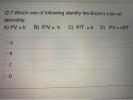 Q.7 Which one of following identify the Boyle's Law rel ationship A) PV = k B) PN = k C) РЛ = k D) PV = nRT ОООО
One way to write the ideal gas law is PV = nRT where P is the...
One way to write the ideal gas law is PV = nRT where P is the pressure, V is the volume, n is the number of moles, R is the universal gas law constant and T is the temperature. Solve the ideal gas law for T.
3. A gas obeys the equation of state PV = nRT - an'/V, where n is...
 3. A gas obeys the equation of state PV = nRT - an'/V, where n is the number of moles of gas and a is constant. Substitute with rearrangement into the differential equation for work, and integrate from Vito V2 to find an equation for the work done by this gas as the result of a reversible isothermal process. Show algebraically that the work is proportional to n to the first power.
The Ideal Gas Law is given by the equation:pv=nrt Where: p = pressure v = volume...
The Ideal Gas Law is given by the equation:pv=nrt Where: p = pressure v = volume n = moles t = temperature in Kelvin In order to solve for the volume, V, you must multiply both sides of the equation by the same expression: PV x ___=nRT X __ The resulting equation is: V=? In order to solve the equation above for , you must multiply both sides of the equation by the same expression: a=b/c ax_?_=b/c x _?_ The...
Practice problems 1. Freshman chemistry courses teach the ideal gas law: pV-nRT. The units are: V...
 Practice problems 1. Freshman chemistry courses teach the ideal gas law: pV-nRT. The units are: V (m3), n (mol), R (kg.m2/°K-mol-s2) and T (°K), what are the units of the p component?
 Name Ideal Gas Law, Ratios PV=nRT When we have the same ideal gas at two times, we can express the ratio equation as P,V, n,RT P,V, n, RT a) Which of the following would be the correct way to solve for the second ter if you held the moles of gas and gas pressure constant but allowed the volume and temperature to vary? v,т, V,T V. 2 V,T, 2 T b) If n and V are held constant and the...
 8. 10 Point Bonus! The Ideal Gas Equation of State is pV = nRT, where n= number of moles of gas & R is the ideal the gas constant. The Van der Waals Equation of State is briefly discussed in Ch. 5 of the book by Reif. It is an empirical, crude attempt to improve on the Ideal Gas Model by allowing gas molecules to interact with each other. For one mole of non-ideal gas this equation of state is...
 Q.7 Which one of following identify the Boyle's Law rel ationship A) PV = k B) PN = k C) РЛ = k D) PV = nRT ОООО
 3. A gas obeys the equation of state PV = nRT - an'/V, where n is the number of moles of gas and a is constant. Substitute with rearrangement into the differential equation for work, and integrate from Vito V2 to find an equation for the work done by this gas as the result of a reversible isothermal process. Show algebraically that the work is proportional to n to the first power.
 Practice problems 1. Freshman chemistry courses teach the ideal gas law: pV-nRT. The units are: V (m3), n (mol), R (kg.m2/°K-mol-s2) and T (°K), what are the units of the p component?
Most questions answered within 3 hours.
-
Where is the error in this code sequence?
String s1 = "Hello";
String s2 = "ello";...
asked 11 months ago -
Financial data for Joel de Paris, Inc., for last year
follow:
Joel de Paris, Inc.
Balance...
asked 11 months ago -
Consider this reaction:
Al2(SO4)3 (aq)+ BaCl3
(aq) Al2Cl6 (aq)- +
3BaSO4(s) . What is the...
asked 11 months ago -
Suppose that Savneet is considering increasing her
recent random sample from 20 car rentals to 40...
asked 11 months ago -
Trucks arrive at an unloading terminal at an average rate of 120
per hour.
Trucks arrive...
asked 11 months ago -
Why are methanol and ethanol completely soluble in water while
octanol is not very little soluble....
asked 11 months ago -
A facilities manager at a university reads in a research report
that the mean amount of...
asked 11 months ago -
When the CuSO4 is rehydrated by adding water to the anhydrous
compound, is this an endothermic...
asked 11 months ago -
A ray of sunlight is passing from diamond into crown glass; the
angle of incidence is...
asked 11 months ago -
A block of mass 0.249 kg is placed on top of a light, vertical
spring of...
asked 11 months ago -
how do the kidneys compensate in the presences of acidosis
a) trigger hyperventilate
b) reserve acid...
asked 11 months ago -
Question 501 pts
The rental rate of capital to the firm increases. Which of the
following...
asked 11 months ago