some substrates for glutathione S-transferase don't form a glutathione conjugate as the product of the glutathione...
some substrates for glutathione S-transferase don't form a glutathione conjugate as the product of the glutathione S-transferase and glutathione-dependent reaction, what are some examples ?
Homework Answers
Some substrates for glutathione S-transferase don't form a glutathione conjugate as the product of the glutathione S-transferase and glutathione-dependent reaction.
First example-
Reaction of maleylacetoacetate and maleylacetone which is get isomerized into fumarylacetoacetate and fumarylacetone by glutathionetransferase.
Second example-
Reaction of androst-5-ene-3,17-dione and phenylalanine. The enzyme glutathione S-transferase isomerize the androst-5-ene-3,17-dione to androstenedione.
Both the reaction show no consumption of glutathione S-transferase in the reaction.
Thanking you
Add Answer to:
some substrates for glutathione S-transferase don't form a
glutathione conjugate as the product of the glutathione...
Using suitable examples explain why does Hoffman product (more substituted alken) predominates in some Elimination reactions...
 Using suitable examples explain why does Hoffman product (more substituted alken) predominates in some Elimination reactions whilst the Hoffrman product (less substituted alkene) form in others Using suitable examples, explain the differences in mechanism, mechanism, substrates, nucleophile and solvents in a SN1and SN2, Using suitable examples, explain the differences in mechanisms, substrates, bases in an El and an E2 reaction.
4. a. Show the substrates that combine to give this Diels-Alder product. b. Draw the other...
 4. a. Show the substrates that combine to give this Diels-Alder product. b. Draw the other regioisomeric product that can form. Don't worry about showing chirality wedges/dashes!
Predict the product(s) for the following reaction, and designate the conjugate acid and conjugate base. HCHO2(aq)...
Predict the product(s) for the following reaction, and designate the conjugate acid and conjugate base. HCHO2(aq) + PO4-3(aq) ↔ ?
2. Predict the product(s) from the acid catalyzed dehydration of the following substrates. If there is...
 2. Predict the product(s) from the acid catalyzed dehydration of the following substrates. If there is more than one possible product indicate which is the major product. a. 1-methyl cyclohexanol b. 3,methyl 2-butanol c. 3-hexanol d. 1-phenyl 1-propano
please respond for every product a mechanism or doesnt form In the following reaction what product(s)...
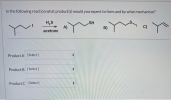 please respond for every product a mechanism or doesnt form
In the following reaction what product(s) would you expect to form and by what mechanism? Product A (Select) Product B Select] Product C (Select]
please respond for every product a mechanism or doesnt form
In the following reaction what product(s) would you expect to form and by what mechanism? Product A (Select) Product B Select] Product C (Select]
Some human brain cancer cells contain a mutated form of isocitrate dehydrogenase that has lost its...
Some human brain cancer cells contain a mutated form of isocitrate dehydrogenase that has lost its normal activity and instead catalyzes the NADP+-dependent reduction of the carbonyl group of α-ketoglutarate. Draw the structure of the reaction product.
Problem 2 (15 points, 3 points each). Supply the substrates), reaction condition(s) or the produc...
 Problem 2 (15 points, 3 points each). Supply the substrates), reaction condition(s) or the products) needed to complete each of the following transformations. If multiple enantiomers, diastereomers, or regioisomers are formed, they must be indicated for full credit. You do not need to labal major and minor products. In some cases, no reaction may occur. Assume an aqueous workup step for each reaction. H2N AcOH ls b. (This is almost identical to the quiz question!) MgBr 1) TsOH, xcess MeOH...
Part A For the reaction Ca(s)+Cl2(g)--> CaCl2(s) calculate how many grams of the product form when...
Part A For the reaction Ca(s)+Cl2(g)--> CaCl2(s) calculate how many grams of the product form when 20.4 of Ca completely reacts. Assume that there is more than enough of the other reactant. Part B. For the reaction 2K(s)+Br2(l)-->2KBr(s) calculate how many grams of the product form when 20.4g of Br2 completely reacts. Assume theres more than enough. Part C. For the reaction 4Cr(s)+3O2(g)--->2Cr2O3(s) calculate how many grams of the product form when 20.4g of O2 completely reacts. Assume theres more...
Q.Q. Draw the major product(s) for the nitration of the following substrates OOH OCH3 NH2 CN...
 Q.Q. Draw the major product(s) for the nitration of the following substrates OOH OCH3 NH2 CN CH2CH3 Q. Which of the following compounds will be in the ether layer after the addition of sodium hydroxide and why? None of the previous NaOH doesn't react with organic compounds Q. The structures of glucose and acetominophen are shown below. Using water and ethyl acetate (a typical organic solvent), in which layer are you likely to find the compounds and why? VOOH но...
A weak acid (HA) reacts with a weak base (B) to form the conjugate base of...
A weak acid (HA) reacts with a weak base (B) to form the conjugate base of the acid (A-) and the conjugate acid of the base (B-H+). If the pKa of HA was 4.7 and the pKa of BH+ (i.e., the pKabH of B) was 9.4, what would be the value of the equilibrium constant for the above reaction to the nearest ones? Obviously, by expressing the answer to the nearest ones, we are using too many figures than is...
 Using suitable examples explain why does Hoffman product (more substituted alken) predominates in some Elimination reactions whilst the Hoffrman product (less substituted alkene) form in others Using suitable examples, explain the differences in mechanism, mechanism, substrates, nucleophile and solvents in a SN1and SN2, Using suitable examples, explain the differences in mechanisms, substrates, bases in an El and an E2 reaction.
 4. a. Show the substrates that combine to give this Diels-Alder product. b. Draw the other regioisomeric product that can form. Don't worry about showing chirality wedges/dashes!
 2. Predict the product(s) from the acid catalyzed dehydration of the following substrates. If there is more than one possible product indicate which is the major product. a. 1-methyl cyclohexanol b. 3,methyl 2-butanol c. 3-hexanol d. 1-phenyl 1-propano
 please respond for every product a mechanism or doesnt form
In the following reaction what product(s) would you expect to form and by what mechanism? Product A (Select) Product B Select] Product C (Select]
please respond for every product a mechanism or doesnt form
In the following reaction what product(s) would you expect to form and by what mechanism? Product A (Select) Product B Select] Product C (Select]
 Problem 2 (15 points, 3 points each). Supply the substrates), reaction condition(s) or the products) needed to complete each of the following transformations. If multiple enantiomers, diastereomers, or regioisomers are formed, they must be indicated for full credit. You do not need to labal major and minor products. In some cases, no reaction may occur. Assume an aqueous workup step for each reaction. H2N AcOH ls b. (This is almost identical to the quiz question!) MgBr 1) TsOH, xcess MeOH...
 Q.Q. Draw the major product(s) for the nitration of the following substrates OOH OCH3 NH2 CN CH2CH3 Q. Which of the following compounds will be in the ether layer after the addition of sodium hydroxide and why? None of the previous NaOH doesn't react with organic compounds Q. The structures of glucose and acetominophen are shown below. Using water and ethyl acetate (a typical organic solvent), in which layer are you likely to find the compounds and why? VOOH но...
Most questions answered within 3 hours.
-
Where is the error in this code sequence?
String s1 = "Hello";
String s2 = "ello";...
asked 10 months ago -
Financial data for Joel de Paris, Inc., for last year
follow:
Joel de Paris, Inc.
Balance...
asked 10 months ago -
Consider this reaction:
Al2(SO4)3 (aq)+ BaCl3
(aq) Al2Cl6 (aq)- +
3BaSO4(s) . What is the...
asked 10 months ago -
Suppose that Savneet is considering increasing her
recent random sample from 20 car rentals to 40...
asked 10 months ago -
Trucks arrive at an unloading terminal at an average rate of 120
per hour.
Trucks arrive...
asked 10 months ago -
Why are methanol and ethanol completely soluble in water while
octanol is not very little soluble....
asked 10 months ago -
A facilities manager at a university reads in a research report
that the mean amount of...
asked 10 months ago -
When the CuSO4 is rehydrated by adding water to the anhydrous
compound, is this an endothermic...
asked 10 months ago -
A ray of sunlight is passing from diamond into crown glass; the
angle of incidence is...
asked 10 months ago -
A block of mass 0.249 kg is placed on top of a light, vertical
spring of...
asked 10 months ago -
how do the kidneys compensate in the presences of acidosis
a) trigger hyperventilate
b) reserve acid...
asked 10 months ago -
Question 501 pts
The rental rate of capital to the firm increases. Which of the
following...
asked 10 months ago