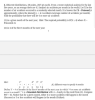
using the inverse transformation method for discrete distributions discussed in class, define a process for generating...
Homework Answers

Add Answer to:
using the inverse transformation method for discrete distributions
discussed in class, define a process for generating...
oated? variates from Apply the inverse transformation method to generate three 0.10, U;2 30.15 the following...
 oated? variates from Apply the inverse transformation method to generate three 0.10, U;2 30.15 the following distributions using Ui 0.10, U2 0.53, and U30 the following distributions using U1 a. Probability density function: for α < x < β elsewhere f(x)-1β-α where β 7 and α--4. b. Probability mass function: p(x)sP(X-x): 1.5 for x 1,2, 3, 4, 5 0 elsewhere ow would a random
variates of X, where 2. Using the inverse transformation method to generate three randorm 0.1,k1 0.3,...
 variates of X, where 2. Using the inverse transformation method to generate three randorm 0.1,k1 0.3, k 2: Prob(X -k) F04,k3 0.2,k 4 RN: 728, 347, 304, 852
Let x be a discrete random variable that possesses a binomial distribution. Using the binomial formula,...
 Let x be a discrete random variable that possesses a binomial distribution. Using the binomial formula, find the following probability. P(x = 5) for n = 6 and p = 0.4 Round your answer to four decimal places. P(x = 5) = the absolute tolerance is +/-0.0001
Let X be a discrete random variable that possesses a binomial distribution. Using the binomial formula,...
Let X be a discrete random variable that possesses a binomial distribution. Using the binomial formula, find the following probability. P(x=2) for n=4 and p= 0.4 round your answer to four decimal places. P(x=2) =
The moment generating function ф(t) of random variable X is defined for all values of t by et*p(x), if X is discrete e...
 The moment generating function ф(t) of random variable X is defined for all values of t by et*p(x), if X is discrete e f (x)dx, if X is continus (a) Find the moment generating function of a Binomial random variable X with parameters n (the total number of trials) and p (the probability of success). (b) If X and Y are independent Binomial random variables with parameters (n1 p) and (n2, p), respectively, then what is the distribution of X...
binomial RV B(n,p) 2. Simulating a Binomial RV. One procedure for generating uses n EXi is...
 binomial RV B(n,p) 2. Simulating a Binomial RV. One procedure for generating uses n EXi is binomial if realizations of a uniform random variable and exploits the fact that Y the Xi are Bernoulli RVs. Here is an alternative procedure that requires generating only a single (!) uniform variate: 1/p and B 1/(1 p) 0) Let 1) Set 0 U[0, 1] 2) Generate 3) If k n, go to step 5; else, k ++ au; if u B(u- p). Go...
He second form for one-parameter exponential family distributions, introduced during lecture 09.1...
 he second form for one-parameter exponential family distributions, introduced during lecture 09.1, was Jy (y | θ) = b(y)ec(0)t(y)-d(0) Let η = c(0). If c is an invertible function, we can rewrite (1) as where η is called the natural, or canonical, parameter and K(n) = d(C-1(n)). Expression (2) is referred to as the canonical representation of the exponential family distribution (a) Function κ(η) is called the log-normalizer: it ensures that the distribution fy(y n) integrates to one. Show that,...
11. Chi-Squared Test for a Family of Discrete Distributions A Bookmark this page In the problems...
 11. Chi-Squared Test for a Family of Discrete Distributions A Bookmark this page In the problems on this page you will apply the goodness of fit test to determine whether or not a sample has a binomial distribution So far, we have used the x test to determine if our data had a categorical distribution with specific parameters (e.s uniform on an set). element For the problems on this page, we extend the discussion on x tests beyond what was...
2. Using only reagents and conditions that have been discussed in class, outline a method to...
 2. Using only reagents and conditions that have been discussed in class, outline a method to accomplish the following transformation: (20 points) OH COẠCHẠCH C-CH3 CH 3. Consider the molecule below. A) Classify it as aromatic, antiaromatic or non-aromatic. Explain you answer. (10 points) B) Predict the expected reactivity pattern of the molecule. Explain. (10 Points)
2. (Discrete distributions, 20 points, 20/3 pts each). From a recent statistical analysis for the last...
 2. (Discrete distributions, 20 points, 20/3 pts each). From a recent statistical analysis for the last five years, on an average there are 4.1 (major) air accidents per month in the world. Let X be the number of air accidents occurred in a randomly selected month. It is known that X-Poisson() approximately, where the intensity 2. = 4.1 accidents (average number of accidents per month). Find the probability that there will be 4 or more air accidents (1) in a...
 oated? variates from Apply the inverse transformation method to generate three 0.10, U;2 30.15 the following distributions using Ui 0.10, U2 0.53, and U30 the following distributions using U1 a. Probability density function: for α < x < β elsewhere f(x)-1β-α where β 7 and α--4. b. Probability mass function: p(x)sP(X-x): 1.5 for x 1,2, 3, 4, 5 0 elsewhere ow would a random
 variates of X, where 2. Using the inverse transformation method to generate three randorm 0.1,k1 0.3, k 2: Prob(X -k) F04,k3 0.2,k 4 RN: 728, 347, 304, 852
 Let x be a discrete random variable that possesses a binomial distribution. Using the binomial formula, find the following probability. P(x = 5) for n = 6 and p = 0.4 Round your answer to four decimal places. P(x = 5) = the absolute tolerance is +/-0.0001
 The moment generating function ф(t) of random variable X is defined for all values of t by et*p(x), if X is discrete e f (x)dx, if X is continus (a) Find the moment generating function of a Binomial random variable X with parameters n (the total number of trials) and p (the probability of success). (b) If X and Y are independent Binomial random variables with parameters (n1 p) and (n2, p), respectively, then what is the distribution of X...
 binomial RV B(n,p) 2. Simulating a Binomial RV. One procedure for generating uses n EXi is binomial if realizations of a uniform random variable and exploits the fact that Y the Xi are Bernoulli RVs. Here is an alternative procedure that requires generating only a single (!) uniform variate: 1/p and B 1/(1 p) 0) Let 1) Set 0 U[0, 1] 2) Generate 3) If k n, go to step 5; else, k ++ au; if u B(u- p). Go...
 he second form for one-parameter exponential family distributions, introduced during lecture 09.1, was Jy (y | θ) = b(y)ec(0)t(y)-d(0) Let η = c(0). If c is an invertible function, we can rewrite (1) as where η is called the natural, or canonical, parameter and K(n) = d(C-1(n)). Expression (2) is referred to as the canonical representation of the exponential family distribution (a) Function κ(η) is called the log-normalizer: it ensures that the distribution fy(y n) integrates to one. Show that,...
 11. Chi-Squared Test for a Family of Discrete Distributions A Bookmark this page In the problems on this page you will apply the goodness of fit test to determine whether or not a sample has a binomial distribution So far, we have used the x test to determine if our data had a categorical distribution with specific parameters (e.s uniform on an set). element For the problems on this page, we extend the discussion on x tests beyond what was...
 2. Using only reagents and conditions that have been discussed in class, outline a method to accomplish the following transformation: (20 points) OH COẠCHẠCH C-CH3 CH 3. Consider the molecule below. A) Classify it as aromatic, antiaromatic or non-aromatic. Explain you answer. (10 points) B) Predict the expected reactivity pattern of the molecule. Explain. (10 Points)
 2. (Discrete distributions, 20 points, 20/3 pts each). From a recent statistical analysis for the last five years, on an average there are 4.1 (major) air accidents per month in the world. Let X be the number of air accidents occurred in a randomly selected month. It is known that X-Poisson() approximately, where the intensity 2. = 4.1 accidents (average number of accidents per month). Find the probability that there will be 4 or more air accidents (1) in a...
Most questions answered within 3 hours.
-
Where is the error in this code sequence?
String s1 = "Hello";
String s2 = "ello";...
asked 10 months ago -
Financial data for Joel de Paris, Inc., for last year
follow:
Joel de Paris, Inc.
Balance...
asked 10 months ago -
Consider this reaction:
Al2(SO4)3 (aq)+ BaCl3
(aq) Al2Cl6 (aq)- +
3BaSO4(s) . What is the...
asked 10 months ago -
Suppose that Savneet is considering increasing her
recent random sample from 20 car rentals to 40...
asked 10 months ago -
Trucks arrive at an unloading terminal at an average rate of 120
per hour.
Trucks arrive...
asked 10 months ago -
Why are methanol and ethanol completely soluble in water while
octanol is not very little soluble....
asked 10 months ago -
A facilities manager at a university reads in a research report
that the mean amount of...
asked 10 months ago -
When the CuSO4 is rehydrated by adding water to the anhydrous
compound, is this an endothermic...
asked 10 months ago -
A ray of sunlight is passing from diamond into crown glass; the
angle of incidence is...
asked 10 months ago -
A block of mass 0.249 kg is placed on top of a light, vertical
spring of...
asked 10 months ago -
how do the kidneys compensate in the presences of acidosis
a) trigger hyperventilate
b) reserve acid...
asked 10 months ago -
Question 501 pts
The rental rate of capital to the firm increases. Which of the
following...
asked 10 months ago