Write a Python function has_subsequence(a,s) that determines if the list (or string), a, contains s as...
Write a Python function has_subsequence(a,s) that determines if the list (or string), a, contains s as a (not necessarily consecutive) subsequence.
Examples
- 'here we go again' contains 'we gain' as a subsequence.
- 'green eggs and ham sandwhiches' contains 'reggae' as a subsequence.
Your function should return an array of indices that shows the location of the elements of s in a. In the 'here we go again' example this array would contains [5,6,12,13,14,15].
If you can't find s as a subsequence of a, then you should return None.
Homework Answers
# python code to check if a is subsequence of b
# Recursive Python program to check if a string is
subsequence
# of another string
# Returns true if str1[] is a subsequence of str2[]. m is
# length of str1 and n is length of str2
# index stores indexes of string 1
index=[]
def isSubSequence(string1, string2, m, n):
# Base Cases
if m == 0: return True
if n == 0: return False
# If last characters of two strings are
matching
if string1[m-1] == string2[n-1]:
index.append(m-1)
return isSubSequence(string1,
string2, m-1, n-1)
# If last characters are not matching
return isSubSequence(string1, string2, m, n-1)
# Driver program to test the above function
string1 = "gksrek"
string2 = "geeksforgeeks"
m = len(string1)
n = len(string2)
if isSubSequence(string1, string2, m, n):
print(index)
else:
print "No"
Add Answer to:
Write a Python function has_subsequence(a,s) that determines if
the list (or string), a, contains s as...
Write a function in python, index(arr, value) to find indices of elements equal to some value...
Write a function in python, index(arr, value) to find indices of elements equal to some value in a Numpy array. The input arr is a 1-d numpy array, and input value is the value to search for. The function should return the index of the value. If the value occurs for multiple times, then all the indices should be returned as a 1-d numpy array. For example, if arr=[1 0 2 0 3 0 4 0 5 0 6 7...
Python: P2 Write a function that reverses a python list using recursion (Chapter 6-3 in our...
Python: P2 Write a function that reverses a python list using recursion (Chapter 6-3 in our textbook) E.g.: Input: [9, 8, 7, 6, 5, 4, 3, 2, 1, 0] Output: [0, 1, 2, 3, 4, 5, 6, 7, 8, 9] Constraints: - List elements are integers - The function should return a reversed array, not print its elements You may use the following code as template: def reverse(my_list, index = None): # your code here
Python3: Write the function longestSubpalindrome(s), that takes a string s and returns the longest palindrome that...
Python3: Write the function longestSubpalindrome(s), that takes a string s and returns the longest palindrome that occurs as consecutive characters (not just letters, but any characters) in s. so longestSubpalindrome("ab-4-be!!!") returns "b-4-b".If there is a tie, return the lexicographically larger value -- in Python, a string s1 is lexicographically greater than a string s2 if (s1 > s2). So: longestSubpalindrome("abcbce") returns "cbc", since ("cbc" > "bcb"). Note that unlike the previous functions, this function is case-sensitive (so "A" is not...
python 3 Write a function that receives an array S representing a disjoint set forest and...
 python 3
Write a function that receives an array S representing a disjoint set forest and an integer k and determines if k is a root in S. What is the running time of your function with respect to the size of S? 6. 7. Write a function that receives an array S representing a disjoint set forest and an integer k and determines if k is a leaf in S. What is the running time of your function with...
python 3
Write a function that receives an array S representing a disjoint set forest and an integer k and determines if k is a root in S. What is the running time of your function with respect to the size of S? 6. 7. Write a function that receives an array S representing a disjoint set forest and an integer k and determines if k is a leaf in S. What is the running time of your function with...
On Python 3.6, write a function char_table(s), where s is a string. The function should produce...
On Python 3.6, write a function char_table(s), where s is a string. The function should produce a table that shows the characters in the string and the number of occurrences of each character. Make the table nicely formatted, using right justification for the numbers (check out the format command.). List the characters in order (the order in the character encoding). Give some examples of the output.
python function will Return True if string x contains 3 vowels in a row, in consecutive...
python function will Return True if string x contains 3 vowels in a row, in consecutive locations, false otherwise. assuming that 'vowels' refer to the following lowercase lttrs: a,e,i,o,u programs fails partially, only allowed to use float, str, int, appen, split, strip, len, range def vowels_three(x): for i in range (o, len(x), 2): if x[i] not in ('a,e,i,o,u'): return False return True
Write a Python function fun3(e) to update a list of numbers e such that the first...
Write a Python function fun3(e) to update a list of numbers e such that the first and last elements have been exchanged. The function needs to also return multiplication of elements of e. You should assume that the list e has at least 2 elements. Example: >>>lst = [4, 1, 2, -1] >>>fun3(list) -8 >>>lst [-1, 1, 2, 4] *We are an intro to CS class so please do not use anything too advance or fancy. Stick to basics. Right...
Write a Python function that will take a string and a list as its only parameters....
Write a Python function that will take a string and a list as its only parameters. The function needs to return a new string that is the original string with all of the characters appearing in the list parameter replaced with an asterisk(*). The returned string needs to have the remaining characters appear in the same location as the characters they replaced. Hint/Reminder: Note you can make a string out of characters optimally without repeatedly using the concatenation operator.
1. use python List to Dictionary Write a function that has three parameters: a list of...
 1. use python List to Dictionary Write a function that has three parameters: a list of unsorted numbers with no duplicates, a start number, and an end number. This function should return a dictionary with all integers between the start and end number (inclusive) as the keys and their respective indices in the list as the value. If the integer is not in the list, the corresponding value would be None. Example unsorted list: [2,1,10,0,4,3] two numbers: 3, 10 returned...
In python Write a function named printList to print the elements of a list with labels...
 In python
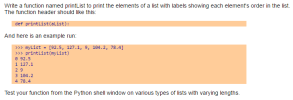
Write a function named printList to print the elements of a list with labels showing each element's order in the list. The function header should like this: def printList(aList): And here is an example run: > > > myList = [92.5, 127.1, 9, 104.2, 78.4] > > > printList(myList) 0 92.5 1 127.1 2 9 3 104.2 4 78.4 Test your function from the Python shell window on various types of lists with varying lengths.
In python
Write a function named printList to print the elements of a list with labels showing each element's order in the list. The function header should like this: def printList(aList): And here is an example run: > > > myList = [92.5, 127.1, 9, 104.2, 78.4] > > > printList(myList) 0 92.5 1 127.1 2 9 3 104.2 4 78.4 Test your function from the Python shell window on various types of lists with varying lengths.
 python 3
Write a function that receives an array S representing a disjoint set forest and an integer k and determines if k is a root in S. What is the running time of your function with respect to the size of S? 6. 7. Write a function that receives an array S representing a disjoint set forest and an integer k and determines if k is a leaf in S. What is the running time of your function with...
python 3
Write a function that receives an array S representing a disjoint set forest and an integer k and determines if k is a root in S. What is the running time of your function with respect to the size of S? 6. 7. Write a function that receives an array S representing a disjoint set forest and an integer k and determines if k is a leaf in S. What is the running time of your function with...
 1. use python List to Dictionary Write a function that has three parameters: a list of unsorted numbers with no duplicates, a start number, and an end number. This function should return a dictionary with all integers between the start and end number (inclusive) as the keys and their respective indices in the list as the value. If the integer is not in the list, the corresponding value would be None. Example unsorted list: [2,1,10,0,4,3] two numbers: 3, 10 returned...
 In python
Write a function named printList to print the elements of a list with labels showing each element's order in the list. The function header should like this: def printList(aList): And here is an example run: > > > myList = [92.5, 127.1, 9, 104.2, 78.4] > > > printList(myList) 0 92.5 1 127.1 2 9 3 104.2 4 78.4 Test your function from the Python shell window on various types of lists with varying lengths.
In python
Write a function named printList to print the elements of a list with labels showing each element's order in the list. The function header should like this: def printList(aList): And here is an example run: > > > myList = [92.5, 127.1, 9, 104.2, 78.4] > > > printList(myList) 0 92.5 1 127.1 2 9 3 104.2 4 78.4 Test your function from the Python shell window on various types of lists with varying lengths.
Most questions answered within 3 hours.
-
Where is the error in this code sequence?
String s1 = "Hello";
String s2 = "ello";...
asked 11 months ago -
Financial data for Joel de Paris, Inc., for last year
follow:
Joel de Paris, Inc.
Balance...
asked 11 months ago -
Consider this reaction:
Al2(SO4)3 (aq)+ BaCl3
(aq) Al2Cl6 (aq)- +
3BaSO4(s) . What is the...
asked 11 months ago -
Suppose that Savneet is considering increasing her
recent random sample from 20 car rentals to 40...
asked 11 months ago -
Trucks arrive at an unloading terminal at an average rate of 120
per hour.
Trucks arrive...
asked 11 months ago -
Why are methanol and ethanol completely soluble in water while
octanol is not very little soluble....
asked 11 months ago -
A facilities manager at a university reads in a research report
that the mean amount of...
asked 11 months ago -
When the CuSO4 is rehydrated by adding water to the anhydrous
compound, is this an endothermic...
asked 11 months ago -
A ray of sunlight is passing from diamond into crown glass; the
angle of incidence is...
asked 11 months ago -
A block of mass 0.249 kg is placed on top of a light, vertical
spring of...
asked 11 months ago -
how do the kidneys compensate in the presences of acidosis
a) trigger hyperventilate
b) reserve acid...
asked 11 months ago -
Question 501 pts
The rental rate of capital to the firm increases. Which of the
following...
asked 11 months ago