Ligand A and protein B bind to each other with a Kd of 15 μM. If...
Ligand A and protein B bind to each other with a Kd of 15 μM. If the total concentrations of A and B are 456 μM and 1,060 μM, respectively, then what fraction of A is bound?
Homework Answers
In a bimolecular equilibrium reaction
[A] + [B] ==> [AB], Ka = [AB] / [A][B]
[AB] ==> [A] +[B]
Kd = [A][B]/[AB]
From this the fraction of A Bound = [AB] / [A] + [AB] = 1/ ([A]/[AB] + 1) = 1/(Kd/[B] +1) = [B] / Kd + [B]
[A] (ligand) = 456 uM
[B] (protein) = 1060 uM
Kd = 15 uM
Fraction of A Bound = 1060 uM /(15 + 1060) uM = 0.9860
Fraction of Ligand A bound to protein = 0.9860.
A binding protein binds to a ligand with Kd=30nm. What is the concentration of ligand when...
 A binding protein binds to a ligand with Kd=30nm. What is the
concentration of ligand when the [L] when the fraction
bound,,
is a) 0.25, b) 0.6 and c) 0.95.
A binding protein binds to a ligand with Kd=30nm. What is the
concentration of ligand when the [L] when the fraction
bound,,
is a) 0.25, b) 0.6 and c) 0.95.
Two proteins bind to the same ligand, and protein A has a fractional saturation of 0.5...
Two proteins bind to the same ligand, and protein A has a fractional saturation of 0.5 when the ligand concentration is 0.5 mM, while protein B has a fractional saturation of 0.25 at 0.3 mM of the ligand. Which protein binds the ligand more strongly, and what is the dissociation constant for that protein-ligand interaction? *** I know the answer I just need the steps to do it*** Answer: Protein A binds more strongly, and Kd = 0.5 mM.
Protein A Protein B [PL), UM 0.00 0 0.000 0 1) (10 marks) You study ligand...
 Protein A Protein B [PL), UM 0.00 0 0.000 0 1) (10 marks) You study ligand binding to two proteins, A and B. You measured the concentration, (PL), of the ligand-bound form of the protein at various ligand concentrations, [L]. The data are summarized in the two tables below. Note that you do not know the total concentration of the protein, but you know that adding more ligand did not noticeably change the bound- protein concentration. [L), UM [PL], uM...
4. You have a protein that needs to bind ATP to be functional and has a...
4. You have a protein that needs to bind ATP to be functional and has a KD for ATP of 10 μM. In you experiment your protein concentration is much less than that of ATP, and your final ATP concentration is 30 μM. A) What fraction of the protein is functional? Show your work. B) Suppose that you have a fluorescent ATP analog that can bind and activate your proteins that becomes quenched when it binds. Why would fluorescence change...
-3. (5 pt) Beginning with the equilibrium for protein-ligand binding: P + NL PLN derive the...
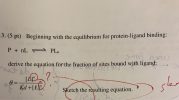 -3. (5 pt) Beginning with the equilibrium for protein-ligand binding: P + NL PLN derive the equation for the fraction of sites bound with ligand: Kd +[Lju. Sketch the resulting equation.
Avidin binds biotin with a Kd of ~10−15 mol/L. A protein of interest can be covalently...
Avidin binds biotin with a Kd of ~10−15 mol/L. A protein of interest can be covalently linked to biotin and subsequently isolated by incubating with beads coated with avidin. If the concentration of biotinylated protein is 10-8 M at the beginning of the assay and the beads provided an excess of avidin-binding sites, then one could expect the beads to bind: a. Less then half of the biotinylated protein will be bound to the beads. b. Exactly one-half of the...
A (non-allosteric) protein binds its ligand with a Kd of 2.5 mM. What proportion of the...
A (non-allosteric) protein binds its ligand with a Kd of 2.5 mM. What proportion of the ligand-binding sites will be occupied at a protein concentration of 1.0 mM and a ligand concentration of 1.5 mM? The answer is 37.5%, but how do you find this answer?
You are characterizing the binding of a ligand to a protein. Knowing that the rate of...
You are characterizing the binding of a ligand to a protein. Knowing that the rate of association between the protein and ligand is diffusion controlled and that the KD is expected to be around 100 µM, a) What do you expect that half-life of the complex to be? b) What method would you choose to measure the KD? Briefly describe why the method is appropriate
What type of protein-ligand mechanism do antigens bind antibodies? A. Lock-and-key model B. Induced fit C....
What type of protein-ligand mechanism do antigens bind antibodies? A. Lock-and-key model B. Induced fit C. Molecular dynamics D. All of the above
If 20% of binding sites of a protein are occupied by its ligand when the concentration...
If 20% of binding sites of a protein are occupied by its ligand when the concentration of the ligand is 1mM, what is the Kd of this protein-ligand interaction? A. 0.2mM B. 1mM C. 2.5 mM D. 4mM E. 5mM
 A binding protein binds to a ligand with Kd=30nm. What is the
concentration of ligand when the [L] when the fraction
bound,,
is a) 0.25, b) 0.6 and c) 0.95.
A binding protein binds to a ligand with Kd=30nm. What is the
concentration of ligand when the [L] when the fraction
bound,,
is a) 0.25, b) 0.6 and c) 0.95.
 Protein A Protein B [PL), UM 0.00 0 0.000 0 1) (10 marks) You study ligand binding to two proteins, A and B. You measured the concentration, (PL), of the ligand-bound form of the protein at various ligand concentrations, [L]. The data are summarized in the two tables below. Note that you do not know the total concentration of the protein, but you know that adding more ligand did not noticeably change the bound- protein concentration. [L), UM [PL], uM...
 -3. (5 pt) Beginning with the equilibrium for protein-ligand binding: P + NL PLN derive the equation for the fraction of sites bound with ligand: Kd +[Lju. Sketch the resulting equation.
Most questions answered within 3 hours.
-
Where is the error in this code sequence?
String s1 = "Hello";
String s2 = "ello";...
asked 10 months ago -
Financial data for Joel de Paris, Inc., for last year
follow:
Joel de Paris, Inc.
Balance...
asked 10 months ago -
Consider this reaction:
Al2(SO4)3 (aq)+ BaCl3
(aq) Al2Cl6 (aq)- +
3BaSO4(s) . What is the...
asked 10 months ago -
Suppose that Savneet is considering increasing her
recent random sample from 20 car rentals to 40...
asked 10 months ago -
Trucks arrive at an unloading terminal at an average rate of 120
per hour.
Trucks arrive...
asked 10 months ago -
Why are methanol and ethanol completely soluble in water while
octanol is not very little soluble....
asked 10 months ago -
A facilities manager at a university reads in a research report
that the mean amount of...
asked 10 months ago -
When the CuSO4 is rehydrated by adding water to the anhydrous
compound, is this an endothermic...
asked 10 months ago -
A ray of sunlight is passing from diamond into crown glass; the
angle of incidence is...
asked 10 months ago -
A block of mass 0.249 kg is placed on top of a light, vertical
spring of...
asked 10 months ago -
how do the kidneys compensate in the presences of acidosis
a) trigger hyperventilate
b) reserve acid...
asked 10 months ago -
Question 501 pts
The rental rate of capital to the firm increases. Which of the
following...
asked 10 months ago