12. At equilibrium the Na+ concentrations are 100 mM outside and 10 mM inside the cell,...
12. At equilibrium the Na+ concentrations are 100 mM outside and 10 mM inside the cell, what is the voltage difference across the membrane?
Homework Answers

Add Answer to:
12. At equilibrium the Na+ concentrations are 100 mM outside and
10 mM inside the cell,...
In intestinal epithelial cells, the following conditions exist: a. Na+ concentrations are higher outside of the...
In intestinal epithelial cells, the following conditions exist: a. Na+ concentrations are higher outside of the cell. The Na+ concentration gradient is maintained by the consumption of ATP. b. Amino acid concentration is higher inside the cell. c. Amino acid transporters are membrane proteins that facilitate the transport of amino across the plasma membrane, moving both amino and Na+ into the cell. Based on the facts above, this mechanism is categorized as ______________.
At 37 °C the equilibrium concentration of Ca2+ inside a cell is 0.098 M and outside...
At 37 °C the equilibrium concentration of Ca2+ inside a cell is 0.098 M and outside is 0.019 M. The cell membrane is permeable to Ca2+ and Cl–. The only ion present in addition to Ca2+ and Cl– is a protein (Prin+/–) inside the cell. The protein holds a single positive or negative charge. The Cl– is at equilibrium across the membrane while the protein is inside the cell and cannot permeate the membrane. What is the concentration of Prin+/–...
At 37 °C the equilibrium concentration of Ca2+ inside a cell is 0.067 M and outside...
At 37 °C the equilibrium concentration of Ca2+ inside a cell is 0.067 M and outside is 0.034 M. The cell membrane is permeable to Ca2+ and Cl–. The only ion present in addition to Ca2+ and Cl– is a protein (Prin+/–) inside the cell. The protein holds a single positive or negative charge. The Cl– is at equilibrium across the membrane while the protein is inside the cell and cannot permeate the membrane. What is the concentration of Prin+/–...
Assuming normal concentrations of all ions inside and outside of the cell, and that K+ and...
Assuming normal concentrations of all ions inside and outside of the cell, and that K+ and Cl- channels are blocked but Na+ channels are open, the membrane potential will be ________. A. 70 mV B. -60 mV C. + 60 mV D. +30 mV
At 37 °C the concentration of Fe3+ inside a cell is 0.099 M and outside is...
At 37 °C the concentration of Fe3+ inside a cell is 0.099 M and outside is 0.014 M. The cell membrane is permeable to Fe3+. What potential difference in volts would have to exist across the membrane for Fe3+ to be in equilibrium at the stated conditions? Give you answer as the absolute value of the potential difference in volts.
HW 11-1 Recall that the Na + concentration is significantly higher outside the cell than inside...
HW 11-1 Recall that the Na + concentration is significantly higher outside the cell than inside the cell. The symporter couples the "downhill" transport of two Na + ions into the cell to the "uphill" transport of glucose into the cell. If the Na + concentration outside the cell ( [ Na + ] out ) is 149 mM and that inside the cell ( [ Na + ] in ) is 19.0 mM, and the cell potential is −...
You are working with a mammalian cell that has K+ leak channels, Na+ leak channels, and...
You are working with a mammalian cell that has K+ leak channels, Na+ leak channels, and Na+ /K+ ATPase. In the extracellular solution, you use NaCl and KCl in which both the Na+ and K+ ions were radioactively labeled. The ion concentrations are as follows: inside [K+ ] = 150 mM, inside [Na+ ] = 10 mM, outside [K+ ] = 15 mM, outside [Na+ ] = 140 mM. a. When the Na+ ions are at electrochemical equilibrium, what is...
A cell is found with the following concentrations of solutes inside 2. A cell is found...
 A cell is found with the following concentrations of solutes
inside
2. A cell is found with the following concentrations of solutes inside: 300 mM glucose and 150 mM Cach. The cell membrane of these cells is made with pores which are permeable to glucose but not to ions. These cells are isolated and then placed in a 150 mM CaCl2. What happened to the cells after the solution and the cells come to equilibrium? (4 Points) a. They cells...
A cell is found with the following concentrations of solutes
inside
2. A cell is found with the following concentrations of solutes inside: 300 mM glucose and 150 mM Cach. The cell membrane of these cells is made with pores which are permeable to glucose but not to ions. These cells are isolated and then placed in a 150 mM CaCl2. What happened to the cells after the solution and the cells come to equilibrium? (4 Points) a. They cells...
An important driving force in cellular processes is the concentration difference of ions outside and inside...
 An important driving force in cellular processes is the concentration difference of ions outside and inside cells. If the Nat concentration is [Na+] = 50 mM. outside a cell and [Na+] = 504 mM inside the cell, what is AG for the movement of Nat from inside to outside the cell at 37 °C? Na+ (inside, 504 mm) → Na+(outside, 50 mm)
En (mv) [] in mM 150 Inside Outside neuron neuron 10 12 120 100 1.25 250...
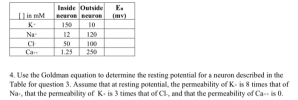 En (mv) [] in mM 150 Inside Outside neuron neuron 10 12 120 100 1.25 250 Na+ CI Ca++ 4. Use the Goldman equation to determine the resting potential for a neuron described in the Table for question 3. Assume that at resting potential, the permeability of K+ is 8 times that of Na+, that the permeability of K+ is 3 times that of Cl., and that the permeability of Ca++ is 0.
 A cell is found with the following concentrations of solutes
inside
2. A cell is found with the following concentrations of solutes inside: 300 mM glucose and 150 mM Cach. The cell membrane of these cells is made with pores which are permeable to glucose but not to ions. These cells are isolated and then placed in a 150 mM CaCl2. What happened to the cells after the solution and the cells come to equilibrium? (4 Points) a. They cells...
A cell is found with the following concentrations of solutes
inside
2. A cell is found with the following concentrations of solutes inside: 300 mM glucose and 150 mM Cach. The cell membrane of these cells is made with pores which are permeable to glucose but not to ions. These cells are isolated and then placed in a 150 mM CaCl2. What happened to the cells after the solution and the cells come to equilibrium? (4 Points) a. They cells...
 An important driving force in cellular processes is the concentration difference of ions outside and inside cells. If the Nat concentration is [Na+] = 50 mM. outside a cell and [Na+] = 504 mM inside the cell, what is AG for the movement of Nat from inside to outside the cell at 37 °C? Na+ (inside, 504 mm) → Na+(outside, 50 mm)
 En (mv) [] in mM 150 Inside Outside neuron neuron 10 12 120 100 1.25 250 Na+ CI Ca++ 4. Use the Goldman equation to determine the resting potential for a neuron described in the Table for question 3. Assume that at resting potential, the permeability of K+ is 8 times that of Na+, that the permeability of K+ is 3 times that of Cl., and that the permeability of Ca++ is 0.
Most questions answered within 3 hours.
-
Where is the error in this code sequence?
String s1 = "Hello";
String s2 = "ello";...
asked 10 months ago -
Financial data for Joel de Paris, Inc., for last year
follow:
Joel de Paris, Inc.
Balance...
asked 10 months ago -
Consider this reaction:
Al2(SO4)3 (aq)+ BaCl3
(aq) Al2Cl6 (aq)- +
3BaSO4(s) . What is the...
asked 10 months ago -
Suppose that Savneet is considering increasing her
recent random sample from 20 car rentals to 40...
asked 10 months ago -
Trucks arrive at an unloading terminal at an average rate of 120
per hour.
Trucks arrive...
asked 10 months ago -
Why are methanol and ethanol completely soluble in water while
octanol is not very little soluble....
asked 10 months ago -
A facilities manager at a university reads in a research report
that the mean amount of...
asked 10 months ago -
When the CuSO4 is rehydrated by adding water to the anhydrous
compound, is this an endothermic...
asked 10 months ago -
A ray of sunlight is passing from diamond into crown glass; the
angle of incidence is...
asked 10 months ago -
A block of mass 0.249 kg is placed on top of a light, vertical
spring of...
asked 10 months ago -
how do the kidneys compensate in the presences of acidosis
a) trigger hyperventilate
b) reserve acid...
asked 10 months ago -
Question 501 pts
The rental rate of capital to the firm increases. Which of the
following...
asked 10 months ago