What kind of decay, and why, would you expect from each of the following? Note that...
What kind of decay, and why, would you expect from each of the following? Note that if you look these up on the internet, you may find that each decays by more than one mechanism. The only correct/acceptable answers will be those that could be reasonably predicted based upon nuclear makeup.
S-35
Ac-226
C-11
Ti-52
Md-257
O-15
Homework Answers
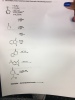
a) Sulfur-35 : It is unstable nuclei and undergo electron decay
Negative Beta decay : 16S35
------------> 17Cl35 +
-1 0
0
Sulphur Chlorine
b) Actinium 226 : It is unstable nuclei and undergo 3 decays :
a) Negative Beta decay :
89Ac226 ------------>
90Th226 + -10
Actinium Thorium
b) Electron capture decay : 89Ac226 + -1e0 ------> 88Ra226
Radium
c) alpha decay : 89Ac226 --------> 87Fr222 + 2He4
Francium helium
C) Carbon -11 : It is unstable nuclei and undergo 2 decays :
a) Negative beta decay : 6C11
----------> 5B11 + -10
Carbon Boron
b) Electron capture decay : 6C11 + -1e0 ------> 5B11
D) Titanium-52 : It is unstable nuclei and undergo beta decay.
a) Negative beta decay : 22Ti52
--------> 21V52 + -10
Vanadium
E) Mendelevium-257 : It is unstable nuclei and undergo 2 decays
a) Electron capture decay : 101Md257 + -1e0 ------> 100Fm257
Mendelevium Fermium
b) Alpha decay : 101Md257 -------> 99Es253 + 2He4
Einsteinium
F) Oxygen-15 : It is unstable nuclei and undergo positron decay.
a) Positron/positive electron decay : 8O15
-------> 7N15 + +10
Nitrogen positron
Add Answer to:
What kind of decay, and why, would you expect from each of the
following? Note that...
What kind of decay, and why, would you expect from each of the following? You may...
What kind of decay, and why, would you expect from each of the following? You may find that each decays by more than one mechanism. The only correct/acceptable answers will be those that could be reasonably predicted based upon nuclear makeup. a) S-35 b) Ac-226 c) C-11 d) Ti-52 e) Md-257 f) O-15
Carbon-11 is radioactive. How would you expect it to decay? Like all nuclides with more than...
 Carbon-11 is radioactive. How would you expect it to decay? Like all nuclides with more than 83 protons, radon-226 is radioactive. If it decays through alpha emission, provide the identity of the nucleus that remains Pb from 228Th, which proceeds by a series of decay reations involving the step-wise Write a nuclear reaction for each step in the formation of emission of a,a,a,a,B.B
What kind of decay would you expect lithium-8 to undergo, assuming it is not stable? (Lithium...
What kind of decay would you expect lithium-8 to undergo, assuming it is not stable? (Lithium is the third element.)
What kind of iodine values would you expect from the following fats and oils: butterfat, dripping...
What kind of iodine values would you expect from the following fats and oils: butterfat, dripping (from rendering of sheep fat), lard (pig fat), coconut oil, palm-kernel oil, marine oils, linseed oil? In each case briefly outline the relationship of iodine value to the fatty acid composition. Include the reference
Draw the 1H NMR spectra you would expect for the following compound. Note that you must...
 Draw the 1H NMR spectra you would expect for the following
compound. Note that you must put the peaks at the proper range of
chemical shift, with proper integral labeled below the peak, and
the proper spin-spin splitting.
CHM 2440 (FA 2013) CI D. spin-spin splitting integral chemical shift Label of H's 10 8 (ppm) 7. Use curved arrows to draw the mechanisms (pushing electrons) of the following two reactions. Note that each your mechanism has to agree with the...
Draw the 1H NMR spectra you would expect for the following
compound. Note that you must put the peaks at the proper range of
chemical shift, with proper integral labeled below the peak, and
the proper spin-spin splitting.
CHM 2440 (FA 2013) CI D. spin-spin splitting integral chemical shift Label of H's 10 8 (ppm) 7. Use curved arrows to draw the mechanisms (pushing electrons) of the following two reactions. Note that each your mechanism has to agree with the...
Which product(s) would you expect to obtain from each of the following reactions? In each part...
 Which product(s) would you expect to obtain from each of the following reactions? In each part give the mechanism (Sw1, SN2, E1 or E2) by which each product is formed. Explain your reasoning. (20 pts) 6. a. NaSH OTs DMSO b. CI NaOCH3 C. OMs NaOCH2CH3 d. ON HCECNa e. KOC(CH3).3 CI Br NaOCH2CH3 CH3CH2OHH
Please help complete What Major product would you expect from each of the following reactions?
 Please help complete
What Major product would you expect from each of the following reactions?
Please help complete
What Major product would you expect from each of the following reactions?
What stereoisomers would you expect to obtain from each of the following reactions? Part A H2...
 What stereoisomers would you expect to obtain from each of the following reactions? Part A H2 CH3CH2CH3 CEC CH3CH2CH3 Pic Draw the molecules on the canvas by choosing buttons from th toolbars. The single bond is active by default. Show the approp! buttons and then clicking a bond on the canvas.
What stereoisomers would you expect to obtain from each of the following reactions? CH:CHCH CH Сн, снен, Draw the m...
 What stereoisomers would you expect to obtain from each of the following reactions? CH:CHCH CH Сн, снен, Draw the molecule on the canvas by choosing buttons from the Tools (for bonds), Atoms, and Advanced Template toolbars. The single bond is active by default Show the appropriate stereochemistry by choosing the dashed or wedged buttons and then clicking a bond on the canvas L H : 100 0 + : 33 -CH
Background (Part 1): We are continuously exposed to ionizing radiation from natural and artificial sources. All...
Background (Part 1): We are continuously exposed to ionizing radiation from natural and artificial sources. All of us are exposed to radiation every day, from natural sources such as minerals in the ground and cosmic radiation to man-made sources such as medical x-rays. According to the National Council on Radiation Protection and Measurements (NCRP), the average annual radiation dose per person in the U.S. is 620 millirem. In this activity, you will use the interactive online dose calculator to estimate...
 Carbon-11 is radioactive. How would you expect it to decay? Like all nuclides with more than 83 protons, radon-226 is radioactive. If it decays through alpha emission, provide the identity of the nucleus that remains Pb from 228Th, which proceeds by a series of decay reations involving the step-wise Write a nuclear reaction for each step in the formation of emission of a,a,a,a,B.B
 Draw the 1H NMR spectra you would expect for the following
compound. Note that you must put the peaks at the proper range of
chemical shift, with proper integral labeled below the peak, and
the proper spin-spin splitting.
CHM 2440 (FA 2013) CI D. spin-spin splitting integral chemical shift Label of H's 10 8 (ppm) 7. Use curved arrows to draw the mechanisms (pushing electrons) of the following two reactions. Note that each your mechanism has to agree with the...
Draw the 1H NMR spectra you would expect for the following
compound. Note that you must put the peaks at the proper range of
chemical shift, with proper integral labeled below the peak, and
the proper spin-spin splitting.
CHM 2440 (FA 2013) CI D. spin-spin splitting integral chemical shift Label of H's 10 8 (ppm) 7. Use curved arrows to draw the mechanisms (pushing electrons) of the following two reactions. Note that each your mechanism has to agree with the...
 Which product(s) would you expect to obtain from each of the following reactions? In each part give the mechanism (Sw1, SN2, E1 or E2) by which each product is formed. Explain your reasoning. (20 pts) 6. a. NaSH OTs DMSO b. CI NaOCH3 C. OMs NaOCH2CH3 d. ON HCECNa e. KOC(CH3).3 CI Br NaOCH2CH3 CH3CH2OHH
 Please help complete
What Major product would you expect from each of the following reactions?
Please help complete
What Major product would you expect from each of the following reactions?
 What stereoisomers would you expect to obtain from each of the following reactions? Part A H2 CH3CH2CH3 CEC CH3CH2CH3 Pic Draw the molecules on the canvas by choosing buttons from th toolbars. The single bond is active by default. Show the approp! buttons and then clicking a bond on the canvas.
 What stereoisomers would you expect to obtain from each of the following reactions? CH:CHCH CH Сн, снен, Draw the molecule on the canvas by choosing buttons from the Tools (for bonds), Atoms, and Advanced Template toolbars. The single bond is active by default Show the appropriate stereochemistry by choosing the dashed or wedged buttons and then clicking a bond on the canvas L H : 100 0 + : 33 -CH
Most questions answered within 3 hours.
-
Where is the error in this code sequence?
String s1 = "Hello";
String s2 = "ello";...
asked 11 months ago -
Financial data for Joel de Paris, Inc., for last year
follow:
Joel de Paris, Inc.
Balance...
asked 11 months ago -
Consider this reaction:
Al2(SO4)3 (aq)+ BaCl3
(aq) Al2Cl6 (aq)- +
3BaSO4(s) . What is the...
asked 11 months ago -
Suppose that Savneet is considering increasing her
recent random sample from 20 car rentals to 40...
asked 11 months ago -
Trucks arrive at an unloading terminal at an average rate of 120
per hour.
Trucks arrive...
asked 11 months ago -
Why are methanol and ethanol completely soluble in water while
octanol is not very little soluble....
asked 11 months ago -
A facilities manager at a university reads in a research report
that the mean amount of...
asked 11 months ago -
When the CuSO4 is rehydrated by adding water to the anhydrous
compound, is this an endothermic...
asked 11 months ago -
A ray of sunlight is passing from diamond into crown glass; the
angle of incidence is...
asked 11 months ago -
A block of mass 0.249 kg is placed on top of a light, vertical
spring of...
asked 11 months ago -
how do the kidneys compensate in the presences of acidosis
a) trigger hyperventilate
b) reserve acid...
asked 11 months ago -
Question 501 pts
The rental rate of capital to the firm increases. Which of the
following...
asked 11 months ago