Find two syntax errors in the following program: #include <iostream> using namespace std; int area(int length,...
Find two syntax errors in the following program:
#include <iostream>
using namespace std;
int area(int length, int width = 0);
int main()
{
int length, width;
// for rectangle use both arguments
cout << "Enter length and width of a rectangle" <<
endl;
cin >> length >> width;
cout << "The area is " << area(length, width) << endl;
// for square, only need first argument
cout << "Enter side of a square" << endl;
cin >> length;
cout << "The area is " << area(length) << endl;
return 0;
}
int area(int length, int width = 0);
{
if ( width == 0 )
return length * length;
return length * width;
}
Homework Answers
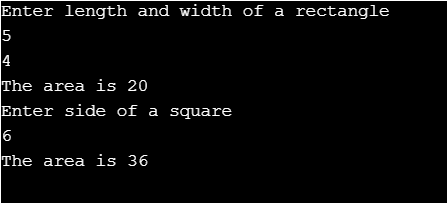
#include <iostream>

using namespace std;

int area(int length, int width=0);

int main()
{
int length, width;

// for rectangle use both arguments
cout << "Enter length and width of a rectangle" << endl;
cin >> length >> width;

cout << "The area is " << area(length, width) << endl;

// for square, only need first argument
cout << "Enter side of a square" << endl;
cin >> length;

cout << "The area is " << area(length) << endl;

return 0;
}

int area(int length, int width)
{
if ( width == 0 )
return length * length;

return length * width;
}

Add Answer to:
Find two syntax errors in the following
program:
#include <iostream>
using namespace std;
int area(int length,...
Find the errors in the following program. You must use pass by reference. #include <iostream> using...
Find the errors in the following program. You must use pass by reference. #include <iostream> using namespace std; void area2(int area, int length, int width = 0); int main() { int length, width, area; // for rectangle use two arguments cout << "Enter length and width of a rectangle" << endl; cin >> length >> width; cout << "The area is " << area2(area, length, width) << endl; // for squares use one argument cout << "Enter side of a...
Write following program using Switch statement. #include <iostream> using namespace std; int main() int number; cout...
 Write following program using Switch statement. #include <iostream> using namespace std; int main() int number; cout << "Enter an integer cin >> number; if (number > B) cout << You entered a positive integer: " << number << endl; else if (number (8) cout<<"You entered a negative integer: " << number << endl; cout << "You entered e." << endl; cout << "This line is always printed." return 0;
// This program uses the programmer-defined Rectangle class. #include "Rectangle.cpp" #include <iostream> using namespace std; int...
// This program uses the programmer-defined Rectangle class. #include "Rectangle.cpp" #include <iostream> using namespace std; int main() { Rectangle rectangle1; Rectangle rectangle2; rectangle1.setLength(10.0); rectangle1.setWidth(5.0); rectangle2.setLength(7.0); rectangle2.setWidth(3.0); cout << "Perimeter of rectangle1 is " << rectangle1.calculatePerimeter() << endl; cout << "Area of rectangle1 is " << rectangle1.calculateArea() << endl; cout << "Perimeter of rectangle2 is " << rectangle2.calculatePerimeter() << endl; cout << "Area of rectangle2 is " << rectangle2.calculateArea() << endl;...
C++ Fix the errors in the following code. (Not all errors are syntax related) #include <iostream>...
C++ Fix the errors in the following code. (Not all errors are syntax related) #include <iostream> using namespace std; int main() { //Part A int numA numA = 10; cout << numA << end; /* Part B */*/ int numB = numA; cin >> usrInput; int usrInput = 0; numB = numB + usrInput; cout << numB <"/n"; /* Part C */ int numC = 10000000000; cout << numC << endl; return 0; }
#include <iostream> #include <chrono> using namespace std; double improvedPow(double x, int y) { // To be...
#include <iostream> #include <chrono> using namespace std; double improvedPow(double x, int y) { // To be implemented by you } int main() { cout << "To calculate x^y ..." << endl; double x; int y; cout << "Please enter x: "; cin >> x; cout << "Please enter y: "; cin >> y; if(x == 0) { if (y > 0) cout << 0 << endl; else cout << "x^y is not defined" <<endl; } else { cout << improvedPow(x,y)...
Add comments on this Fibonacci C++ program in detail. #include <iostream> using namespace std; int fib(int...
Add comments on this Fibonacci C++ program in detail. #include <iostream> using namespace std; int fib(int n){ int a = 0,b = 1,c; if(n == 0 || n == 1){ return n; } while(n>2){ c = b + a; a = b; b = c; n--; } return c; } int main(){ int n; cout<<"Enter n: "; cin>>n; int result = fib(n); cout<<"Fib("<<n<<") = "<<result<<endl; return 0; }
Write the missing statements for the following program. #include <iostream> using namespace std; int main(void) {...
Write the missing statements for the following program. #include <iostream> using namespace std; int main(void) { int Num1; cout << "Enter 2 numbers: "; cin >> Num2; if (Num1 < Num2) cout << "Smallest number is " << Num1; else cout << "Smallest number is " << Num2; return 0; }
This program illustrates dynamic variables #include <iostream> using namespace std; int main () { int...
This program illustrates dynamic variables #include <iostream> using namespace std; int main () { int *p1; p1 = new int; // Variables created using the new operator are called dynamic variables cout << "Enter an integer \n"; cin >> *p1; *p1 = *p1 + 7; cout << << "Your input + 7 = " << *p1 << endl; delete p1; // Delete the dynamic variable p1 and return the memory occupied by p1 to...
#include <iostream> #include <string> using namespace std; int main() { int number; int sum = 0;...
#include <iostream> #include <string> using namespace std; int main() { int number; int sum = 0; while(true) { cout << "Please enter a number between 1 and 11: "; cin >> number; if (number >= 1 && number <= 11) { cout << number << endl; sum = sum + number; //only add the sum when number is in range: 1-11, so add wthin this if case } else { cout << number << endl; cout << "Out of range;...
Consider the following C++ program: #include <iostream> #include <cstdlib> using namespace std; int main int n...
 Consider the following C++ program: #include <iostream> #include <cstdlib> using namespace std; int main int n =0; int i = 0; cout << "Please enter a strictly positive number:"; cin >> n if (n <= 0) exit(EXIT_FAILURE) while (n > 1) n-n/2; i << endl; cout"Output:" return 0; Answer the following questions: What is the output of the program for each of the following values of n: -1, 0, 1, 2, 3, 4, 5, 6, 7, 8, 9? What does...
 Write following program using Switch statement. #include <iostream> using namespace std; int main() int number; cout << "Enter an integer cin >> number; if (number > B) cout << You entered a positive integer: " << number << endl; else if (number (8) cout<<"You entered a negative integer: " << number << endl; cout << "You entered e." << endl; cout << "This line is always printed." return 0;
 Consider the following C++ program: #include <iostream> #include <cstdlib> using namespace std; int main int n =0; int i = 0; cout << "Please enter a strictly positive number:"; cin >> n if (n <= 0) exit(EXIT_FAILURE) while (n > 1) n-n/2; i << endl; cout"Output:" return 0; Answer the following questions: What is the output of the program for each of the following values of n: -1, 0, 1, 2, 3, 4, 5, 6, 7, 8, 9? What does...
Most questions answered within 3 hours.
-
Where is the error in this code sequence?
String s1 = "Hello";
String s2 = "ello";...
asked 11 months ago -
Financial data for Joel de Paris, Inc., for last year
follow:
Joel de Paris, Inc.
Balance...
asked 11 months ago -
Consider this reaction:
Al2(SO4)3 (aq)+ BaCl3
(aq) Al2Cl6 (aq)- +
3BaSO4(s) . What is the...
asked 11 months ago -
Suppose that Savneet is considering increasing her
recent random sample from 20 car rentals to 40...
asked 11 months ago -
Trucks arrive at an unloading terminal at an average rate of 120
per hour.
Trucks arrive...
asked 11 months ago -
Why are methanol and ethanol completely soluble in water while
octanol is not very little soluble....
asked 11 months ago -
A facilities manager at a university reads in a research report
that the mean amount of...
asked 11 months ago -
When the CuSO4 is rehydrated by adding water to the anhydrous
compound, is this an endothermic...
asked 11 months ago -
A ray of sunlight is passing from diamond into crown glass; the
angle of incidence is...
asked 11 months ago -
A block of mass 0.249 kg is placed on top of a light, vertical
spring of...
asked 11 months ago -
how do the kidneys compensate in the presences of acidosis
a) trigger hyperventilate
b) reserve acid...
asked 11 months ago -
Question 501 pts
The rental rate of capital to the firm increases. Which of the
following...
asked 11 months ago