A flexible pavement is to be designed to last 10 years. The initial PSI is 4.2...
Homework Answers


Add Answer to:
A flexible pavement is to be designed to last 10 years. The
initial PSI is 4.2...
A flexible pavement is to be designed to last 10 years. The initial PSI is 4.2...
A flexible pavement is to be designed to last 10 years. The initial PSI is 4.2 and the TSI (the final PSI) is determined to be 2.5. The subgrade has a soil resilient modulus of 15,000 lb/in2 . Reliability is 95% with an overall standard deviation of 0.35. For design, the daily car, pickup truck and light van traffic is 40,000 and the daily truck traffic consists of 1500 passes of single-unit trucks with two single axles and 325 passes...
3. A flexible pavement is designed with an initial PSI of 4.5 and terminal PSI of...
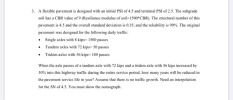 3. A flexible pavement is designed with an initial PSI of 4.5 and terminal PSI of 2.5. The subgrade soil has a CBR value of 9 (Resilience modulus of soil=1500*CBR). The structural number of this pavement is 4.5 and the overall standard deviation is 0.35, and the reliability is 90%. The original pavement was designed for the following daily traffic: • Single axles with 8 kips= 1500 passes • Tandem axles with 72 kips= 50 passes • Tridem axles with...
A flexible pavement is designed with 4 inches of sand-mix asphalt wearing surface, 6 inches of...
A flexible pavement is designed with 4 inches of sand-mix asphalt wearing surface, 6 inches of dense-graded crushed stone base, and 8 inches of crushed stone subbase. All drainage coefficients are 1.0. The initial PSI is 4.5, the TSI is 2.5, the soil resilient modulus is 12,000 lb/in2, reliability is 90%, the overall standard deviation is 0.4, and the design life is 15 years. A design mistake was made that ignored 100 daily passes of trucks with 22-kip single and...
A rigid pavement is designed with a 10-inch slab, an Ec of 6 million lb/in2, a...
A rigid pavement is designed with a 10-inch slab, an Ec of 6 million lb/in2, a concrete modulus of rupture of 432 lb/in2, a load transfer coefficient of 3.0, an initial PSI of 4.7, and a terminal serviceability index of 2.5. The overall standard deviation is 0.35, the modulus of subgrade reaction is 190 lb/in3, and a reliability of 90% is used along with a drainage coefficient of 0.8. The pavement is designed assuming traffic is composed entirely of trucks...
rigid and flexible pavement
A rigid pavement is on a highway with two lanesin one direction, and the pavement is conservativelydesigned. The pavement has an 11-inch slab with amodulus of elasticity of 5,000,000 lb/in2 and a concretemodulus of rupture of 700 lb/in2, and it is on a soil witha CBR of 25. The design drainage coefficient is 1.0, theoverall standard deviation is 0.3, and the load transfercoefficient is 3.0. The pavement was designed to last 20years (initial PSI of 4.7 and a final PSI...
urgent solution needed - A contractor wants to design a flexible pavement which has a 4-inch...
 urgent solution needed
- A contractor wants to design a flexible pavement which has a 4-inch sand-mix asphalt wearing surface, 11-inch soil cement base, and a 11-inch crushed stone subbase. It is designed to withstand 400 22-kip single-axle loads and 800 34-kip tandem axle loads per day. The subgrade CBR is 8, the overall standard deviation is 0.45, the initial PSI is 4.2, and the final PSI is 2.5. What is the probability that this pavement will have a PSI...
urgent solution needed
- A contractor wants to design a flexible pavement which has a 4-inch sand-mix asphalt wearing surface, 11-inch soil cement base, and a 11-inch crushed stone subbase. It is designed to withstand 400 22-kip single-axle loads and 800 34-kip tandem axle loads per day. The subgrade CBR is 8, the overall standard deviation is 0.45, the initial PSI is 4.2, and the final PSI is 2.5. What is the probability that this pavement will have a PSI...
1- (18%) An engineer wants to design a flexible pavement which has a 4-inch sand-mix asphalt...
 1- (18%) An engineer wants to design a flexible pavement which has a 4-inch sand-mix asphalt wearing surface, 11-inch soil cement base, and a 11-inch crushed stone subbase. It is designed to withstand 400 22-kip single-axle loads and 800 34-kip tandem axle loads per day. The subgrade CBR is 8, the overall standard deviation is 0.45, the initial PSI is 4.2, and the final PSI is 2.5. What is the probability that this pavement will have a PSI above 2.5...
1- (18%) An engineer wants to design a flexible pavement which has a 4-inch sand-mix asphalt...
 1- (18%) An engineer wants to design a flexible pavement which has a 4-inch sand-mix asphalt wearing surface, 11-inch soil cement base, and a 11-inch crushed stone subbase. It is designed to withstand 400 22-kip single-axle loads and 800 34-kip tandem axle loads per day. The subgrade CBR is 8, the overall standard deviation is 0.45, the initial PSI is 4.2, and the final PSI is 2.5. What is the probability that this pavement will have a PSI above 2.5...
1- (18%) An engineer wants to design a flexible pavement which has a 4-inch sand-mix asphalt...
1- (18%) An engineer wants to design a flexible pavement which has a 4-inch sand-mix asphalt wearing surface, 11-inch soil cement base, and a 11- inch crushed stone subbase. It is designed to withstand 400 22-kip single-axle loads and 800 34-kip tandem axle loads per day. The subgrade CBR is 8, the overall standard deviation is 0.45, the initial PSI is 4.2, and the final PSI is 2.5. What is the probability that this pavement will have a PSI above...
1- (18%) An engineer wants to design a flexible pavement which has a 4-inch sand-mix asphalt...
 1- (18%) An engineer wants to design a flexible pavement which has a 4-inch sand-mix asphalt wearing surface, 11-inch soil cement base, and a 11-inch crushed stone subbase. It is designed to withstand 400 22-kip single-axle loads and 800 34-kip tandem axle loads per day. The subgrade CBR is 8, the overall standard deviation is 0.45, the initial PSI is 4.2, and the final PSI is 2.5. What is the probability that this pavement will have a PSI above 2.5...
 3. A flexible pavement is designed with an initial PSI of 4.5 and terminal PSI of 2.5. The subgrade soil has a CBR value of 9 (Resilience modulus of soil=1500*CBR). The structural number of this pavement is 4.5 and the overall standard deviation is 0.35, and the reliability is 90%. The original pavement was designed for the following daily traffic: • Single axles with 8 kips= 1500 passes • Tandem axles with 72 kips= 50 passes • Tridem axles with...
 urgent solution needed
- A contractor wants to design a flexible pavement which has a 4-inch sand-mix asphalt wearing surface, 11-inch soil cement base, and a 11-inch crushed stone subbase. It is designed to withstand 400 22-kip single-axle loads and 800 34-kip tandem axle loads per day. The subgrade CBR is 8, the overall standard deviation is 0.45, the initial PSI is 4.2, and the final PSI is 2.5. What is the probability that this pavement will have a PSI...
urgent solution needed
- A contractor wants to design a flexible pavement which has a 4-inch sand-mix asphalt wearing surface, 11-inch soil cement base, and a 11-inch crushed stone subbase. It is designed to withstand 400 22-kip single-axle loads and 800 34-kip tandem axle loads per day. The subgrade CBR is 8, the overall standard deviation is 0.45, the initial PSI is 4.2, and the final PSI is 2.5. What is the probability that this pavement will have a PSI...
 1- (18%) An engineer wants to design a flexible pavement which has a 4-inch sand-mix asphalt wearing surface, 11-inch soil cement base, and a 11-inch crushed stone subbase. It is designed to withstand 400 22-kip single-axle loads and 800 34-kip tandem axle loads per day. The subgrade CBR is 8, the overall standard deviation is 0.45, the initial PSI is 4.2, and the final PSI is 2.5. What is the probability that this pavement will have a PSI above 2.5...
 1- (18%) An engineer wants to design a flexible pavement which has a 4-inch sand-mix asphalt wearing surface, 11-inch soil cement base, and a 11-inch crushed stone subbase. It is designed to withstand 400 22-kip single-axle loads and 800 34-kip tandem axle loads per day. The subgrade CBR is 8, the overall standard deviation is 0.45, the initial PSI is 4.2, and the final PSI is 2.5. What is the probability that this pavement will have a PSI above 2.5...
 1- (18%) An engineer wants to design a flexible pavement which has a 4-inch sand-mix asphalt wearing surface, 11-inch soil cement base, and a 11-inch crushed stone subbase. It is designed to withstand 400 22-kip single-axle loads and 800 34-kip tandem axle loads per day. The subgrade CBR is 8, the overall standard deviation is 0.45, the initial PSI is 4.2, and the final PSI is 2.5. What is the probability that this pavement will have a PSI above 2.5...
Most questions answered within 3 hours.
-
Where is the error in this code sequence?
String s1 = "Hello";
String s2 = "ello";...
asked 11 months ago -
Financial data for Joel de Paris, Inc., for last year
follow:
Joel de Paris, Inc.
Balance...
asked 11 months ago -
Consider this reaction:
Al2(SO4)3 (aq)+ BaCl3
(aq) Al2Cl6 (aq)- +
3BaSO4(s) . What is the...
asked 11 months ago -
Suppose that Savneet is considering increasing her
recent random sample from 20 car rentals to 40...
asked 11 months ago -
Trucks arrive at an unloading terminal at an average rate of 120
per hour.
Trucks arrive...
asked 11 months ago -
Why are methanol and ethanol completely soluble in water while
octanol is not very little soluble....
asked 11 months ago -
A facilities manager at a university reads in a research report
that the mean amount of...
asked 11 months ago -
When the CuSO4 is rehydrated by adding water to the anhydrous
compound, is this an endothermic...
asked 11 months ago -
A ray of sunlight is passing from diamond into crown glass; the
angle of incidence is...
asked 11 months ago -
A block of mass 0.249 kg is placed on top of a light, vertical
spring of...
asked 11 months ago -
how do the kidneys compensate in the presences of acidosis
a) trigger hyperventilate
b) reserve acid...
asked 11 months ago -
Question 501 pts
The rental rate of capital to the firm increases. Which of the
following...
asked 11 months ago