implement a class of infix calculators (Using C++). Consider a simple infix expression that consist of...
implement a class of infix calculators (Using C++).
Consider a simple infix expression that consist of single digit operands; the operators +, -, *, and / ; and parentheses. Assume that unary operators are illegal and that the expression contains no embedded spaces.
Design and implement a class of infix calculators. Use the algorithms given in the chapter 6 to evaluate infix expressions as entered into the calculator. You must first convert the infix expression to postfix form and then evaluate the resulting postfix expression. You need to implement a driver function that takes one line of infix expression either from console or an input file infix.dat, and print out the post fix expression and calculated result to the console.
Homework Answers
CODE
/* C++ implementation to convert infix expression to postfix*/
// Note that here we use std::stack for Stack operations
#include<bits/stdc++.h>
using namespace std;
//Function to return precedence of operators
int prec(char c)
{
if(c == '^')
return 3;
else if(c == '*' || c == '/')
return 2;
else if(c == '+' || c == '-')
return 1;
else
return -1;
}
// The main function to convert infix expression
//to postfix expression
string infixToPostfix(string s)
{
std::stack<char> st;
st.push('N');
int l = s.length();
string ns;
for(int i = 0; i < l; i++)
{
// If the scanned character is an operand, add it to output string.
if((s[i] >= 'a' && s[i] <= 'z')||(s[i] >= 'A' && s[i] <= 'Z')||(s[i] >= '0' && s[i] <= '9'))
ns+=s[i];
// If the scanned character is an ‘(‘, push it to the stack.
else if(s[i] == '(')
st.push('(');
// If the scanned character is an ‘)’, pop and to output string from the stack
// until an ‘(‘ is encountered.
else if(s[i] == ')')
{
while(st.top() != 'N' && st.top() != '(')
{
char c = st.top();
st.pop();
ns += c;
}
if(st.top() == '(')
{
char c = st.top();
st.pop();
}
}
//If an operator is scanned
else{
while(st.top() != 'N' && prec(s[i]) <= prec(st.top()))
{
char c = st.top();
st.pop();
ns += c;
}
st.push(s[i]);
}
}
//Pop all the remaining elements from the stack
while(st.top() != 'N')
{
char c = st.top();
st.pop();
ns += c;
}
return ns;
}
// Stack type
struct Stack
{
int top;
unsigned capacity;
int* array;
};
// Stack Operations
struct Stack* createStack( unsigned capacity )
{
struct Stack* stack = (struct Stack*) malloc(sizeof(struct Stack));
if (!stack) return NULL;
stack->top = -1;
stack->capacity = capacity;
stack->array = (int*) malloc(stack->capacity * sizeof(int));
if (!stack->array) return NULL;
return stack;
}
int isEmpty(struct Stack* stack)
{
return stack->top == -1 ;
}
char peek(struct Stack* stack)
{
return stack->array[stack->top];
}
char pop(struct Stack* stack)
{
if (!isEmpty(stack))
return stack->array[stack->top--] ;
return '$';
}
void push(struct Stack* stack, char op)
{
stack->array[++stack->top] = op;
}
// The main function that returns value of a given postfix expression
int evaluatePostfix(string exp)
{
// Create a stack of capacity equal to expression size
struct Stack* stack = createStack(exp.size());
int i;
// See if stack was created successfully
if (!stack) return -1;
// Scan all characters one by one
for (i = 0; exp[i]; ++i)
{
// If the scanned character is an operand (number here),
// push it to the stack.
if (isdigit(exp[i]))
push(stack, exp[i] - '0');
// If the scanned character is an operator, pop two
// elements from stack apply the operator
else
{
int val1 = pop(stack);
int val2 = pop(stack);
switch (exp[i])
{
case '+': push(stack, val2 + val1); break;
case '-': push(stack, val2 - val1); break;
case '*': push(stack, val2 * val1); break;
case '/': push(stack, val2/val1); break;
}
}
}
return pop(stack);
}
//Driver program to test above functions
int main()
{
string exp;
cout << "Enter an infix expression: ";
cin >> exp;
string postfix = infixToPostfix(exp);
cout << "Postfix expression: " << postfix << endl;
cout<<"postfix evaluation: " << evaluatePostfix(postfix);
return 0;
}
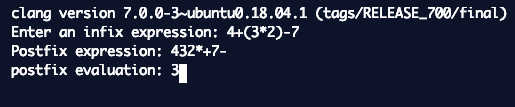
NOTE: Due to lack of time(we get only 2 hours), I could only implement the code which could accept only single digit as operands.
Add Answer to:
implement a class of infix calculators (Using C++).
Consider a simple infix expression that consist of...
For this project you will implement a simple calculator. Your calculator is going to parse infix...
For this project you will implement a simple calculator. Your calculator is going to parse infix algebraic expressions, create the corresponding postfix expressions and then evaluate the postfix expressions. The operators it recognizes are: +, -, * and /. The operands are integers. Your program will either evaluate individual expressions or read from an input file that contains a sequence of infix expressions (one expression per line). When reading from an input file, the output will consist of two files:...
We as humans write math expression in infix notation, e.g. 5 + 2 (the operators are...
We as humans write math expression in infix notation, e.g. 5 + 2 (the operators are written in-between the operands). In a computer’s language, however, it is preferred to have the operators on the right side of the operands, i.e. 5 2 +. For more complex expressions that include parenthesis and multiple operators, a compiler has to convert the expression into postfix first and then evaluate the resulting postfix. Write a program that takes an “infix” expression as input, uses...
Programming Assignment 2 – RPN Calculator – Infix to Postfix Conversion and The Evaluations of the Postfix Expression. You are to design and implement and algorithm in Java, to input an Infix expressi...
Programming Assignment 2 – RPN Calculator – Infix to Postfix Conversion and The Evaluations of the Postfix Expression. You are to design and implement and algorithm in Java, to input an Infix expression , convert to a postfix expression and finally evaluate the postfix expression… Follow the examples done during class lectures… We are used to infix notation - ”3 + 4” - where the operator is between the operands. There is also prefix notation, where the operand comes before...
Using ADT Stack: Evaluating infix expressions by converting them to postfix expressions Postfix notation: In a...
Using ADT Stack: Evaluating infix expressions by converting them to postfix expressions Postfix notation: In a postfix expression, a binary operation follows its two opperands. The order of the operands in a infix expression is the same as in the corresponding postfix expression but the order of the operators might change based on the precedence of the operators and the existing of paranthses. Infix Postfix a + b a b + (a + b) * c a b + c...
Write a java program for the following: Your program reads an infix expression represented by a...
Write a java program for the following: Your program reads an infix expression represented by a string S from the standard input (the keyboard). Then your program converts the infix expression into a postfix expression P using the algorithm. Next, your program evaluates the postfix expression P to produce a single result R. At last, your program displays the original infix expression S, the corresponding postfix expression P and the final result R on the standard output ( the screen...
write a program in c++ Read an infix expression from an input file and convert to...
write a program in c++ Read an infix expression from an input file and convert to postfix. Instead of displaying directly on the screen, first place in a queue, and then display the contents of the queue on the screen. Precondition: The expression will be read from a file (input.txt) that contains a single line. There will be no spaces between the operands and the operators. The following operators are allowed: ( ) + - * / The normal rules...
Stacks are used by compilers to help in the process of evaluating expressions and generating machine...
 Stacks are used by compilers to help in the process of
evaluating expressions and generating machine language code.In this
exercise, we investigate how compilers evaluate arithmetic
expressions consisting only of constants, operators and
parentheses. Humans generally write expressions like 3 + 4and 7 /
9in which the operator (+ or / here) is written between its
operands—this is called infix notation. Computers “prefer” postfix
notation in which the operator is written to the right of its two
operands. The preceding...
Stacks are used by compilers to help in the process of
evaluating expressions and generating machine language code.In this
exercise, we investigate how compilers evaluate arithmetic
expressions consisting only of constants, operators and
parentheses. Humans generally write expressions like 3 + 4and 7 /
9in which the operator (+ or / here) is written between its
operands—this is called infix notation. Computers “prefer” postfix
notation in which the operator is written to the right of its two
operands. The preceding...
This project is designed to practice with OOP, stack data structure, its applications, and C++/Java programming...
 This project is designed to practice with OOP, stack data structure, its applications, and C++/Java programming language. You will write a program that reads an infix expression, converts it to a postfix expression, evaluates the postfix expression, and prints out the answer. You must define and implement your own Stack class and a Calculator class. Your Stack class supports standard basic stack operations and you can implement it with an array or a linked list. You should create a class...
Total point: 15 Introduction: For this assignment you have to write a c program that will...
Total point: 15 Introduction: For this assignment you have to write a c program that will take an infix expression as input and display the postfix expression of the input. After converting the postfix expression, the program should evaluate the expression from the postfix and display the result. What should you submit? Write all the code in a single file and upload the .c file. Problem We as humans write math expression in infix notation, e.g. 5 + 2 (the...
You are to write a program name expressionTree.java that evaluates an infix expression entered by the...
You are to write a program name expressionTree.java that evaluates an infix expression entered by the user. The expression may contain the following tokens: (1) Integer constants (a series of decimal digits). (2) One alphabetic character - "x" (representing a value to be supplied later). (3) Binary operators (+, -, *, / and % (modulo)). (4) Parentheses You will parse the input expression creating an expression tree with the tokens, then use the postOrder tree traversal algorithm to extract...
 Stacks are used by compilers to help in the process of
evaluating expressions and generating machine language code.In this
exercise, we investigate how compilers evaluate arithmetic
expressions consisting only of constants, operators and
parentheses. Humans generally write expressions like 3 + 4and 7 /
9in which the operator (+ or / here) is written between its
operands—this is called infix notation. Computers “prefer” postfix
notation in which the operator is written to the right of its two
operands. The preceding...
Stacks are used by compilers to help in the process of
evaluating expressions and generating machine language code.In this
exercise, we investigate how compilers evaluate arithmetic
expressions consisting only of constants, operators and
parentheses. Humans generally write expressions like 3 + 4and 7 /
9in which the operator (+ or / here) is written between its
operands—this is called infix notation. Computers “prefer” postfix
notation in which the operator is written to the right of its two
operands. The preceding...
 This project is designed to practice with OOP, stack data structure, its applications, and C++/Java programming language. You will write a program that reads an infix expression, converts it to a postfix expression, evaluates the postfix expression, and prints out the answer. You must define and implement your own Stack class and a Calculator class. Your Stack class supports standard basic stack operations and you can implement it with an array or a linked list. You should create a class...
Most questions answered within 3 hours.
-
Where is the error in this code sequence?
String s1 = "Hello";
String s2 = "ello";...
asked 10 months ago -
Financial data for Joel de Paris, Inc., for last year
follow:
Joel de Paris, Inc.
Balance...
asked 10 months ago -
Consider this reaction:
Al2(SO4)3 (aq)+ BaCl3
(aq) Al2Cl6 (aq)- +
3BaSO4(s) . What is the...
asked 10 months ago -
Suppose that Savneet is considering increasing her
recent random sample from 20 car rentals to 40...
asked 10 months ago -
Trucks arrive at an unloading terminal at an average rate of 120
per hour.
Trucks arrive...
asked 10 months ago -
Why are methanol and ethanol completely soluble in water while
octanol is not very little soluble....
asked 10 months ago -
A facilities manager at a university reads in a research report
that the mean amount of...
asked 10 months ago -
When the CuSO4 is rehydrated by adding water to the anhydrous
compound, is this an endothermic...
asked 10 months ago -
A ray of sunlight is passing from diamond into crown glass; the
angle of incidence is...
asked 10 months ago -
A block of mass 0.249 kg is placed on top of a light, vertical
spring of...
asked 10 months ago -
how do the kidneys compensate in the presences of acidosis
a) trigger hyperventilate
b) reserve acid...
asked 10 months ago -
Question 501 pts
The rental rate of capital to the firm increases. Which of the
following...
asked 10 months ago