Two particles of equal masses undergo a totally elasticcollision. What are their velocities after the collision?Show...
Two particles of equal masses undergo a totally elasticcollision. What are their velocities after the collision?Show work.
Homework Answers

Add Answer to:
Two particles of equal masses undergo a totally
elasticcollision. What are their velocities after the
collision?Show...
017 10.0 points Two masses undergo a front-to-back collision. The masses are mı = m, with...
 017 10.0 points Two masses undergo a front-to-back collision. The masses are mı = m, with initial velocity 2vo, and m2 = 3.5m, with initial velocity vo. Due to the collision, they stick together, forming a compound system. 20. D. es m m2 If m = 2 kg and vo = 5.6 m/s, find the magnitude of the loss in kinetic energy after the collision. Answer in units of J.
The particles in the figure below (m1 = 1.4 kg and m2 = 3.5 kg) undergo...
 The particles in the figure below (m1 = 1.4 kg and m2 = 3.5 kg) undergo an elastic collision in one dimension. Their velocities before the collision are v1,-12 m/s and v2i =-7.5 m/s. Find the velocities of the two particles after the collision. (Indicate the direction with the sign of your answer.) m/s m1 712
Two particles of mass m1 = 2.0 kg and m2 = 2.6 kg undergo a one-dimensional...
 Two particles of mass m1 = 2.0 kg and m2 = 2.6 kg undergo a one-dimensional head-on collision as shown in the figure below. Their initial velocities along x are vii = 15 m/s and v2,--6.8 m/s. The two particles stick together after the collision (a completely inelastic collision. (Assume to the right as the positive direction.) mi m2 (a) Find the velocity after the collision. 2.6782 m/s (b) How much kinetic energy is lost in the collision? 153.907x
show all work, please answer asap thankss Problem 3 Let assume that two objects with masses...
 show all work, please answer asap thankss
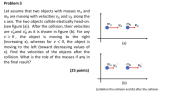
Problem 3 Let assume that two objects with masses ma and mg are moving with velocities va and va along the x axis. The two objects collide elastically head-on. (see figure (a)). After the collision, their velocities are vaand up as it is shown in figure (b). For any V>0, the object is moving to the right (increasing x), whereas for v < 0, the object is moving to the left (toward decreasing...
show all work, please answer asap thankss
Problem 3 Let assume that two objects with masses ma and mg are moving with velocities va and va along the x axis. The two objects collide elastically head-on. (see figure (a)). After the collision, their velocities are vaand up as it is shown in figure (b). For any V>0, the object is moving to the right (increasing x), whereas for v < 0, the object is moving to the left (toward decreasing...
Consider two masses sliding across a frictionless surface about to undergo a head-on collision as shown...
 Consider two masses sliding across a frictionless surface about to undergo a head-on collision as shown in the figure. The first mass (m1 =3 kg) is travelling to the right with a speed of v1 = 8 m/s. The speed of the second mass (m2 = 5 kg) is unknown. After the masses collide, ma rebounds moving off at a speed of v = 2 m/s in the opposite direction, while mz is motionless. a)(10 pts.) At what velocity, v2...
Consider two masses sliding across a frictionless surface about to undergo a head-on collision as shown...
 Consider two masses sliding across a frictionless surface about to undergo a head-on collision as shown in the figure. The first mass (m1 = 3 kg) is travelling to the right with a speed of V1 = 8 m/s. The speed of the second mass (m2 = 5 kg) is unknown. After the masses collide, m1 rebounds moving off at a speed of v = 2 m/s in the opposite direction, while m2 is motionless. a)(10 pts.) At what velocity,...
Two billiard balls of equal mass undergo a perfectly elastic head-on collision. If the speed of...
Two billiard balls of equal mass undergo a perfectly elastic head-on collision. If the speed of ball 1 was initially 3.31 m/s, and the speed of ball 2 was 6.6 m/s in the opposite direction, what will be the speed of ball 1 after the collision?
Two asteroids drifting at constant velocity collide. The masses and velocities of the asteroids before collision...
 Two
asteroids drifting at constant velocity collide. The masses and
velocities of the asteroids before collision are indicated on the
figure
K of 1 Figure 00kg 20 m/s 250 kg 10 m/s Part During View O Adk me anything Part A Sketch graphs of the momenta of asteroids A and B before the collision View Available Hint s) add graphadd points Xdelete graphi graph inforeset ? help 20000 15000 10000 5000 0 -5000 10000 -15000 -20000 с Submit Incorrect: Try...
Two
asteroids drifting at constant velocity collide. The masses and
velocities of the asteroids before collision are indicated on the
figure
K of 1 Figure 00kg 20 m/s 250 kg 10 m/s Part During View O Adk me anything Part A Sketch graphs of the momenta of asteroids A and B before the collision View Available Hint s) add graphadd points Xdelete graphi graph inforeset ? help 20000 15000 10000 5000 0 -5000 10000 -15000 -20000 с Submit Incorrect: Try...
Two balls, of masses m and 2m, travelling in a vacuum with initial velocities 2v and...
 Two balls, of masses m and 2m, travelling in a vacuum with initial
velocities 2v and v respectively, collide with each other head-on,
as shown. m 2v v 2m After the collision, the ball of mass m
rebounds to the left with velocity v. What is the loss of kinetic
energy in the collision?
A 3/4 mv^2 B 3/2 mv^2 C 9/4 mv^2 D 9/2mv^2
10 Two balls, of masses m and 2m, travelling in a vacuum with initial velocities...
Two balls, of masses m and 2m, travelling in a vacuum with initial
velocities 2v and v respectively, collide with each other head-on,
as shown. m 2v v 2m After the collision, the ball of mass m
rebounds to the left with velocity v. What is the loss of kinetic
energy in the collision?
A 3/4 mv^2 B 3/2 mv^2 C 9/4 mv^2 D 9/2mv^2
10 Two balls, of masses m and 2m, travelling in a vacuum with initial velocities...
Two particles with masses m and 3m are moving toward each other along the x-axis with...
Two particles with masses m and 3m are moving toward each other along the x-axis with the same initial speeds v0. Particle m is traveling to the left and particle 3m is traveling to the right. They undergo an elastic, off-center/oblique collision such that m is moving downward after the collision at a right angle from its initial direction. Find the final speeds of the two particles, and the angle θ at which the particle 3m is scattered.
 017 10.0 points Two masses undergo a front-to-back collision. The masses are mı = m, with initial velocity 2vo, and m2 = 3.5m, with initial velocity vo. Due to the collision, they stick together, forming a compound system. 20. D. es m m2 If m = 2 kg and vo = 5.6 m/s, find the magnitude of the loss in kinetic energy after the collision. Answer in units of J.
 The particles in the figure below (m1 = 1.4 kg and m2 = 3.5 kg) undergo an elastic collision in one dimension. Their velocities before the collision are v1,-12 m/s and v2i =-7.5 m/s. Find the velocities of the two particles after the collision. (Indicate the direction with the sign of your answer.) m/s m1 712
 Two particles of mass m1 = 2.0 kg and m2 = 2.6 kg undergo a one-dimensional head-on collision as shown in the figure below. Their initial velocities along x are vii = 15 m/s and v2,--6.8 m/s. The two particles stick together after the collision (a completely inelastic collision. (Assume to the right as the positive direction.) mi m2 (a) Find the velocity after the collision. 2.6782 m/s (b) How much kinetic energy is lost in the collision? 153.907x
 show all work, please answer asap thankss
Problem 3 Let assume that two objects with masses ma and mg are moving with velocities va and va along the x axis. The two objects collide elastically head-on. (see figure (a)). After the collision, their velocities are vaand up as it is shown in figure (b). For any V>0, the object is moving to the right (increasing x), whereas for v < 0, the object is moving to the left (toward decreasing...
show all work, please answer asap thankss
Problem 3 Let assume that two objects with masses ma and mg are moving with velocities va and va along the x axis. The two objects collide elastically head-on. (see figure (a)). After the collision, their velocities are vaand up as it is shown in figure (b). For any V>0, the object is moving to the right (increasing x), whereas for v < 0, the object is moving to the left (toward decreasing...
 Consider two masses sliding across a frictionless surface about to undergo a head-on collision as shown in the figure. The first mass (m1 =3 kg) is travelling to the right with a speed of v1 = 8 m/s. The speed of the second mass (m2 = 5 kg) is unknown. After the masses collide, ma rebounds moving off at a speed of v = 2 m/s in the opposite direction, while mz is motionless. a)(10 pts.) At what velocity, v2...
 Consider two masses sliding across a frictionless surface about to undergo a head-on collision as shown in the figure. The first mass (m1 = 3 kg) is travelling to the right with a speed of V1 = 8 m/s. The speed of the second mass (m2 = 5 kg) is unknown. After the masses collide, m1 rebounds moving off at a speed of v = 2 m/s in the opposite direction, while m2 is motionless. a)(10 pts.) At what velocity,...
 Two
asteroids drifting at constant velocity collide. The masses and
velocities of the asteroids before collision are indicated on the
figure
K of 1 Figure 00kg 20 m/s 250 kg 10 m/s Part During View O Adk me anything Part A Sketch graphs of the momenta of asteroids A and B before the collision View Available Hint s) add graphadd points Xdelete graphi graph inforeset ? help 20000 15000 10000 5000 0 -5000 10000 -15000 -20000 с Submit Incorrect: Try...
Two
asteroids drifting at constant velocity collide. The masses and
velocities of the asteroids before collision are indicated on the
figure
K of 1 Figure 00kg 20 m/s 250 kg 10 m/s Part During View O Adk me anything Part A Sketch graphs of the momenta of asteroids A and B before the collision View Available Hint s) add graphadd points Xdelete graphi graph inforeset ? help 20000 15000 10000 5000 0 -5000 10000 -15000 -20000 с Submit Incorrect: Try...
 Two balls, of masses m and 2m, travelling in a vacuum with initial
velocities 2v and v respectively, collide with each other head-on,
as shown. m 2v v 2m After the collision, the ball of mass m
rebounds to the left with velocity v. What is the loss of kinetic
energy in the collision?
A 3/4 mv^2 B 3/2 mv^2 C 9/4 mv^2 D 9/2mv^2
10 Two balls, of masses m and 2m, travelling in a vacuum with initial velocities...
Two balls, of masses m and 2m, travelling in a vacuum with initial
velocities 2v and v respectively, collide with each other head-on,
as shown. m 2v v 2m After the collision, the ball of mass m
rebounds to the left with velocity v. What is the loss of kinetic
energy in the collision?
A 3/4 mv^2 B 3/2 mv^2 C 9/4 mv^2 D 9/2mv^2
10 Two balls, of masses m and 2m, travelling in a vacuum with initial velocities...
Most questions answered within 3 hours.
-
Where is the error in this code sequence?
String s1 = "Hello";
String s2 = "ello";...
asked 10 months ago -
Financial data for Joel de Paris, Inc., for last year
follow:
Joel de Paris, Inc.
Balance...
asked 10 months ago -
Consider this reaction:
Al2(SO4)3 (aq)+ BaCl3
(aq) Al2Cl6 (aq)- +
3BaSO4(s) . What is the...
asked 10 months ago -
Suppose that Savneet is considering increasing her
recent random sample from 20 car rentals to 40...
asked 10 months ago -
Trucks arrive at an unloading terminal at an average rate of 120
per hour.
Trucks arrive...
asked 10 months ago -
Why are methanol and ethanol completely soluble in water while
octanol is not very little soluble....
asked 10 months ago -
A facilities manager at a university reads in a research report
that the mean amount of...
asked 10 months ago -
When the CuSO4 is rehydrated by adding water to the anhydrous
compound, is this an endothermic...
asked 10 months ago -
A ray of sunlight is passing from diamond into crown glass; the
angle of incidence is...
asked 10 months ago -
A block of mass 0.249 kg is placed on top of a light, vertical
spring of...
asked 10 months ago -
how do the kidneys compensate in the presences of acidosis
a) trigger hyperventilate
b) reserve acid...
asked 10 months ago -
Question 501 pts
The rental rate of capital to the firm increases. Which of the
following...
asked 10 months ago