compare the generation time of B. subtilis with that of M smegmatis and explain the difference
compare the generation time of B. subtilis with that
of M smegmatis and explain the difference
Homework Answers
Generation time indicates the time at which the population become double.
Generation time of B. subtilis is 100min-120min (30 mins under ideal conditions) while the generation time of M. smegmatis is 3-4 hours.
B. subtilis is a gram positive bacteria and a member of the genus bacillus.It inhabits the Gastro-intestinal tract of humans and ruminants.This rod shaped bacteria can form endospore during harsh conditions.They undergo binary fissions to multiply their numbers.
M. smegmatis belongs to the genus mycobacterium and is an acid fast bacteria. Ut has bacillus shape and it is also a gram positive bacteria.They are mostly found in water, plants and soil. It rarely causes disease and isn't dependant on living in an animal like B. subtilis.
Add Answer to:
compare the generation time of B. subtilis with that
of M smegmatis and explain the difference
Define terms . Explain concept or process binary fission, generation, generation time, disinfection, antisepsis, sterilization, aseptic,...
 Define terms . Explain concept or process binary fission, generation, generation time, disinfection, antisepsis, sterilization, aseptic, degerming, sanitization, pasteurization, non- ionizing and ionizing, surfactants, lag phase, exponential (log) phase, stationary phage, death phase, pyrimidines, antimicrobial, bacteriostatic, bactericidal, bacteriolytic, fastidious, mannitol salt agar, blood agar How to teichoic wall proteins, m-proteins and mycolic acids add to an organism virulence? (last week) • Describe binary fission Name where, and explain why, on the bacterial growth curve microbes are: Most virulent, most difficult...
Explain the chemiosmotic mechanism of ATP generation. How does oxidative phosphorylation compare with substrate level phosphorylation...
Explain the chemiosmotic mechanism of ATP generation. How does oxidative phosphorylation compare with substrate level phosphorylation found in glycolysis and the Kreb’s cycle?
Explain the chemiosmotic mechanism of ATP generation. How does oxidative phosphorylation compare with substrate level phosphorylation...
Explain the chemiosmotic mechanism of ATP generation. How does oxidative phosphorylation compare with substrate level phosphorylation found in glycolysis and th e Kreb’s cycle?
Use your own words to explain incubation period and generation time and explain what is the...
Use your own words to explain incubation period and generation time and explain what is the significance for disease outbreak between the two to a person who does not know epidemiology?
Explain the differences among first-, second-, third-, and fourth-generation time-management systems.
Explain the differences among first-, second-, third-, and fourth-generation time-management systems.
14. What is the difference between generation time and the rate of population growth? 15. When...
14. What is the difference between generation time and the rate of population growth? 15. When using the logistic population growth model, what are the different causes of slow population growth at low population sizes versus high population sizes? 8. What are the patterns of survival with age in the three types of survivorship curves? 9. How would you describe the generation time of a population? 10. Given that white tailed deer give birth to fawns each spring, which population...
1:23 h Date Laboratory Report 45) Determination of a Bacterial Growth Curve and the Generation Time...
 1:23 h Date Laboratory Report 45) Determination of a Bacterial Growth Curve and the Generation Time of a Culture 1. Collect your data on alsorance in the following table. Inbeton Time Absorbance 600 m 083 336 SIE .769 971 150 2. Estimate the generation time for this E. coli culture by the indirect method using your growth curve graph and extrapolations from the absorbances for doubling. Be sure to put UNITS on your answers. * From growth curve (indicate what...
QUESTION 22 Explain how sexual reproduction overcomes the inherent disadvantage of generation time in the host...
 QUESTION 22 Explain how sexual reproduction overcomes the inherent disadvantage of generation time in the host of an asexually reproducing pathogen. TTT Arial 3 (12pt) : T. E.S.'s
Riboflavin is a B vitamin synthesized by the bacteria B. subtilis. The four genes required for...
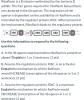 Riboflavin is a B vitamin synthesized by the bacteria B. subtilis. The four genes required for riboflavin biosynthesis are clustered in the rib operon. The expression of the operon is dependent on the availability of riboflavin and is controlled by the regulator protein, RibC. When present in the environment, Riboflavin binds to the regulatory protein. m2 (ribo r z @ riboribb riba ribH Use this information to respond to the following questions. A. Is the rib operon expressed when riboflavin...
9. How would you describe the generation time of a population? 10. Given that white tailed...
9. How would you describe the generation time of a population? 10. Given that white tailed deer give birth to fawns each spring, which population growth model would be the most appropriate and why? 11. If a life table projects a population size of 100 females and the sex ratio of the population is one-to-one, how large is the entire population? 12. In a life table, what is the fundamental different between survival rate and survivorship in words and in...
 Define terms . Explain concept or process binary fission, generation, generation time, disinfection, antisepsis, sterilization, aseptic, degerming, sanitization, pasteurization, non- ionizing and ionizing, surfactants, lag phase, exponential (log) phase, stationary phage, death phase, pyrimidines, antimicrobial, bacteriostatic, bactericidal, bacteriolytic, fastidious, mannitol salt agar, blood agar How to teichoic wall proteins, m-proteins and mycolic acids add to an organism virulence? (last week) • Describe binary fission Name where, and explain why, on the bacterial growth curve microbes are: Most virulent, most difficult...
 1:23 h Date Laboratory Report 45) Determination of a Bacterial Growth Curve and the Generation Time of a Culture 1. Collect your data on alsorance in the following table. Inbeton Time Absorbance 600 m 083 336 SIE .769 971 150 2. Estimate the generation time for this E. coli culture by the indirect method using your growth curve graph and extrapolations from the absorbances for doubling. Be sure to put UNITS on your answers. * From growth curve (indicate what...
 QUESTION 22 Explain how sexual reproduction overcomes the inherent disadvantage of generation time in the host of an asexually reproducing pathogen. TTT Arial 3 (12pt) : T. E.S.'s
 Riboflavin is a B vitamin synthesized by the bacteria B. subtilis. The four genes required for riboflavin biosynthesis are clustered in the rib operon. The expression of the operon is dependent on the availability of riboflavin and is controlled by the regulator protein, RibC. When present in the environment, Riboflavin binds to the regulatory protein. m2 (ribo r z @ riboribb riba ribH Use this information to respond to the following questions. A. Is the rib operon expressed when riboflavin...
Most questions answered within 3 hours.
-
Where is the error in this code sequence?
String s1 = "Hello";
String s2 = "ello";...
asked 10 months ago -
Financial data for Joel de Paris, Inc., for last year
follow:
Joel de Paris, Inc.
Balance...
asked 10 months ago -
Consider this reaction:
Al2(SO4)3 (aq)+ BaCl3
(aq) Al2Cl6 (aq)- +
3BaSO4(s) . What is the...
asked 10 months ago -
Suppose that Savneet is considering increasing her
recent random sample from 20 car rentals to 40...
asked 10 months ago -
Trucks arrive at an unloading terminal at an average rate of 120
per hour.
Trucks arrive...
asked 10 months ago -
Why are methanol and ethanol completely soluble in water while
octanol is not very little soluble....
asked 10 months ago -
A facilities manager at a university reads in a research report
that the mean amount of...
asked 10 months ago -
When the CuSO4 is rehydrated by adding water to the anhydrous
compound, is this an endothermic...
asked 10 months ago -
A ray of sunlight is passing from diamond into crown glass; the
angle of incidence is...
asked 10 months ago -
A block of mass 0.249 kg is placed on top of a light, vertical
spring of...
asked 10 months ago -
how do the kidneys compensate in the presences of acidosis
a) trigger hyperventilate
b) reserve acid...
asked 10 months ago -
Question 501 pts
The rental rate of capital to the firm increases. Which of the
following...
asked 10 months ago