chloroplast: 1) describe 2 examples of how form is linked to function. 2) what Is the...
chloroplast:
1) describe 2 examples of how form is linked to function.
2) what Is the name of the electron donor and final electron
acceptor for light dependent reactions (overall photosystem 1 and
2)
3) similarities and differences in ATP production between
mitochondria and chloroplast
Homework Answers
Answer-:
1) Describe 2 examples of how form is linked to function.
Explanation-
a-The photosysnthesis are follow for food formation like sugar (carbohydrate) and biomaas (carbon)storage for plant life spun.
b-In this process oxygen is most important product that is the base of life of our biotic system.
2) What is the name of the electron doner and final electron acceptor for light dependent reactions (overall photosystem 1 and 2) ?
Explanation-
Process of light dependent reaction-:
1- Light energy splits water and extracts electron in photosystem II (PS II) ;then electron are moved from PS-II to cytochrome b6f to photosysem I (PS-I) and reduse energy.
2-Electron are re energized in PS-I and those high energy electrons reduce NADP+ to NADPH.
3-In non cyclic photophosphorylation cytochrome b6f uses the energy of electrons from PS-II to pump hydrogen ion from the lumen to the stroma ;this energy allows ATP synthase to attach a third phosphate group to ADP,which from ATP.
4-In cyclic photophosphorylation ,cytochrome b6f uses the energy of electrons from both PS-II to PS-I to create more ATPand to stop the production of NADPH ,maintaining the right proportions of NADPH and ATP.
KEY TERMS-:
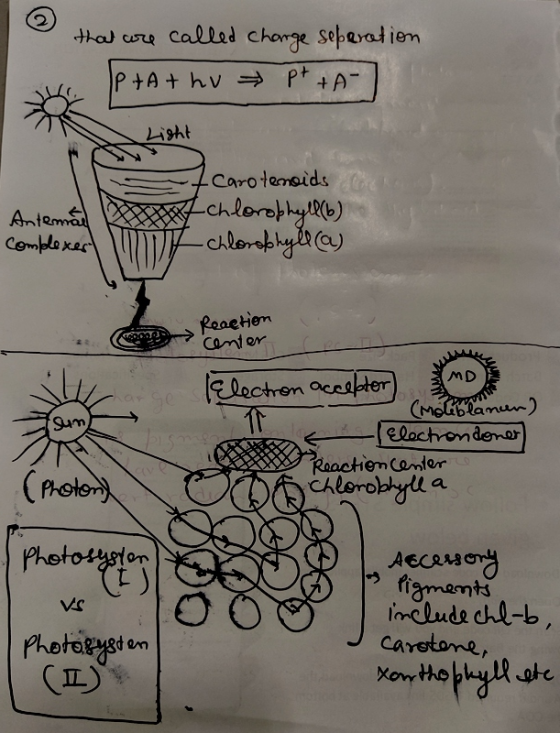
1-PHOTOSYSTEM- Either of two biochemical system active in chloroplast that are part of photosynthesis .
2-Photophosphorylation-The addition of a phosphate(PO43-) group to a protein or other organic molecule by photosynthesis.
3-Chemiosmosis-The movement of ion across a selectively
permeable membrane down their electrochemical
gradient.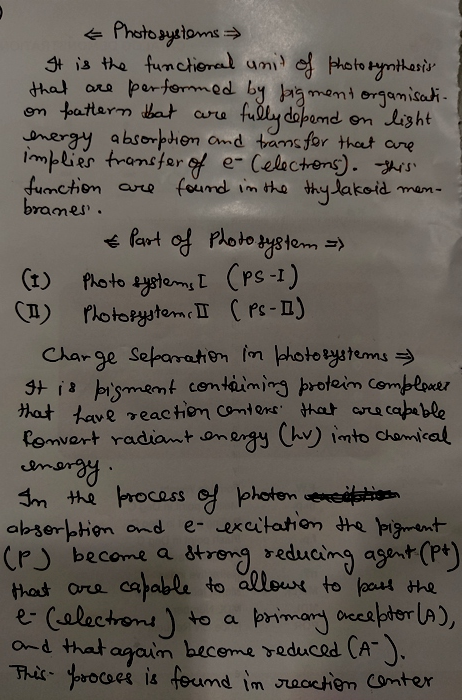
3)Similarities and differences in ATP production between mitochondria and chloroplast.
Explanation-
Similarities
Mitochondria and chloroplast both have:
- A double membrane surrounding the organelles.
- Purportedly prokaryotic origins according to the endosymbiotic theory which suggests that mitochondria and chloroplast were once prokaryotic bacteria engulfed by endocytosis in early eukaryotes.
- Their own circular DNA which codes for certain enzymes required for the chemical reactions that take place in these organelles.
- Their own 70S ribosomes made up of 50S and 30S subunits to translate proteins
- The enzyme ATP synthase which utilizes the energy released from the movement of protons across it (proton-motive force) to phosphorylate ADP to ATP. (Thus, another similarity would be that they both produce ATP)
- Electron transport chains, which are embedded in the inner mitochondrial membrane and thylakoid membrane in mitochondria and chloroplasts respectively.
- Both organelles have chemical cycles in which the initial acceptor is regenerated at the end of the cycle. In mitochondria, the Krebs cycle occurs after which oxaloacetate is regenerated at the end of the reaction. In chloroplasts, the Calvin cycle occurs in which ribulose bisphosphate (RuBP) is regenerated at the end of the reaction.
Differences
- Obvious structural and naming differences that you should be able to figure out from the diagram above.
- Mitochondria are involved in cellular respiration whereas chloroplasts are involved in photosynthesis. Thus, the overall chemical reactions for the processes occurring in them are different and reversed.
-
- Respiration: C6H12O6+6O2 ---> 6CO2+6H2O+ATP
- Photosynthesis: 6CO2+6H2O --->C6H12O6+6O2
- Mitochondria are found in all animal and plant cells. Chloroplasts, however, are found in only specific types of plant cells, such as the palisade mesophyll and spongy mesophyll cells of leaves. These cells are the ones involved in carrying out photosynthesis. Other types of plant cells, such as root cells do not contain chloroplasts.
- Chloroplasts contain pigments such as chlorophyll a, chlorophyll b and carotenoids. Mitochondria do not contain any such pigments.
- The ATP synthase in mitochondria and chloroplast are orientated differently. ATP synthase in mitochondria points into the matrix, with protons flowing from the intermembrane space to the matrix. In chloroplasts however, ATP synthase points towards the stroma, and protons flow from the thylakoid space into the stroma.
- The types of electron acceptors present in mitochondria and chloroplast vary. While mitochondria contain NAD and FAD, chloroplasts contain NADP.
- The sources of energy used to synthesize ATP in mitochondria and chloroplasts are different. In mitochondria, this energy comes from the oxidation of glucose, and is hence termed oxidative phosphorylation. In chloroplast, this energy comes from light, so it is called photophosphorylation.
- Mitochondria function under both light and dark conditions. Chloroplasts, on the other hand, do need light to function.
- Electron transport chains: The final electron acceptor in mitochondria is oxygen, whereas the final electron acceptor in chloroplasts is NADP.
- In mitochondria, the root source of electrons is generally glucose (it could be other substrates depending on what was utilized). In chloroplasts, however, the root source of electrons is the photolysis of water occurring at photosystem II. Water (H2O) is broken down to release 2 protons, 2 electrons and a molecule of oxygen.
- Mitochondria give out carbon dioxide from the decarboxylation (removal of carbon)reactions that occur during the link reaction and Krebs cycle but chloroplasts give out oxygen due to photolysis as explained above.
Reference-: LUMEN boundless biology.
Quora (A level biology... by -Rozalin Mohanty).
Add Answer to:
chloroplast:
1) describe 2 examples of how form is linked to function.
2) what Is the...
How many membranes does the chloroplast have? 30. How many membranes doos the mitochondria have? 31....
 How many membranes does the chloroplast have? 30. How many membranes doos the mitochondria have? 31. A stack of thylakoids are known as d, 4 e, 3 a. Thylakoid dises b, c. thy lakoid lumen 32. The products produced in the light independent reaction are used to drive the light dependent reac a. True b, False 33. The ATP and NADPH produces in the light reaction are used to drive the synthesis of sugars from CO2 a. True b. False...
19. How many membranes does the chloroplast have 50. How many membranes does the mitochondria have?...
 19. How many membranes does the chloroplast have 50. How many membranes does the mitochondria have? 0.4 C3 31 A stack of this lakoids are known as: granum Thylakoid dises Grama ethylakid lumen 32. The products produced in the light independent reaction are used to drive the light dependent reaction . Stroma Trie h. False 33. The Aland NADPI pride in the light reaction are used to drive the synthesis of gars from CO2 True 34. Photosystem II in photosynthesis,...
please label important parts. Cellular Respiration begins with biologycomer.com GLYCOLYSIS PYRUVATE FERMENTATION OXYGEN KREB'S CYCLE GLUCOSE...
 please label important parts.
Cellular Respiration begins with biologycomer.com GLYCOLYSIS PYRUVATE FERMENTATION OXYGEN KREB'S CYCLE GLUCOSE ETHANOL ACETYL-COA MITOCHONDRIAL MATRIX LACTIC ACID MITOCHONDRIAL CHRISTAE CARBON DIOXIDE CYTOPLASM ELECTRON TRANSPORT CHAIN ATP SNADH 2 FAOH 2 ATP 2 NADH 36 ATP which is broken down during which occurs in the 0 9900 30 coerrymes produces a net gain of results in 2 molecules of produces O in the can be used in that is used in requires releases which is oxidized,...
please label important parts.
Cellular Respiration begins with biologycomer.com GLYCOLYSIS PYRUVATE FERMENTATION OXYGEN KREB'S CYCLE GLUCOSE ETHANOL ACETYL-COA MITOCHONDRIAL MATRIX LACTIC ACID MITOCHONDRIAL CHRISTAE CARBON DIOXIDE CYTOPLASM ELECTRON TRANSPORT CHAIN ATP SNADH 2 FAOH 2 ATP 2 NADH 36 ATP which is broken down during which occurs in the 0 9900 30 coerrymes produces a net gain of results in 2 molecules of produces O in the can be used in that is used in requires releases which is oxidized,...
6. What wavelengths of light provide energy for photosynthesis? 7. What does the light do? 8....
 6. What wavelengths of light provide energy for photosynthesis? 7. What does the light do? 8. Summarize photosynthesis in a chemical reaction. What is oxidized and what is reduced? 9. What part of the visible light spectrum is best at driving photosynthesis? 10. What happens in the light harvesting complex? The reaction center complex? 11. What donates the electrons to the primary electron acceptor in photosystem I? What replaces those electrons? 12. What donates electrons to photosystems 1? 13. How...
1. describe the structure (membrane) and function of the mitochondria, chloroplast, lysome and the nucleus. 2....
1. describe the structure (membrane) and function of the mitochondria, chloroplast, lysome and the nucleus. 2. describe the steps involved in endospore formation. 3. draw and label t4 bacteriaphage. 4. state the color of gram positive and gram negative bacteria in each step of the gram staining procedure. please go in depth with the answer.
8. The following molecules form during the stages of glycolysis: 1. pyruvate 2. NADH 3. Fructose-1,6...
 8. The following molecules form during the stages of glycolysis: 1. pyruvate 2. NADH 3. Fructose-1,6 biphosphate glyceraldehyde-3-phosphate (G3P) 5. phosphoenol-pyruvate (PEP) In which order do they form? a. 3,2,5,4,1 b. 1, 2, 3, 4, 5 c. 5,4,3,2,1 d. 3, 4,2,5,1 9. What is true of the organic molecules that can be used in aerobic cellular respiration? Lipids and proteins can be used, but carbohydrates must be in the form of monosaccharides. b. Carbohydrates and lipids can be used, but...
25. Which of the following process takes place only in the stroma of chloroplast? (a) Calvin...
 25. Which of the following process takes place only in the stroma of chloroplast? (a) Calvin cycle (c) Glycolysis (b) Krebs cycle (d) chemiosmosis 26. The citric acid cycle can produce (a) NADH (c) FAD (b) FADH; (d) both a and b 27. The alcohol fermentation produces (a) ethanol only (c) ethanol and CO2 (b) lactate only (d) lactate and CO2 28. Which of the following polymers of glucose is! used as a vehicle to store energy reserves in animal...
Using number 1 to help, I need number 2. #1: Fill in this concept map depicting...
 Using number 1 to help, I need number 2.
#1: Fill in this concept map depicting the major steps in photosynthesis in the chloroplast: absorption of absorption of the HO Od Photosystem containing containing pumps transfers to produce Synthesis ATP Word Bank: Electron Transport Chain ATP Synthase Calvin Cycle Light NADPH Chlorophyll Protons CO2 Photosystem 11 Electrons I synthesizes GBP (Sugar Building Block) #2: Fill in the table: Major Steps in Photosynthesis Does this step depend on any other step?...
Using number 1 to help, I need number 2.
#1: Fill in this concept map depicting the major steps in photosynthesis in the chloroplast: absorption of absorption of the HO Od Photosystem containing containing pumps transfers to produce Synthesis ATP Word Bank: Electron Transport Chain ATP Synthase Calvin Cycle Light NADPH Chlorophyll Protons CO2 Photosystem 11 Electrons I synthesizes GBP (Sugar Building Block) #2: Fill in the table: Major Steps in Photosynthesis Does this step depend on any other step?...
Could someone please help me answer these 5 biology questions related to photosynthesis. 1. If NADP+...
Could someone please help me answer these 5 biology questions related to photosynthesis. 1. If NADP+ is not available as the final electron acceptor, where will the electron go? Select one: a. The electron is ejected into the stroma. b. The electron is returned back to the photosystem through a series of proteins. c. The electron is donated to H2O. d. The electron is recycled directly back to the reaction center pigment. 2. Which of the following is NOT true...
que photosynthetic pigment instead of chlorophyll. The leaves of this plant always appear to be green....
 que photosynthetic pigment instead of chlorophyll. The leaves of this plant always appear to be green. What colors of light would be least effective for photosynthesis for this plant? A plant has a unique photo yellow, not green. What co A. green B. white C. red D. blue E yellow 25. Which of the following is NOT a product of the light reactions? A. NADPH В. АТР C. oxygen D. carbon dioxide 26. Which of the following are products of...
 How many membranes does the chloroplast have? 30. How many membranes doos the mitochondria have? 31. A stack of thylakoids are known as d, 4 e, 3 a. Thylakoid dises b, c. thy lakoid lumen 32. The products produced in the light independent reaction are used to drive the light dependent reac a. True b, False 33. The ATP and NADPH produces in the light reaction are used to drive the synthesis of sugars from CO2 a. True b. False...
 19. How many membranes does the chloroplast have 50. How many membranes does the mitochondria have? 0.4 C3 31 A stack of this lakoids are known as: granum Thylakoid dises Grama ethylakid lumen 32. The products produced in the light independent reaction are used to drive the light dependent reaction . Stroma Trie h. False 33. The Aland NADPI pride in the light reaction are used to drive the synthesis of gars from CO2 True 34. Photosystem II in photosynthesis,...
 please label important parts.
Cellular Respiration begins with biologycomer.com GLYCOLYSIS PYRUVATE FERMENTATION OXYGEN KREB'S CYCLE GLUCOSE ETHANOL ACETYL-COA MITOCHONDRIAL MATRIX LACTIC ACID MITOCHONDRIAL CHRISTAE CARBON DIOXIDE CYTOPLASM ELECTRON TRANSPORT CHAIN ATP SNADH 2 FAOH 2 ATP 2 NADH 36 ATP which is broken down during which occurs in the 0 9900 30 coerrymes produces a net gain of results in 2 molecules of produces O in the can be used in that is used in requires releases which is oxidized,...
please label important parts.
Cellular Respiration begins with biologycomer.com GLYCOLYSIS PYRUVATE FERMENTATION OXYGEN KREB'S CYCLE GLUCOSE ETHANOL ACETYL-COA MITOCHONDRIAL MATRIX LACTIC ACID MITOCHONDRIAL CHRISTAE CARBON DIOXIDE CYTOPLASM ELECTRON TRANSPORT CHAIN ATP SNADH 2 FAOH 2 ATP 2 NADH 36 ATP which is broken down during which occurs in the 0 9900 30 coerrymes produces a net gain of results in 2 molecules of produces O in the can be used in that is used in requires releases which is oxidized,...
 6. What wavelengths of light provide energy for photosynthesis? 7. What does the light do? 8. Summarize photosynthesis in a chemical reaction. What is oxidized and what is reduced? 9. What part of the visible light spectrum is best at driving photosynthesis? 10. What happens in the light harvesting complex? The reaction center complex? 11. What donates the electrons to the primary electron acceptor in photosystem I? What replaces those electrons? 12. What donates electrons to photosystems 1? 13. How...
 8. The following molecules form during the stages of glycolysis: 1. pyruvate 2. NADH 3. Fructose-1,6 biphosphate glyceraldehyde-3-phosphate (G3P) 5. phosphoenol-pyruvate (PEP) In which order do they form? a. 3,2,5,4,1 b. 1, 2, 3, 4, 5 c. 5,4,3,2,1 d. 3, 4,2,5,1 9. What is true of the organic molecules that can be used in aerobic cellular respiration? Lipids and proteins can be used, but carbohydrates must be in the form of monosaccharides. b. Carbohydrates and lipids can be used, but...
 25. Which of the following process takes place only in the stroma of chloroplast? (a) Calvin cycle (c) Glycolysis (b) Krebs cycle (d) chemiosmosis 26. The citric acid cycle can produce (a) NADH (c) FAD (b) FADH; (d) both a and b 27. The alcohol fermentation produces (a) ethanol only (c) ethanol and CO2 (b) lactate only (d) lactate and CO2 28. Which of the following polymers of glucose is! used as a vehicle to store energy reserves in animal...
 Using number 1 to help, I need number 2.
#1: Fill in this concept map depicting the major steps in photosynthesis in the chloroplast: absorption of absorption of the HO Od Photosystem containing containing pumps transfers to produce Synthesis ATP Word Bank: Electron Transport Chain ATP Synthase Calvin Cycle Light NADPH Chlorophyll Protons CO2 Photosystem 11 Electrons I synthesizes GBP (Sugar Building Block) #2: Fill in the table: Major Steps in Photosynthesis Does this step depend on any other step?...
Using number 1 to help, I need number 2.
#1: Fill in this concept map depicting the major steps in photosynthesis in the chloroplast: absorption of absorption of the HO Od Photosystem containing containing pumps transfers to produce Synthesis ATP Word Bank: Electron Transport Chain ATP Synthase Calvin Cycle Light NADPH Chlorophyll Protons CO2 Photosystem 11 Electrons I synthesizes GBP (Sugar Building Block) #2: Fill in the table: Major Steps in Photosynthesis Does this step depend on any other step?...
 que photosynthetic pigment instead of chlorophyll. The leaves of this plant always appear to be green. What colors of light would be least effective for photosynthesis for this plant? A plant has a unique photo yellow, not green. What co A. green B. white C. red D. blue E yellow 25. Which of the following is NOT a product of the light reactions? A. NADPH В. АТР C. oxygen D. carbon dioxide 26. Which of the following are products of...
Most questions answered within 3 hours.
-
Where is the error in this code sequence?
String s1 = "Hello";
String s2 = "ello";...
asked 11 months ago -
Financial data for Joel de Paris, Inc., for last year
follow:
Joel de Paris, Inc.
Balance...
asked 11 months ago -
Consider this reaction:
Al2(SO4)3 (aq)+ BaCl3
(aq) Al2Cl6 (aq)- +
3BaSO4(s) . What is the...
asked 11 months ago -
Suppose that Savneet is considering increasing her
recent random sample from 20 car rentals to 40...
asked 11 months ago -
Trucks arrive at an unloading terminal at an average rate of 120
per hour.
Trucks arrive...
asked 11 months ago -
Why are methanol and ethanol completely soluble in water while
octanol is not very little soluble....
asked 11 months ago -
A facilities manager at a university reads in a research report
that the mean amount of...
asked 11 months ago -
When the CuSO4 is rehydrated by adding water to the anhydrous
compound, is this an endothermic...
asked 11 months ago -
A ray of sunlight is passing from diamond into crown glass; the
angle of incidence is...
asked 11 months ago -
A block of mass 0.249 kg is placed on top of a light, vertical
spring of...
asked 11 months ago -
how do the kidneys compensate in the presences of acidosis
a) trigger hyperventilate
b) reserve acid...
asked 11 months ago -
Question 501 pts
The rental rate of capital to the firm increases. Which of the
following...
asked 11 months ago