Write a c function that rotates a 32 bit int one bit to the left using...
Write a c function that rotates a 32 bit int one bit to the left using
#define MASK0 0x00000001
#define MASK31 0x80000000
Homework Answers
solution:
#include<stdio.h>
#define INT_BITS 32
/*Function to left rotate n by 1 bits*/
int leftRotate(int n, unsigned int d)
{
/* In n<<d, last d bits are 0. To put first 3 bits of n at
last, do bitwise or of n<<d with n >>(INT_BITS - d) */
return (n << d)|(n >> (INT_BITS - d));
}
int main()
{
int n = 16;
int d = 1;
printf("Left Rotation of %d by %d is ", n, d);
printf("%d", leftRotate(n, d));
return 0;
}
Output:
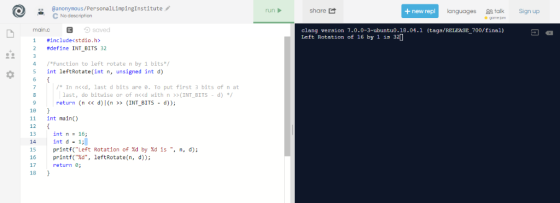
Please give thumbsup, if you like it. Thanks.
Add Answer to:
Write a c function that rotates a 32 bit int one bit to the left
using...
write a C program!! Q2 and Q3 Write the following functioned int search(int a[], int n,...
 write a C program!! Q2 and Q3
Write the following functioned int search(int a[], int n, int key, int **loc); a is an array to be searched, n is the number of elements in the array, key is the search key, and loc is a pointer to the first location of the search key in array a (if found) or NULL otherwise. The function returns 1 if key is found in a, and returns 0 otherwise. Write a main() and...
write a C program!! Q2 and Q3
Write the following functioned int search(int a[], int n, int key, int **loc); a is an array to be searched, n is the number of elements in the array, key is the search key, and loc is a pointer to the first location of the search key in array a (if found) or NULL otherwise. The function returns 1 if key is found in a, and returns 0 otherwise. Write a main() and...
Write a program in C that reads a string of bits( so either a one or...
Write a program in C that reads a string of bits( so either a one or zero) in from the user one char at a time using the function getChar, which returns a char. hint in order to convert a char to an int, subtract the character. Then store the bits into an array. start with this: #include "stdio.h" #define MAX_BITS 32 int main() { printf("Enter up to 32 bits (hit 'enter' to terminate early): "); char bit = getchar();...
Write a C function that takes a long int y as argument as well as two...
Write a C function that takes a long int y as argument as well as two integers n and m, the function should swap byte i and j of a long int y (64-Bit Integer).and returns a long int. long int swapBytes(long int y, int i, int j) Rules: Not allowed to use division, multiplication, or modulus, relative comparison (<, >, <=, >=), loops, switches, function calls, macros, conditionals (if or ?:) ALLOWED to use all bit level and logic...
Defining a binary in c language, write the function int binToDec(const int bin[]) to convert an...
Defining a binary in c language, write the function int binToDec(const int bin[]) to convert an eight-bit unsigned binary number to a nonnegative decimal integer. Do not output the decimal integer in the function. Test your function with interactive input?
Done in C++ using visual studio 1. Write a program with one additional function called int[]...
Done in C++ using visual studio 1. Write a program with one additional function called int[] reverseArray(int array). This function will receive an array from main and then reverse and should return the reversed array to the main to print out. Use a single array and a single loop, you’re are neither allowed to print out just in reverse order nor allowed to use another array variable to store the original array in reverse order. 2. Write a program which...
I need help doing the code using Verilog modelsim Design a 32-bit register using the D...
I need help doing the code using Verilog modelsim Design a 32-bit register using the D Flip-Flop from part (1) so that it has the following features: (a) The Register has these ports Outputs: Q[31:0] Inputs: D[31:0] CLK is the clock signal EN is a synchronous signal for enabling the register. When EN is asserted at the sensitive edge of the CLK, the input D is loaded into the register. RESET We will leave this input unconnected, but will define...
C++ clock.h /* Write a function get_hours that returns an int and accepts an int seconds_since_1970...
C++ clock.h /* Write a function get_hours that returns an int and accepts an int seconds_since_1970 parameter */ int get_hours(int seconds_since_1970); /* Write a function get_minutes that returns an int and accepts an int seconds_since_1970 parameter */ int get_minutes(int seconds_since_1970); /* Write a function get_seconds that returns an int and accepts an int seconds_since_1970 parameter */ int get_seconds(int seconds_since_1970); clock.cpp #include "clock.h" /* Write get_hours code to return hours given seconds since 1970 int */ /* Write get_minutes code to...
In C im trying write a method where the int parameter is converted from decimal to...
In C im trying write a method where the int parameter is converted from decimal to binary and then adds up the groups of ones in the number, this is what I have so far. keeps failing for countGroups(0x80000000). int countGroups(int num){ int count, one, rem; count = 0; one = 0; while(num>0){ rem = num %2; if(rem ==1){ if(one == 0){ count = count + 1; } one = 1; } ...
Using lenguague C E5.5 (página 239) Write a function setbits(int x.char p.char n) that returns x...
 Using lenguague C
E5.5 (página 239) Write a function setbits(int x.char p.char n) that returns x with the n bits that begin at position p inverted (ie 1 changed to O and vice versa). Consider the position 0 the least significant bit of the variable x (remember that x is an integer)
Using lenguague C
E5.5 (página 239) Write a function setbits(int x.char p.char n) that returns x with the n bits that begin at position p inverted (ie 1 changed to O and vice versa). Consider the position 0 the least significant bit of the variable x (remember that x is an integer)
using C: Write code for a function with the following prototype: /* * Mask with least...
using C: Write code for a function with the following prototype: /* * Mask with least signficant n bits set to 1 * Examples: n = 6 --> 0x3F, n = 17 --> 0x1FFFF * Assume 1 <= n <= w */ int lower_one_mask(int n); Your function should follow the bit-level integer coding rules. Be careful of the case n =w.
 write a C program!! Q2 and Q3
Write the following functioned int search(int a[], int n, int key, int **loc); a is an array to be searched, n is the number of elements in the array, key is the search key, and loc is a pointer to the first location of the search key in array a (if found) or NULL otherwise. The function returns 1 if key is found in a, and returns 0 otherwise. Write a main() and...
write a C program!! Q2 and Q3
Write the following functioned int search(int a[], int n, int key, int **loc); a is an array to be searched, n is the number of elements in the array, key is the search key, and loc is a pointer to the first location of the search key in array a (if found) or NULL otherwise. The function returns 1 if key is found in a, and returns 0 otherwise. Write a main() and...
 Using lenguague C
E5.5 (página 239) Write a function setbits(int x.char p.char n) that returns x with the n bits that begin at position p inverted (ie 1 changed to O and vice versa). Consider the position 0 the least significant bit of the variable x (remember that x is an integer)
Using lenguague C
E5.5 (página 239) Write a function setbits(int x.char p.char n) that returns x with the n bits that begin at position p inverted (ie 1 changed to O and vice versa). Consider the position 0 the least significant bit of the variable x (remember that x is an integer)
Most questions answered within 3 hours.
-
Where is the error in this code sequence?
String s1 = "Hello";
String s2 = "ello";...
asked 1 year ago -
Financial data for Joel de Paris, Inc., for last year
follow:
Joel de Paris, Inc.
Balance...
asked 1 year ago -
Consider this reaction:
Al2(SO4)3 (aq)+ BaCl3
(aq) Al2Cl6 (aq)- +
3BaSO4(s) . What is the...
asked 1 year ago -
Suppose that Savneet is considering increasing her
recent random sample from 20 car rentals to 40...
asked 1 year ago -
Trucks arrive at an unloading terminal at an average rate of 120
per hour.
Trucks arrive...
asked 1 year ago -
Why are methanol and ethanol completely soluble in water while
octanol is not very little soluble....
asked 1 year ago -
A facilities manager at a university reads in a research report
that the mean amount of...
asked 1 year ago -
When the CuSO4 is rehydrated by adding water to the anhydrous
compound, is this an endothermic...
asked 1 year ago -
A ray of sunlight is passing from diamond into crown glass; the
angle of incidence is...
asked 1 year ago -
A block of mass 0.249 kg is placed on top of a light, vertical
spring of...
asked 1 year ago -
how do the kidneys compensate in the presences of acidosis
a) trigger hyperventilate
b) reserve acid...
asked 1 year ago -
Question 501 pts
The rental rate of capital to the firm increases. Which of the
following...
asked 1 year ago