Find the equivalent Henderson-Hasselbach Equation for A- + H2O --> HA + OH- , pOH =...
Find the equivalent Henderson-Hasselbach Equation for A- + H2O --> HA + OH- , pOH = f(pKb, [HA], [A- ])
Homework Answers

Add Answer to:
Find the equivalent Henderson-Hasselbach Equation for A- + H2O
--> HA + OH- , pOH =...
1. Calculate the charge on the side chain of the amino acid histidine using the Henderson-Hasselbach...
1. Calculate the charge on the side chain of the amino acid histidine using the Henderson-Hasselbach equation pH = pKa + log (A/HA+). Use pH =7 and a pKa = 6 and solve to 2 significant figures. 2. Cysteine proteases have unusually reactive cysteine side chains. For one of these enzymes in solution at pH 7 you are able to measure the amount of the deprotonated sulfhydryl (ie, the negatively charged species) as 40% of the total. Calculate the pKa...
Extra Credit Question (5 points): 1. Derive the Henderson-Hasselbach equation for weak acids. I have given...
 Extra Credit Question (5 points): 1. Derive the Henderson-Hasselbach equation for weak acids. I have given you the equation below. ] pH = pk. - log [nonionized [ionized ] Start from here: K = [H*][A] [HA]
The pKa of aspirin (a.k.a. acetylsalicylic acid) is 3.40. Use the Henderson-Hasselbach equation to calculate the...
The pKa of aspirin (a.k.a. acetylsalicylic acid) is 3.40. Use the Henderson-Hasselbach equation to calculate the ratio of acetylsalicylate (i.e., the conjugate base of aspirin) to aspirin in the stomach at pH = 1.75.
The pKa of aspirin (a.k.a. acetylsalicylic acid) is 3.40. Use the Henderson-Hasselbach equation to calculate the...
The pKa of aspirin (a.k.a. acetylsalicylic acid) is 3.40. Use the Henderson-Hasselbach equation to calculate the ratio of acetylsalicylate (i.e., the conjugate base of aspirin) to aspirin in the stomach at pH = 1.75.
Solve for pH using henderson hasselbach equation a. a solution that is 0.195 M in HC2H3O2...
Solve for pH using henderson hasselbach equation a. a solution that is 0.195 M in HC2H3O2 and 0.110 M in KC2H3O2 b. a solution that is 0.255 M in CH3NH2 and 0.130 M in CH3NH3Br express using two decimal places
Use the Henderson-Hasselbach equation to calculate the mass of solid sodium acetate required to mix with...
Use the Henderson-Hasselbach equation to calculate the mass of solid sodium acetate required to mix with 50.0 mL of 0.10 M acetic acid to prepare a pH 4 buffer. Ka for acetic acid is 1.8 x 10⁻⁵.
3. a. Use the Henderson-Hasselbach equation to determine the ratio of HCO3- to H2CO3 in the...
3. a. Use the Henderson-Hasselbach equation to determine the ratio of HCO3- to H2CO3 in the patient’s blood 10 hours after aspirin ingestion. b. How does this compare to the ratio of HCO3- to H2CO3 in normal blood (indicate value used from the range given in the table). (pKa1=6.35). c. Can the H2CO3/HCO3- system serve as an effective buffer in this patient? Explain
Henderson-Hasselbach equation: pH- pKa log (IA-|/IHA]) 1. Phosphate buffer is a mixture of KH2PO4 and K2HPO4....
 Henderson-Hasselbach equation: pH- pKa log (IA-|/IHA]) 1. Phosphate buffer is a mixture of KH2PO4 and K2HPO4. Note that KH2PO4 has one additional proton. The pKa of the acid is 6.8. Use the Henderson-Hasselbach equation (above) to calculate the ratio of [K2HPO41[KH2PO4] needed to make a solution that is pH 7.2 2. To make a solution that is 0.2 M phosphate, the concentration of KH2PO4 and K2HPO4 must add up to 0.2 M. Use the ratio you calculated above, and the...
Question 7 1 pts Which term in the Henderson-Hasselbach equation determines how much the pH will...
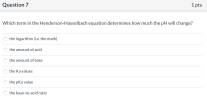 Question 7 1 pts Which term in the Henderson-Hasselbach equation determines how much the pH will change? the logarithm (i.e. the math) the amount of acid the amount of base the Ka values the pka value the base-to-acid ratio Question 8 1 pts What determines the buffer capacity for a buffer? the logarithm (i.e. the math) the amount of acid and base 0 0 öö the Ka or pKa value the base-to-acid ratio
10. Looking at the Henderson-Hasselbalch equation, what would be required to use the ratio as "[HA][A]"...
 10. Looking at the Henderson-Hasselbalch equation, what would be required to use the ratio as "[HA][A]" instead of "Ay[HA]" in the log argument? In other words, manipulate the equation so that the ratio in the log part is inverted. HINT! Remember "properties of logs" and what it means to invert a ratio. I want you to rewrite the Henderson-Hasselbalch equation here so that it is correct but uses "[HA][A]" instead of “[A][HA]" in the log argument, the equation should look...
 Extra Credit Question (5 points): 1. Derive the Henderson-Hasselbach equation for weak acids. I have given you the equation below. ] pH = pk. - log [nonionized [ionized ] Start from here: K = [H*][A] [HA]
 Henderson-Hasselbach equation: pH- pKa log (IA-|/IHA]) 1. Phosphate buffer is a mixture of KH2PO4 and K2HPO4. Note that KH2PO4 has one additional proton. The pKa of the acid is 6.8. Use the Henderson-Hasselbach equation (above) to calculate the ratio of [K2HPO41[KH2PO4] needed to make a solution that is pH 7.2 2. To make a solution that is 0.2 M phosphate, the concentration of KH2PO4 and K2HPO4 must add up to 0.2 M. Use the ratio you calculated above, and the...
 Question 7 1 pts Which term in the Henderson-Hasselbach equation determines how much the pH will change? the logarithm (i.e. the math) the amount of acid the amount of base the Ka values the pka value the base-to-acid ratio Question 8 1 pts What determines the buffer capacity for a buffer? the logarithm (i.e. the math) the amount of acid and base 0 0 öö the Ka or pKa value the base-to-acid ratio
 10. Looking at the Henderson-Hasselbalch equation, what would be required to use the ratio as "[HA][A]" instead of "Ay[HA]" in the log argument? In other words, manipulate the equation so that the ratio in the log part is inverted. HINT! Remember "properties of logs" and what it means to invert a ratio. I want you to rewrite the Henderson-Hasselbalch equation here so that it is correct but uses "[HA][A]" instead of “[A][HA]" in the log argument, the equation should look...
Most questions answered within 3 hours.
-
Where is the error in this code sequence?
String s1 = "Hello";
String s2 = "ello";...
asked 10 months ago -
Financial data for Joel de Paris, Inc., for last year
follow:
Joel de Paris, Inc.
Balance...
asked 10 months ago -
Consider this reaction:
Al2(SO4)3 (aq)+ BaCl3
(aq) Al2Cl6 (aq)- +
3BaSO4(s) . What is the...
asked 10 months ago -
Suppose that Savneet is considering increasing her
recent random sample from 20 car rentals to 40...
asked 10 months ago -
Trucks arrive at an unloading terminal at an average rate of 120
per hour.
Trucks arrive...
asked 10 months ago -
Why are methanol and ethanol completely soluble in water while
octanol is not very little soluble....
asked 10 months ago -
A facilities manager at a university reads in a research report
that the mean amount of...
asked 10 months ago -
When the CuSO4 is rehydrated by adding water to the anhydrous
compound, is this an endothermic...
asked 10 months ago -
A ray of sunlight is passing from diamond into crown glass; the
angle of incidence is...
asked 10 months ago -
A block of mass 0.249 kg is placed on top of a light, vertical
spring of...
asked 10 months ago -
how do the kidneys compensate in the presences of acidosis
a) trigger hyperventilate
b) reserve acid...
asked 10 months ago -
Question 501 pts
The rental rate of capital to the firm increases. Which of the
following...
asked 10 months ago