On a F1 track, a curve of radius of curvature R is inclined at an angle...
On a F1 track, a curve of radius of curvature R is inclined at an angle θ towards the centre of curvature so to prevent the cars to slide outward. If the top velocity of cars in that section is v, what is the minimum angle required to not let them slide out of the track?
Homework Answers
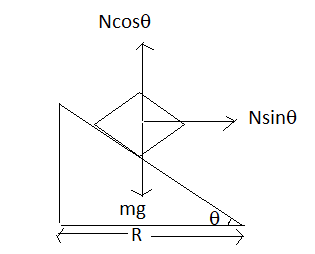
Net force acting on the car in the vertical direction is zero,

Net force acting on the car in the horizontal direction is

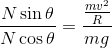

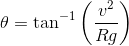
Minimum angle required is
Add Answer to:
On a F1 track, a curve of radius of curvature R is inclined at
an angle...
A section of a high speed test track is circular with a radius of curvature R...
 A section of a high speed test track is circular with a radius
of curvature R = 1700 m.
At what angle of θ should the track be inclined so that a car
traveling at 77.0 m/s (172 mph) would keep moving in a circle if
there is oil on that section of the track, i.e., it would not slip
sideways even with zero friction on that section. (Hint: The car's
vertical acceleration is zero.)
A section of a high speed test track is circular with a radius
of curvature R = 1700 m.
At what angle of θ should the track be inclined so that a car
traveling at 77.0 m/s (172 mph) would keep moving in a circle if
there is oil on that section of the track, i.e., it would not slip
sideways even with zero friction on that section. (Hint: The car's
vertical acceleration is zero.)
A section of a high speed test track is circular with a radius of curvature R...
A section of a high speed test track is circular with a radius of curvature R = 1620 m. At what angle of θ should the track be inclined so that a car traveling at 65.0 m/s (145 mph) would keep moving in a circle if there is oil on that section of the track, i.e., it would not slip sideways even with zero friction on that section. (Hint: The car's vertical acceleration is zero.)
A car rounds a curve that is banked inward. The radius of curvature of the road...
 A car rounds a curve that is banked inward. The radius of curvature
of the road is R = 140 m, the banking angle is θ = 26°, and the
coefficient of static friction is μs = 0.39. Find the minimum speed
that the car can have without slipping.
A car rounds a curve that is banked inward. The radius of curvature of the road is R 140 m, the banking angle is 26e, and the coefficient of static minimum...
A car rounds a curve that is banked inward. The radius of curvature
of the road is R = 140 m, the banking angle is θ = 26°, and the
coefficient of static friction is μs = 0.39. Find the minimum speed
that the car can have without slipping.
A car rounds a curve that is banked inward. The radius of curvature of the road is R 140 m, the banking angle is 26e, and the coefficient of static minimum...
A car rounds a curve that is banked inward. The radius of curvature of the road...
A car rounds a curve that is banked inward. The radius of curvature of the road is R = 152 m, the banking angle is θ = 32°, and the coefficient of static friction is μs = 0.23. Find the minimum speed that the car can have without slipping.
A car rounds a curve that is banked inward. The radius of curvature of the road...
A car rounds a curve that is banked inward. The radius of curvature of the road is R = 142 m, the banking angle is θ = 30°, and the coefficient of static friction is μs = 0.32. Find the minimum speed that the car can have without slipping. I got 36.5196 m/s, which isn't correct.
Consider a car moving on a circular track of radius R with constant velocity v. The...
Consider a car moving on a circular track of radius R with constant velocity v. The track is inclined at an angle β with respect to the ground, such that the interior of the track is lower than the exterior and the tangent of β is greater than the coefficient of static friction of the track µ. (Answer questions in terms of g, R, β and µ.) (1) Draw a free body diagram of the car for v 6= 0....
12. (5 points) A speedway turn, with radius of curvature R, is banked at an angle 0 above the horizontal. If the track surface is ice-free and R 450.0 m, there is a coefficient of friction ,,-0.6...
 12. (5 points) A speedway turn, with radius of curvature R, is banked at an angle 0 above the horizontal. If the track surface is ice-free and R 450.0 m, there is a coefficient of friction ,,-0.65 between the tires and the track, and the 3-450°, what are the m n speeds at which this turn can be taken? 13. (10 points) Rolling down problem. Start from rest Final speed A spherical shell of mass M-0.5 kg and radius R-0.5m...
7. A highway curve with a radius of R metres is banked so that cars moving at v m/s around the curve do not have to rely on friction when taking the turn. IWPS 7. No.4] 7.1 Show (from first principle...
 7. A highway curve with a radius of R metres is banked so that cars moving at v m/s around the curve do not have to rely on friction when taking the turn. IWPS 7. No.4] 7.1 Show (from first principles) that the angle, 6, at which, the road should be banked is given by: 0 arctan 7.2 A particular banked highway curve with a radius of 200 m is designed for traffic moving at 60 km/h. On a rainy...
A circular hoop of mass m, radius r, and infinitesimal thickness rolls without slipping down a ramp inclined at an angle θ with the horizontal. (Intro 1figure)
 A circular hoop of mass m, radius r, and
infinitesimal thickness rolls without slipping down a ramp inclined at an angle θ with the
horizontal. (Intro 1figure)part a)What is the acceleration of
the center of the hoop?Express the acceleration in terms of physical constants and all or some of the
quantities m,r,and θ.part b)What is the minimum coefficient of
(static)friction needed
for the hoop to roll without slipping? Note that it is static and
not kinetic friction that is relevant here,...
A circular hoop of mass m, radius r, and
infinitesimal thickness rolls without slipping down a ramp inclined at an angle θ with the
horizontal. (Intro 1figure)part a)What is the acceleration of
the center of the hoop?Express the acceleration in terms of physical constants and all or some of the
quantities m,r,and θ.part b)What is the minimum coefficient of
(static)friction needed
for the hoop to roll without slipping? Note that it is static and
not kinetic friction that is relevant here,...
A loaded penguin sled weighing 89.0 N rests on a plane inclined at angle θ = 21.0° to the...
A loaded penguin sled weighing 89.0 N rests on a plane inclined at angle θ = 21.0° to the horizontal (see the figure). Between the sled and the plane, the coefficient of static friction is 0.260, and the coefficient of kinetic friction is 0.130. (a) What is the minimum magnitude of the forceF→, parallel to the plane, that will prevent the sled from slipping down the plane? (b) What is the minimum magnitude F that will start the sled moving up the plane? (c) What value of F is required to move the sled up...
 A section of a high speed test track is circular with a radius
of curvature R = 1700 m.
At what angle of θ should the track be inclined so that a car
traveling at 77.0 m/s (172 mph) would keep moving in a circle if
there is oil on that section of the track, i.e., it would not slip
sideways even with zero friction on that section. (Hint: The car's
vertical acceleration is zero.)
A section of a high speed test track is circular with a radius
of curvature R = 1700 m.
At what angle of θ should the track be inclined so that a car
traveling at 77.0 m/s (172 mph) would keep moving in a circle if
there is oil on that section of the track, i.e., it would not slip
sideways even with zero friction on that section. (Hint: The car's
vertical acceleration is zero.)
 A car rounds a curve that is banked inward. The radius of curvature
of the road is R = 140 m, the banking angle is θ = 26°, and the
coefficient of static friction is μs = 0.39. Find the minimum speed
that the car can have without slipping.
A car rounds a curve that is banked inward. The radius of curvature of the road is R 140 m, the banking angle is 26e, and the coefficient of static minimum...
A car rounds a curve that is banked inward. The radius of curvature
of the road is R = 140 m, the banking angle is θ = 26°, and the
coefficient of static friction is μs = 0.39. Find the minimum speed
that the car can have without slipping.
A car rounds a curve that is banked inward. The radius of curvature of the road is R 140 m, the banking angle is 26e, and the coefficient of static minimum...
 12. (5 points) A speedway turn, with radius of curvature R, is banked at an angle 0 above the horizontal. If the track surface is ice-free and R 450.0 m, there is a coefficient of friction ,,-0.65 between the tires and the track, and the 3-450°, what are the m n speeds at which this turn can be taken? 13. (10 points) Rolling down problem. Start from rest Final speed A spherical shell of mass M-0.5 kg and radius R-0.5m...
 7. A highway curve with a radius of R metres is banked so that cars moving at v m/s around the curve do not have to rely on friction when taking the turn. IWPS 7. No.4] 7.1 Show (from first principles) that the angle, 6, at which, the road should be banked is given by: 0 arctan 7.2 A particular banked highway curve with a radius of 200 m is designed for traffic moving at 60 km/h. On a rainy...
 A circular hoop of mass m, radius r, and
infinitesimal thickness rolls without slipping down a ramp inclined at an angle θ with the
horizontal. (Intro 1figure)part a)What is the acceleration of
the center of the hoop?Express the acceleration in terms of physical constants and all or some of the
quantities m,r,and θ.part b)What is the minimum coefficient of
(static)friction needed
for the hoop to roll without slipping? Note that it is static and
not kinetic friction that is relevant here,...
A circular hoop of mass m, radius r, and
infinitesimal thickness rolls without slipping down a ramp inclined at an angle θ with the
horizontal. (Intro 1figure)part a)What is the acceleration of
the center of the hoop?Express the acceleration in terms of physical constants and all or some of the
quantities m,r,and θ.part b)What is the minimum coefficient of
(static)friction needed
for the hoop to roll without slipping? Note that it is static and
not kinetic friction that is relevant here,...
Most questions answered within 3 hours.
-
Where is the error in this code sequence?
String s1 = "Hello";
String s2 = "ello";...
asked 11 months ago -
Financial data for Joel de Paris, Inc., for last year
follow:
Joel de Paris, Inc.
Balance...
asked 11 months ago -
Consider this reaction:
Al2(SO4)3 (aq)+ BaCl3
(aq) Al2Cl6 (aq)- +
3BaSO4(s) . What is the...
asked 11 months ago -
Suppose that Savneet is considering increasing her
recent random sample from 20 car rentals to 40...
asked 11 months ago -
Trucks arrive at an unloading terminal at an average rate of 120
per hour.
Trucks arrive...
asked 11 months ago -
Why are methanol and ethanol completely soluble in water while
octanol is not very little soluble....
asked 11 months ago -
A facilities manager at a university reads in a research report
that the mean amount of...
asked 11 months ago -
When the CuSO4 is rehydrated by adding water to the anhydrous
compound, is this an endothermic...
asked 11 months ago -
A ray of sunlight is passing from diamond into crown glass; the
angle of incidence is...
asked 11 months ago -
A block of mass 0.249 kg is placed on top of a light, vertical
spring of...
asked 11 months ago -
how do the kidneys compensate in the presences of acidosis
a) trigger hyperventilate
b) reserve acid...
asked 11 months ago -
Question 501 pts
The rental rate of capital to the firm increases. Which of the
following...
asked 11 months ago