write a recursive algorithm to find the sum of the first N terms of the series...
Homework Answers
Algorithm:
An algorithm is a step by step procedure that gives a solution to the problem.
The algorithm to find the sum of the given series is given below:
Step 1: Start
Step 2: Declare variables N
Step 3: Read values N
Step 4: calculateSum(N)
Step 4.1: If N = 1
Step 4.2: return 1
Step 4.3: Else
Step 4.4: return 1/N + calculateSum(N - 1)
Step 5: Display the return value
Step 6: Stop
Add Answer to:
write a recursive algorithm to find the sum of the first N terms of
the series...
Consider the following recursive algorithm for computing the sum of the first n cubes: S(n) =...
 Consider the following recursive algorithm for computing the sum
of the first n cubes: S(n) = 13 +
23 + … + n3.
(a) Set up a recurrence relation for the number of
multiplications made by this algorithm.
(b) Provide an initial condition for the
recurrence relation you develop at the question (a).
(c) Solve the recurrence relation of the
question (a) and present the time complexity as described at the
question number 1.
Algorithm S n) Input: A positive...
Consider the following recursive algorithm for computing the sum
of the first n cubes: S(n) = 13 +
23 + … + n3.
(a) Set up a recurrence relation for the number of
multiplications made by this algorithm.
(b) Provide an initial condition for the
recurrence relation you develop at the question (a).
(c) Solve the recurrence relation of the
question (a) and present the time complexity as described at the
question number 1.
Algorithm S n) Input: A positive...
IN MATLAB RECURSIVE FUNCTION 1. Sum of Factorials. The Recursive Function: A series that sums up...
 IN MATLAB
RECURSIVE FUNCTION 1. Sum of Factorials. The Recursive Function: A series that sums up the factorial of the natural numbers from 1 to N can be expressed as The recursive algorithm: N-1 N-2 N-3 Write independent matlab code to solve the above problem with the following methods: 1. 2. 3. A monolithic program (with no functions) A standard (non-recursive) user defined function (an a program to call it) A recursive function (an a program to call it) Test...
IN MATLAB
RECURSIVE FUNCTION 1. Sum of Factorials. The Recursive Function: A series that sums up the factorial of the natural numbers from 1 to N can be expressed as The recursive algorithm: N-1 N-2 N-3 Write independent matlab code to solve the above problem with the following methods: 1. 2. 3. A monolithic program (with no functions) A standard (non-recursive) user defined function (an a program to call it) A recursive function (an a program to call it) Test...
Write a recursive function in Python to find the sum of digits of a number. Name...
 Write a recursive function in Python to find the sum of digits
of a number. Name the function sum_of_digits. The function should
use recursive algorithm (calling itself). The function should print
out the sum of all the digits of a given number. For example,
sum_of_digits(343) should have a output of 10. Marks will be
deducted if you do not follow strictly to the
instructions.
[3]: N 1 def sum_of_digits(n): HNM in sum_of_digits (343) Out[3]: 10
Write a recursive function in Python to find the sum of digits
of a number. Name the function sum_of_digits. The function should
use recursive algorithm (calling itself). The function should print
out the sum of all the digits of a given number. For example,
sum_of_digits(343) should have a output of 10. Marks will be
deducted if you do not follow strictly to the
instructions.
[3]: N 1 def sum_of_digits(n): HNM in sum_of_digits (343) Out[3]: 10
Write a recursive static method that will return the n’th term in the Fibonacci series, a...
Write a recursive static method that will return the n’th term in the Fibonacci series, a series of numbers in which each number is the sum of the two preceding numbers. The first terms are 1, 1, 2, 3, 5, 8, 13, … Therefore fibonacci(5) will return 5.
run/call tle un/cd to compute the sum of the first 15 terms of the series: th (b) It is desired 14 n3 - 20 n2 + 5n, 110) 1,2,..15 n Develop a pseudocode of the required program. roposed algorithm in...
 run/call tle un/cd to compute the sum of the first 15 terms of the series: th (b) It is desired 14 n3 - 20 n2 + 5n, 110) 1,2,..15 n Develop a pseudocode of the required program. roposed algorithm in a flow chart if it is solved using a for loop ow the p () Write a MATLAB script file using for loop
run/call tle un/cd to compute the sum of the first 15 terms of the series: th (b)...
run/call tle un/cd to compute the sum of the first 15 terms of the series: th (b) It is desired 14 n3 - 20 n2 + 5n, 110) 1,2,..15 n Develop a pseudocode of the required program. roposed algorithm in a flow chart if it is solved using a for loop ow the p () Write a MATLAB script file using for loop
run/call tle un/cd to compute the sum of the first 15 terms of the series: th (b)...
Use the sum of the first 10 terms to approximate the sum S of the series....
 Use the sum of the first 10 terms to approximate the sum S of the series. (Round your answers to five decimal places.) 4 n 1 n 1 S Estimate the error. (Use the Remainder Estimate for the Integral Test.) error s
Use the sum of the first 10 terms to approximate the sum S of the series. (Round your answers to five decimal places.) 4 n 1 n 1 S Estimate the error. (Use the Remainder Estimate for the...
Use the sum of the first 10 terms to approximate the sum S of the series. (Round your answers to five decimal places.) 4 n 1 n 1 S Estimate the error. (Use the Remainder Estimate for the Integral Test.) error s
Use the sum of the first 10 terms to approximate the sum S of the series. (Round your answers to five decimal places.) 4 n 1 n 1 S Estimate the error. (Use the Remainder Estimate for the...
In Matlab Write a MATLAB program to calculate the sum of first 100 terms of the...
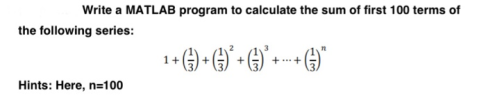 In
Matlab
Write a MATLAB program to calculate the sum of first 100 terms of the following series: 1+()+()*+(3) + + ... + Hints: Here, n=100
In
Matlab
Write a MATLAB program to calculate the sum of first 100 terms of the following series: 1+()+()*+(3) + + ... + Hints: Here, n=100
Write a matlab program to apply Horner's algorithm to evaluate the sum of the first four...
Write a matlab program to apply Horner's algorithm to evaluate the sum of the first four nonzero terms of the Taylor series for sin(x) with c=0. Your program should not use any arrays, the exponentiation operator or the factorial function. Print out your program and include the output upon execution for the special case where x = 1. How many nonzero terms of the above Taylor series are needed to guarantee that the sum approximates sin(x) to within .0001 for...
25. Find the first five terms of the recursive sequence an = n + 3an-1 where...
 25. Find the first five terms of the recursive sequence an = n + 3an-1 where a = -2.
In Java Write a recursive method called sumUpto(n) which will return the sum of the first...
In Java Write a recursive method called sumUpto(n) which will return the sum of the first n integers. For example, sumUpto(4) will return 10 because 1+2+3+4 = 10. sumUpto(5) will return 15 because 1+2+3+4+5=15. So you can see that sumUpto(5) = sumUpto(4) + 5. Make this more general for n : sumUpto(n) = sumUpto(??) + n Figure out the base case and write the method……….. import java.util.Scanner; public class Lab12Num1 { public static int sumUpto(int num) { } public...
 Consider the following recursive algorithm for computing the sum
of the first n cubes: S(n) = 13 +
23 + … + n3.
(a) Set up a recurrence relation for the number of
multiplications made by this algorithm.
(b) Provide an initial condition for the
recurrence relation you develop at the question (a).
(c) Solve the recurrence relation of the
question (a) and present the time complexity as described at the
question number 1.
Algorithm S n) Input: A positive...
Consider the following recursive algorithm for computing the sum
of the first n cubes: S(n) = 13 +
23 + … + n3.
(a) Set up a recurrence relation for the number of
multiplications made by this algorithm.
(b) Provide an initial condition for the
recurrence relation you develop at the question (a).
(c) Solve the recurrence relation of the
question (a) and present the time complexity as described at the
question number 1.
Algorithm S n) Input: A positive...
 IN MATLAB
RECURSIVE FUNCTION 1. Sum of Factorials. The Recursive Function: A series that sums up the factorial of the natural numbers from 1 to N can be expressed as The recursive algorithm: N-1 N-2 N-3 Write independent matlab code to solve the above problem with the following methods: 1. 2. 3. A monolithic program (with no functions) A standard (non-recursive) user defined function (an a program to call it) A recursive function (an a program to call it) Test...
IN MATLAB
RECURSIVE FUNCTION 1. Sum of Factorials. The Recursive Function: A series that sums up the factorial of the natural numbers from 1 to N can be expressed as The recursive algorithm: N-1 N-2 N-3 Write independent matlab code to solve the above problem with the following methods: 1. 2. 3. A monolithic program (with no functions) A standard (non-recursive) user defined function (an a program to call it) A recursive function (an a program to call it) Test...
 Write a recursive function in Python to find the sum of digits
of a number. Name the function sum_of_digits. The function should
use recursive algorithm (calling itself). The function should print
out the sum of all the digits of a given number. For example,
sum_of_digits(343) should have a output of 10. Marks will be
deducted if you do not follow strictly to the
instructions.
[3]: N 1 def sum_of_digits(n): HNM in sum_of_digits (343) Out[3]: 10
Write a recursive function in Python to find the sum of digits
of a number. Name the function sum_of_digits. The function should
use recursive algorithm (calling itself). The function should print
out the sum of all the digits of a given number. For example,
sum_of_digits(343) should have a output of 10. Marks will be
deducted if you do not follow strictly to the
instructions.
[3]: N 1 def sum_of_digits(n): HNM in sum_of_digits (343) Out[3]: 10
 run/call tle un/cd to compute the sum of the first 15 terms of the series: th (b) It is desired 14 n3 - 20 n2 + 5n, 110) 1,2,..15 n Develop a pseudocode of the required program. roposed algorithm in a flow chart if it is solved using a for loop ow the p () Write a MATLAB script file using for loop
run/call tle un/cd to compute the sum of the first 15 terms of the series: th (b)...
run/call tle un/cd to compute the sum of the first 15 terms of the series: th (b) It is desired 14 n3 - 20 n2 + 5n, 110) 1,2,..15 n Develop a pseudocode of the required program. roposed algorithm in a flow chart if it is solved using a for loop ow the p () Write a MATLAB script file using for loop
run/call tle un/cd to compute the sum of the first 15 terms of the series: th (b)...
 Use the sum of the first 10 terms to approximate the sum S of the series. (Round your answers to five decimal places.) 4 n 1 n 1 S Estimate the error. (Use the Remainder Estimate for the Integral Test.) error s
Use the sum of the first 10 terms to approximate the sum S of the series. (Round your answers to five decimal places.) 4 n 1 n 1 S Estimate the error. (Use the Remainder Estimate for the...
Use the sum of the first 10 terms to approximate the sum S of the series. (Round your answers to five decimal places.) 4 n 1 n 1 S Estimate the error. (Use the Remainder Estimate for the Integral Test.) error s
Use the sum of the first 10 terms to approximate the sum S of the series. (Round your answers to five decimal places.) 4 n 1 n 1 S Estimate the error. (Use the Remainder Estimate for the...
 In
Matlab
Write a MATLAB program to calculate the sum of first 100 terms of the following series: 1+()+()*+(3) + + ... + Hints: Here, n=100
In
Matlab
Write a MATLAB program to calculate the sum of first 100 terms of the following series: 1+()+()*+(3) + + ... + Hints: Here, n=100
 25. Find the first five terms of the recursive sequence an = n + 3an-1 where a = -2.
Most questions answered within 3 hours.
-
Where is the error in this code sequence?
String s1 = "Hello";
String s2 = "ello";...
asked 10 months ago -
Financial data for Joel de Paris, Inc., for last year
follow:
Joel de Paris, Inc.
Balance...
asked 10 months ago -
Consider this reaction:
Al2(SO4)3 (aq)+ BaCl3
(aq) Al2Cl6 (aq)- +
3BaSO4(s) . What is the...
asked 10 months ago -
Suppose that Savneet is considering increasing her
recent random sample from 20 car rentals to 40...
asked 10 months ago -
Trucks arrive at an unloading terminal at an average rate of 120
per hour.
Trucks arrive...
asked 10 months ago -
Why are methanol and ethanol completely soluble in water while
octanol is not very little soluble....
asked 10 months ago -
A facilities manager at a university reads in a research report
that the mean amount of...
asked 10 months ago -
When the CuSO4 is rehydrated by adding water to the anhydrous
compound, is this an endothermic...
asked 10 months ago -
A ray of sunlight is passing from diamond into crown glass; the
angle of incidence is...
asked 10 months ago -
A block of mass 0.249 kg is placed on top of a light, vertical
spring of...
asked 10 months ago -
how do the kidneys compensate in the presences of acidosis
a) trigger hyperventilate
b) reserve acid...
asked 10 months ago -
Question 501 pts
The rental rate of capital to the firm increases. Which of the
following...
asked 10 months ago