One selective force (or mixture of forces) limits the largest viable birth weight of a human...
-
One selective force (or mixture of forces) limits the largest viable birth weight of a human baby, while another selective force limits the smallest viable birth weight of a baby. This is called .............. natural selection.
a. Artificial
b. Fictional c. Directional d. Disruptive e. Stabilizing -
A population splits into two rather different populations. The two phenotypic extremes of the original population are favored over the more common central phenotype of the original population. This is called ............ natural selection.
a. Artificial
b. Fictional c. Directional d. Disruptive e. Stabilizing -
What type of natural selection is thought to have caused long necks in giraffes?
a. Artificial
b. Fictional c. Directional d. Disruptive e. Stabilizing -
Any change in the gene pool is called .......... a. Microevolution b. Macroevolution
Homework Answers
1. Disruptive
In the given question, phenotypes with two extreme conditions are being selected, smallest and largest viable weight of the baby. It mean it is a disruptive or destabilizing selection.
2. Disruptive
(Same as 1)
3. Directional
Whenever only one type of phenotype is collected over all the other phenotypes, it is called as directional selection. In the given question one length of neck of Giraffe have been selected, that is the longest length.
4. Mircoevolution
Microevolution is the process which gives rise to different species whereas macroevolution is the process which give rise to the origin of new era of species. In short macroevolution occurs in a very large scale.
Note -
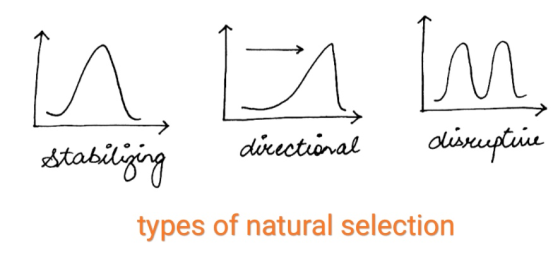
In case of stabilizing natural selection, individual having mean or intermediate phenotypes are selected.
You can see the graph of various natural selections below
Please rate.
Add Answer to:
One selective force (or mixture of forces) limits the largest
viable birth weight of a human...
LLL LULUI AL SOLULIUI 1. What are the four criteria (refer to your lecture notes) that...
 LLL LULUI AL SOLULIUI 1. What are the four criteria (refer to your lecture notes) that must be met in order for natural selection to result in the evolution of a phenotypic trait? Also, explain why a trait evolves in a population as a result of these 4 criteria being met (in other words, provide a clear and detailed explanation of why the Irequency of a phenotypic trait would increase across generations as a result of these 4 criteria being...
 LLL LULUI AL SOLULIUI 1. What are the four criteria (refer to your lecture notes) that must be met in order for natural selection to result in the evolution of a phenotypic trait? Also, explain why a trait evolves in a population as a result of these 4 criteria being met (in other words, provide a clear and detailed explanation of why the Irequency of a phenotypic trait would increase across generations as a result of these 4 criteria being...
Most questions answered within 3 hours.
-
Where is the error in this code sequence?
String s1 = "Hello";
String s2 = "ello";...
asked 10 months ago -
Financial data for Joel de Paris, Inc., for last year
follow:
Joel de Paris, Inc.
Balance...
asked 10 months ago -
Consider this reaction:
Al2(SO4)3 (aq)+ BaCl3
(aq) Al2Cl6 (aq)- +
3BaSO4(s) . What is the...
asked 10 months ago -
Suppose that Savneet is considering increasing her
recent random sample from 20 car rentals to 40...
asked 10 months ago -
Trucks arrive at an unloading terminal at an average rate of 120
per hour.
Trucks arrive...
asked 10 months ago -
Why are methanol and ethanol completely soluble in water while
octanol is not very little soluble....
asked 10 months ago -
A facilities manager at a university reads in a research report
that the mean amount of...
asked 10 months ago -
When the CuSO4 is rehydrated by adding water to the anhydrous
compound, is this an endothermic...
asked 10 months ago -
A ray of sunlight is passing from diamond into crown glass; the
angle of incidence is...
asked 10 months ago -
A block of mass 0.249 kg is placed on top of a light, vertical
spring of...
asked 10 months ago -
how do the kidneys compensate in the presences of acidosis
a) trigger hyperventilate
b) reserve acid...
asked 10 months ago -
Question 501 pts
The rental rate of capital to the firm increases. Which of the
following...
asked 10 months ago