4) The density of a sample of PMMA is 1.18 g/cm3. Estimate the enthalpy change involved...
4) The density of a sample of PMMA is 1.18 g/cm3. Estimate the enthalpy change involved in dissolving 1.0g of PMMAin 50 cm3 of benzene at 20°C. What assumptions have you made in obtaining your answer? (σbenzene = 9.15 (cal/cm3)1/2 , σPMMA = 9.09 (cal/cm3)1/2
Homework Answers
The equation which will be useful to calculate the enthalpy change is
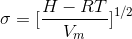
Where  Solubility parameter
H = enthalpy, here it is the heat of vaporization
T = temperature
Vm = molar volume
R = universal gas constant
Now, assuming that the polymer, PMMA, will be complete miscible in benzene, we can find the value of H for each component.
For PMMA



 C
C
R = 8.134 X 10⁷ egr K-1 mol-1


 ********************* (1)
For Benzene
Vm = 50 cm3

Hence

 *************************** (2)
Now (2) - (1)



Add Answer to:
4) The density of a sample of PMMA is 1.18 g/cm3. Estimate the
enthalpy change involved...
The density of K(s) is 0.862 g/cm3. Estimate the change in chemical potential of K(s) if...
 The density of K(s) is 0.862 g/cm3. Estimate the change in chemical potential of K(s) if the pressure is increased from 1.00 x 10 Pa to 1.20 x 10 Pa. The molar entropy of C12(9) is 223.07 J/mol-K at 298 K. Estimate the change in the chemical potential of Cl2(9) if the temperature is increased to 450 K.
A solid cylinder of uniform density of 0.85 g/cm3 floats in a glass of water tinted...
 A solid cylinder of uniform density of 0.85 g/cm3 floats in a glass of water tinted light blue by food coloring. Its circular surfaces are horizontal. What effect will the following changes, each made to the initial system, have on X, the height of the upper surface above the water? The liquids added do not mix with the Water and the cylinder never hitsS the bottom. A liquid with a density of 0.76 g/cm3 is poured into the glass. The...
Imagine that the seawater sample previously at 0◦C is now heated to 17◦C with no change in salinity. Its density (to the fourth decimal place) is now g/cm3.
Imagine that the seawater sample previously at 0◦C is now heated to 17◦C with no change in salinity. Its density (to the fourth decimal place) is now g/cm3.
A solid cylinder of uniform density of 0.85 g/cm3 floats in a glass of water tinted light blue by food coloring. Its c...
 A solid cylinder of uniform density of 0.85 g/cm3 floats in a
glass of water tinted light blue by food coloring.
Its circular surfaces are horizontal. What effect will the
following changes, each made to the initial system, have on X, the
height of the upper surface above the water? The liquids added do
not mix with the water, and the cylinder never hits the bottom.
Answer choices are: I-Increase, D-Decrease, N-No Change
(a) The cylinder is replaced with one...
A solid cylinder of uniform density of 0.85 g/cm3 floats in a
glass of water tinted light blue by food coloring.
Its circular surfaces are horizontal. What effect will the
following changes, each made to the initial system, have on X, the
height of the upper surface above the water? The liquids added do
not mix with the water, and the cylinder never hits the bottom.
Answer choices are: I-Increase, D-Decrease, N-No Change
(a) The cylinder is replaced with one...
1-) Silica gel has a bulk density of about 0.3 g/cm3, so 15 g would occupy...
1-) Silica gel has a bulk density of about 0.3 g/cm3, so 15 g would occupy a volume of 45-50 cm3 (45-50 mL). This quantity is called the: 2-) You are carrying out a chromatographic separation on a 15 mg sample using 6.5 g of silica gel in your column. If you aim for a column height of 10 cm of silica gel, what is the inside diameter of the necessary chromatography column in units of cm? 3-) Consider the...
10. Given the thermochemical data below, what is the change in enthalpy when 10.0 g of...
 10. Given the thermochemical data below, what is the change in enthalpy when 10.0 g of H, are reacted? N; (g) + 3H2(g) → 2NH, (g): AH = -91.2 kJ (A) -452 kJ (B) +452 kJ (C) -151 kJ (D) -1357 kJ 11. Which of the following is NOT a state function? 1. Heat 2. Change in enthalpy 3. Change in internal energy 4. Change in pressure (A) 1 only (B) 2 only (C) 2 and 3 (D) 1 and...
Determine the amount of heat involved in a chemical change using. Hess's Law Question 2C(s) +...
 Determine the amount of heat involved in a chemical change using. Hess's Law Question 2C(s) + 0,(g) + 2 CO(g) AH = -222 kJ 2 H, (g) + O2(g) + 2H2O(g) AH = -484 kJ H,0(1) H2O(g) AH = +44 kJ Use the thermochemical data above to calculate the change in enthalpy for the reaction below. H,0(1) + C(s) + CO(g) +H, () . Your answer should have three significant figures. Provide your answer below: Activity Details You have viewed...
1) In Millikan's experiment, an oil drop of radius 1.95 μm and density 0.857 g/cm3 is...
 1) In Millikan's experiment, an oil drop of radius 1.95 μm and
density 0.857 g/cm3 is suspended in chamber C (see the figure) when
a downward electric field of 1.36 × 10⁵ N/C is applied. Find the
charge on the drop, in terms of e.
2)In the figure a “semi-infinite” nonconducting
rod (that is, infinite in one direction only) has uniform linear
charge density λ = 1.38 μC/m. Find (including sign) (a) the
component of electric field parallel to the...
1) In Millikan's experiment, an oil drop of radius 1.95 μm and
density 0.857 g/cm3 is suspended in chamber C (see the figure) when
a downward electric field of 1.36 × 10⁵ N/C is applied. Find the
charge on the drop, in terms of e.
2)In the figure a “semi-infinite” nonconducting
rod (that is, infinite in one direction only) has uniform linear
charge density λ = 1.38 μC/m. Find (including sign) (a) the
component of electric field parallel to the...
Soil A has a volume of 297.01 cm3, a wet weight of 498.12 grams, and an...
Soil A has a volume of 297.01 cm3, a wet weight of 498.12 grams, and an oven dry weight of 356.41 grams. It has a liquid limit of 50 and a plastic limit of 20. Soil A has a moist bar length 100 cm and an air-dry bar length of 80 cm. Soil B has a volume of 297.01 cm3, a wet weight of 529.86 grams, and an oven dry weight of 445.52 grams. It has a liquid limit of...
1.) Estimate the volume change of vaporization for ammonia at 20ºC. At this temperature, the vapor...
1.) Estimate the volume change of vaporization for ammonia at 20ºC. At this temperature, the vapor pressure of ammonia is 857 kPa. 2.) Consider o-xylene at 240ºC. Determine Z and V (cm3 /mol) when: a.) P = 1 bar (vapor) b.) P = 4 bar (vapor) c.) P = 7.43 bar (saturated vapor) d.) P = 7.43 bar (saturated liquid) 3.) Consider the o-xylene from Problem 2. What is the final volume of the liquid if the saturated liquid at...
 The density of K(s) is 0.862 g/cm3. Estimate the change in chemical potential of K(s) if the pressure is increased from 1.00 x 10 Pa to 1.20 x 10 Pa. The molar entropy of C12(9) is 223.07 J/mol-K at 298 K. Estimate the change in the chemical potential of Cl2(9) if the temperature is increased to 450 K.
 A solid cylinder of uniform density of 0.85 g/cm3 floats in a glass of water tinted light blue by food coloring. Its circular surfaces are horizontal. What effect will the following changes, each made to the initial system, have on X, the height of the upper surface above the water? The liquids added do not mix with the Water and the cylinder never hitsS the bottom. A liquid with a density of 0.76 g/cm3 is poured into the glass. The...
 A solid cylinder of uniform density of 0.85 g/cm3 floats in a
glass of water tinted light blue by food coloring.
Its circular surfaces are horizontal. What effect will the
following changes, each made to the initial system, have on X, the
height of the upper surface above the water? The liquids added do
not mix with the water, and the cylinder never hits the bottom.
Answer choices are: I-Increase, D-Decrease, N-No Change
(a) The cylinder is replaced with one...
A solid cylinder of uniform density of 0.85 g/cm3 floats in a
glass of water tinted light blue by food coloring.
Its circular surfaces are horizontal. What effect will the
following changes, each made to the initial system, have on X, the
height of the upper surface above the water? The liquids added do
not mix with the water, and the cylinder never hits the bottom.
Answer choices are: I-Increase, D-Decrease, N-No Change
(a) The cylinder is replaced with one...
 10. Given the thermochemical data below, what is the change in enthalpy when 10.0 g of H, are reacted? N; (g) + 3H2(g) → 2NH, (g): AH = -91.2 kJ (A) -452 kJ (B) +452 kJ (C) -151 kJ (D) -1357 kJ 11. Which of the following is NOT a state function? 1. Heat 2. Change in enthalpy 3. Change in internal energy 4. Change in pressure (A) 1 only (B) 2 only (C) 2 and 3 (D) 1 and...
 Determine the amount of heat involved in a chemical change using. Hess's Law Question 2C(s) + 0,(g) + 2 CO(g) AH = -222 kJ 2 H, (g) + O2(g) + 2H2O(g) AH = -484 kJ H,0(1) H2O(g) AH = +44 kJ Use the thermochemical data above to calculate the change in enthalpy for the reaction below. H,0(1) + C(s) + CO(g) +H, () . Your answer should have three significant figures. Provide your answer below: Activity Details You have viewed...
 1) In Millikan's experiment, an oil drop of radius 1.95 μm and
density 0.857 g/cm3 is suspended in chamber C (see the figure) when
a downward electric field of 1.36 × 10⁵ N/C is applied. Find the
charge on the drop, in terms of e.
2)In the figure a “semi-infinite” nonconducting
rod (that is, infinite in one direction only) has uniform linear
charge density λ = 1.38 μC/m. Find (including sign) (a) the
component of electric field parallel to the...
1) In Millikan's experiment, an oil drop of radius 1.95 μm and
density 0.857 g/cm3 is suspended in chamber C (see the figure) when
a downward electric field of 1.36 × 10⁵ N/C is applied. Find the
charge on the drop, in terms of e.
2)In the figure a “semi-infinite” nonconducting
rod (that is, infinite in one direction only) has uniform linear
charge density λ = 1.38 μC/m. Find (including sign) (a) the
component of electric field parallel to the...
Most questions answered within 3 hours.
-
Where is the error in this code sequence?
String s1 = "Hello";
String s2 = "ello";...
asked 11 months ago -
Financial data for Joel de Paris, Inc., for last year
follow:
Joel de Paris, Inc.
Balance...
asked 11 months ago -
Consider this reaction:
Al2(SO4)3 (aq)+ BaCl3
(aq) Al2Cl6 (aq)- +
3BaSO4(s) . What is the...
asked 11 months ago -
Suppose that Savneet is considering increasing her
recent random sample from 20 car rentals to 40...
asked 11 months ago -
Trucks arrive at an unloading terminal at an average rate of 120
per hour.
Trucks arrive...
asked 11 months ago -
Why are methanol and ethanol completely soluble in water while
octanol is not very little soluble....
asked 11 months ago -
A facilities manager at a university reads in a research report
that the mean amount of...
asked 11 months ago -
When the CuSO4 is rehydrated by adding water to the anhydrous
compound, is this an endothermic...
asked 11 months ago -
A ray of sunlight is passing from diamond into crown glass; the
angle of incidence is...
asked 11 months ago -
A block of mass 0.249 kg is placed on top of a light, vertical
spring of...
asked 11 months ago -
how do the kidneys compensate in the presences of acidosis
a) trigger hyperventilate
b) reserve acid...
asked 11 months ago -
Question 501 pts
The rental rate of capital to the firm increases. Which of the
following...
asked 11 months ago