Which of the following are consistent, given consistent heuristics h1, h2? • h(n) = min{h1(n), h2(n)}...
Which of the following are consistent, given consistent heuristics h1, h2?
• h(n) = min{h1(n), h2(n)}
• h(n)=wh1(n)+(1−w)h2(n), where 0≤w≤1
• h(n) = max{h1(n), h2(n)}
This is an Artificial Intelligence question
Homework Answers


Add Answer to:
Which of the following are consistent, given consistent
heuristics h1, h2?
• h(n) = min{h1(n), h2(n)}...
H1,H2 > F Material: 304 SS F (N) L (mm) R (mm) H (mm) H1 (mm)...
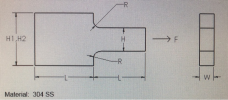 H1,H2 > F Material: 304 SS F (N) L (mm) R (mm) H (mm) H1 (mm) H2 (mm) W (mm) 105000 75 48 55 70 A) R = 0 (sharp comer) and H2 B) R and H1 as listed above C) R and H2 as listed above 2) Perform hand calculations for stress at the fillet, for B) and C) conditions. Compare to simulation results You should observe converging or diverging solutions in your Simulation (FEA) runs, depending on the...
Try this example with water first: H1 H1 H2 H2 H H Water, H20 Partial charges:...
 Try this example with water first: H1 H1 H2 H2 H H Water, H20 Partial charges: His +0.38, O is -0.75 Formal charges: His O, O is o Oxidation State: His +1, O is-2 Electrostatic potential description: The blue (positive) and red (negative) potentials are separated. That makes the molecule polar. The molecule is dark blue (quite positive) over the hydrogen atoms and dark red (quite negative) over the oxygen atom, making water very polar. And now do these two...
with h1(n)=(2)nu(n),h2(n) istheimpulseresponseof y(n)+3y(n−1)=w(n), and x(n)=(4)nu(n). (a) Determine h 2 ( n ) and the overall...
with h1(n)=(2)nu(n),h2(n) istheimpulseresponseof y(n)+3y(n−1)=w(n), and x(n)=(4)nu(n). (a) Determine h 2 ( n ) and the overall impulse response h ( n ) (b) Determine w(n) (c) Determine y(n) (d) Determine the difference equation of the overall system
Let h1(s) be an admissible A* heuristic. Let h2(s)=2*h1(s) Is the solution found by A* tree...
 Let h1(s) be an admissible A* heuristic. Let h2(s)=2*h1(s)
Is the solution found by A* tree search with h2 guaranteed to
be an optimal solution? Justify your answer
Is the solution found by A* tree search with h2 guaranteed to
have a cost at most twice as much as the optimal path? Justify your
answer
Consider the state space graph shown below in which some of the
states are missing a heuristic value. Determine the possible range
for each missing...
Let h1(s) be an admissible A* heuristic. Let h2(s)=2*h1(s)
Is the solution found by A* tree search with h2 guaranteed to
be an optimal solution? Justify your answer
Is the solution found by A* tree search with h2 guaranteed to
have a cost at most twice as much as the optimal path? Justify your
answer
Consider the state space graph shown below in which some of the
states are missing a heuristic value. Determine the possible range
for each missing...
Given to the system with the impulse responses h1(t) and the h2 (t) cos π t,...
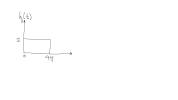 Given to the system with the impulse
responses h1(t) and the h2 (t) cos π t, 0
< t < ∞
Find the impulse response h(t) of a
new system which is a series interconnection of two mentioned
system using the convolutional integral. Present mathematical and
graphical solution.
Given to the system with the impulse
responses h1(t) and the h2 (t) cos π t, 0
< t < ∞
Find the impulse response h(t) of a
new system which is a series interconnection of two mentioned
system using the convolutional integral. Present mathematical and
graphical solution.
Let us consider the Hamiltonians a) Determine the eigenvalues of the Hamiltonian Htot H + H1 b) Let us take the solutio...
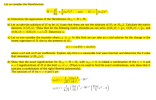 Let us consider the Hamiltonians a) Determine the eigenvalues of the Hamiltonian Htot H + H1 b) Let us take the solutions of H to be n) (note that these are not the solutions of H1 or Htot). Calculate the matrix elements (n' HiIn). Show that for the following matrix elements we can write (0|H110) a,(2H112), and (0 H 12)-(21H10)-α/v2. Determine c) Let us now consider the situation where w w. In this limit we can take as a trial...
Assume that both populations are normally distributed. a) Test whether H1 H2 at the a= 0.10...
 Assume that both populations are normally distributed. a) Test whether H1 H2 at the a= 0.10 level of significance for the given sample data. b) Construct a 90% confidence interval about H1 - H2 n Sample 1 17 16.9 3.5 Sample 2 17 18.6 4.2 S BE! Click the icon to view the Student t-distribution table. a) Perform a hypothesis test. Determine the null and alternative hypotheses. O A. Ho: Hy #H2, H: H = H2 OB. Ho: H1 =...
Consider the hypothesis test Ho : H1 = H2 against H1 : HI # Hz with...
 Consider the hypothesis test Ho : H1 = H2 against H1 : HI # Hz
with known variances oj = 1 1 and oz = 4. Suppose that sample sizes
ni = 11 and n2 = 16 and that X = 4,7 and X2 = 7.9. Use a =
0.05.
Question 1 of 1 < > -/1 View Policies Current Attempt in Progress Consider the hypothesis test Ho: M1 = H2 against H: MM with known variances o = 11...
Consider the hypothesis test Ho : H1 = H2 against H1 : HI # Hz
with known variances oj = 1 1 and oz = 4. Suppose that sample sizes
ni = 11 and n2 = 16 and that X = 4,7 and X2 = 7.9. Use a =
0.05.
Question 1 of 1 < > -/1 View Policies Current Attempt in Progress Consider the hypothesis test Ho: M1 = H2 against H: MM with known variances o = 11...
Which of the following is a consistent estimator: (1) (2) Where . An estimator is consistent...
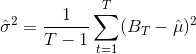 Which of the following is a consistent estimator:
(1)
(2)
Where
. An estimator is consistent if it converges to the right answer as
the sample size grows.
σ? - ΕΣ(Br- (BT - Â) B1 ~ N(u,0?)
Which of the following is a consistent estimator:
(1)
(2)
Where
. An estimator is consistent if it converges to the right answer as
the sample size grows.
σ? - ΕΣ(Br- (BT - Â) B1 ~ N(u,0?)
3) Given a filter with the following structure X(n); Hi(Z) y(n) H2(z) H(z) where Hi(2) 11+1+0.09z...
 3) Given a filter with the following structure X(n); Hi(Z) y(n) H2(z) H(z) where Hi(2) 11+1+0.09z and H(z)--4z1+z1+0.09z2] Hi(Z)- 1/[1+z1+ Find the z-transform H(z) and the frequency response H(e2*) . Say if the filter is FIR or IIR, and if it is stable or not » Find the I/O equatio n and draw the block diagram
 H1,H2 > F Material: 304 SS F (N) L (mm) R (mm) H (mm) H1 (mm) H2 (mm) W (mm) 105000 75 48 55 70 A) R = 0 (sharp comer) and H2 B) R and H1 as listed above C) R and H2 as listed above 2) Perform hand calculations for stress at the fillet, for B) and C) conditions. Compare to simulation results You should observe converging or diverging solutions in your Simulation (FEA) runs, depending on the...
 Try this example with water first: H1 H1 H2 H2 H H Water, H20 Partial charges: His +0.38, O is -0.75 Formal charges: His O, O is o Oxidation State: His +1, O is-2 Electrostatic potential description: The blue (positive) and red (negative) potentials are separated. That makes the molecule polar. The molecule is dark blue (quite positive) over the hydrogen atoms and dark red (quite negative) over the oxygen atom, making water very polar. And now do these two...
 Let h1(s) be an admissible A* heuristic. Let h2(s)=2*h1(s)
Is the solution found by A* tree search with h2 guaranteed to
be an optimal solution? Justify your answer
Is the solution found by A* tree search with h2 guaranteed to
have a cost at most twice as much as the optimal path? Justify your
answer
Consider the state space graph shown below in which some of the
states are missing a heuristic value. Determine the possible range
for each missing...
Let h1(s) be an admissible A* heuristic. Let h2(s)=2*h1(s)
Is the solution found by A* tree search with h2 guaranteed to
be an optimal solution? Justify your answer
Is the solution found by A* tree search with h2 guaranteed to
have a cost at most twice as much as the optimal path? Justify your
answer
Consider the state space graph shown below in which some of the
states are missing a heuristic value. Determine the possible range
for each missing...
 Given to the system with the impulse
responses h1(t) and the h2 (t) cos π t, 0
< t < ∞
Find the impulse response h(t) of a
new system which is a series interconnection of two mentioned
system using the convolutional integral. Present mathematical and
graphical solution.
Given to the system with the impulse
responses h1(t) and the h2 (t) cos π t, 0
< t < ∞
Find the impulse response h(t) of a
new system which is a series interconnection of two mentioned
system using the convolutional integral. Present mathematical and
graphical solution.
 Let us consider the Hamiltonians a) Determine the eigenvalues of the Hamiltonian Htot H + H1 b) Let us take the solutions of H to be n) (note that these are not the solutions of H1 or Htot). Calculate the matrix elements (n' HiIn). Show that for the following matrix elements we can write (0|H110) a,(2H112), and (0 H 12)-(21H10)-α/v2. Determine c) Let us now consider the situation where w w. In this limit we can take as a trial...
 Assume that both populations are normally distributed. a) Test whether H1 H2 at the a= 0.10 level of significance for the given sample data. b) Construct a 90% confidence interval about H1 - H2 n Sample 1 17 16.9 3.5 Sample 2 17 18.6 4.2 S BE! Click the icon to view the Student t-distribution table. a) Perform a hypothesis test. Determine the null and alternative hypotheses. O A. Ho: Hy #H2, H: H = H2 OB. Ho: H1 =...
 Consider the hypothesis test Ho : H1 = H2 against H1 : HI # Hz
with known variances oj = 1 1 and oz = 4. Suppose that sample sizes
ni = 11 and n2 = 16 and that X = 4,7 and X2 = 7.9. Use a =
0.05.
Question 1 of 1 < > -/1 View Policies Current Attempt in Progress Consider the hypothesis test Ho: M1 = H2 against H: MM with known variances o = 11...
Consider the hypothesis test Ho : H1 = H2 against H1 : HI # Hz
with known variances oj = 1 1 and oz = 4. Suppose that sample sizes
ni = 11 and n2 = 16 and that X = 4,7 and X2 = 7.9. Use a =
0.05.
Question 1 of 1 < > -/1 View Policies Current Attempt in Progress Consider the hypothesis test Ho: M1 = H2 against H: MM with known variances o = 11...
 Which of the following is a consistent estimator:
(1)
(2)
Where
. An estimator is consistent if it converges to the right answer as
the sample size grows.
σ? - ΕΣ(Br- (BT - Â) B1 ~ N(u,0?)
Which of the following is a consistent estimator:
(1)
(2)
Where
. An estimator is consistent if it converges to the right answer as
the sample size grows.
σ? - ΕΣ(Br- (BT - Â) B1 ~ N(u,0?)
 3) Given a filter with the following structure X(n); Hi(Z) y(n) H2(z) H(z) where Hi(2) 11+1+0.09z and H(z)--4z1+z1+0.09z2] Hi(Z)- 1/[1+z1+ Find the z-transform H(z) and the frequency response H(e2*) . Say if the filter is FIR or IIR, and if it is stable or not » Find the I/O equatio n and draw the block diagram
Most questions answered within 3 hours.
-
Where is the error in this code sequence?
String s1 = "Hello";
String s2 = "ello";...
asked 10 months ago -
Financial data for Joel de Paris, Inc., for last year
follow:
Joel de Paris, Inc.
Balance...
asked 10 months ago -
Consider this reaction:
Al2(SO4)3 (aq)+ BaCl3
(aq) Al2Cl6 (aq)- +
3BaSO4(s) . What is the...
asked 10 months ago -
Suppose that Savneet is considering increasing her
recent random sample from 20 car rentals to 40...
asked 10 months ago -
Trucks arrive at an unloading terminal at an average rate of 120
per hour.
Trucks arrive...
asked 10 months ago -
Why are methanol and ethanol completely soluble in water while
octanol is not very little soluble....
asked 10 months ago -
A facilities manager at a university reads in a research report
that the mean amount of...
asked 10 months ago -
When the CuSO4 is rehydrated by adding water to the anhydrous
compound, is this an endothermic...
asked 10 months ago -
A ray of sunlight is passing from diamond into crown glass; the
angle of incidence is...
asked 10 months ago -
A block of mass 0.249 kg is placed on top of a light, vertical
spring of...
asked 10 months ago -
how do the kidneys compensate in the presences of acidosis
a) trigger hyperventilate
b) reserve acid...
asked 10 months ago -
Question 501 pts
The rental rate of capital to the firm increases. Which of the
following...
asked 10 months ago