
Homework Answers
Add Answer to:
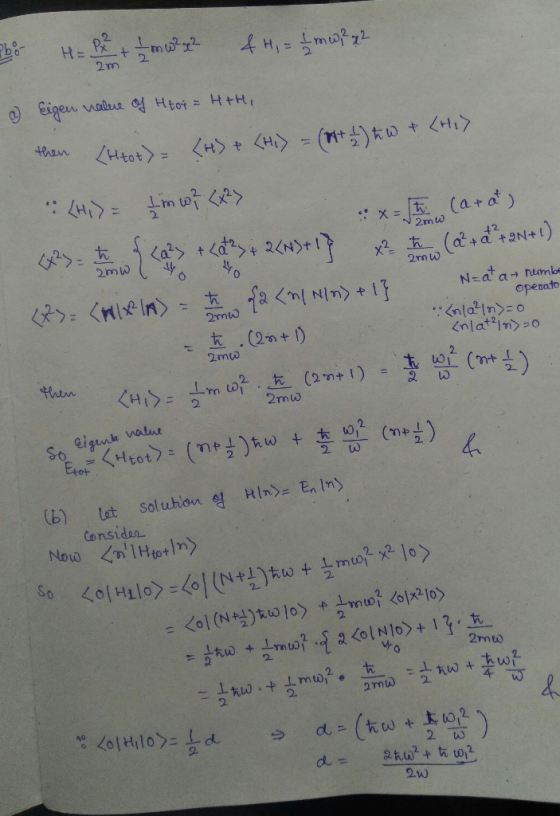
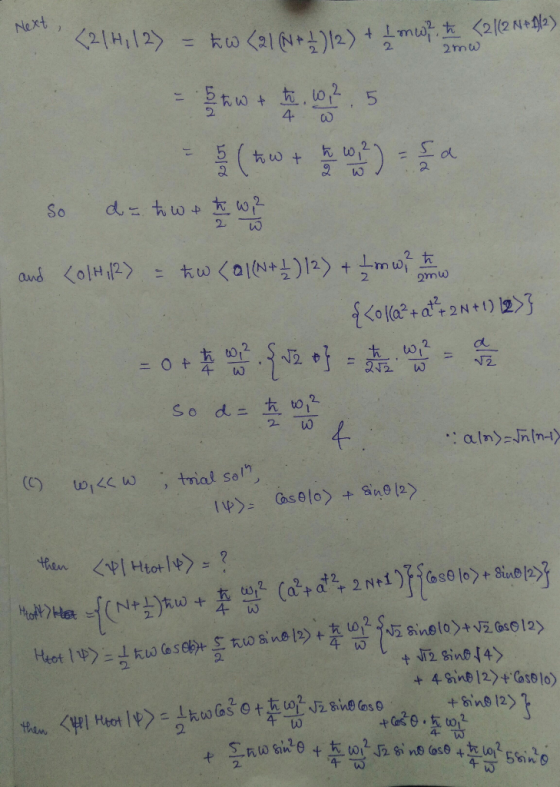
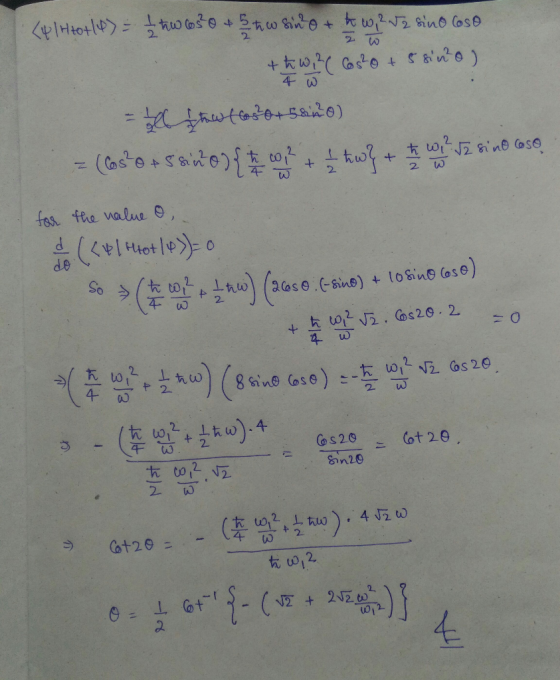
Let us consider the Hamiltonians a) Determine the eigenvalues of the Hamiltonian Htot H + H1 b) Let us take the solutio...
4. A particle moves in a periodic one-dimensional potential, V(x a)-V(x); physically, this may represent the motion of non-interacting electrons in a crys- tal lattice. Let us call n), n - 0, +1, t2,...
 4. A particle moves in a periodic one-dimensional potential, V(x a)-V(x); physically, this may represent the motion of non-interacting electrons in a crys- tal lattice. Let us call n), n - 0, +1, t2, particle located at site n, with (n'In) -Sn,Let H be the system Hamiltonian and U(a) the discrete translation operator: U(a)|n) - [n +1). In the tight- binding approximation, one neglects the overlap of electron states separated by a distance larger than a, so that where is...
4. Let us revisit the shifted harmonic oscillator from problem set 5, but this time through...
 4. Let us revisit the shifted harmonic oscillator from problem set 5, but this time through the lens of perturbation theory. The Hamiltonian of the oscillator is given by * 2m + mw?f? + cî, and, as solved for previously, it has eigenenergies of En = hwan + mwra and eigenstates of (0) = N,,,a1 + role of (rc)*/2, where Do = 42 and a=(mw/h) (a) By treating the term cî as a perturbation, show that the first-order correction to...
Hi, could you post solutions to the following questions. Thanks. 2. (a) Let V be a vector space on R. Give the definition of a subspace W of V 2% (b) For each of the following subsets of IR3 sta...
 Hi,
could you post solutions to the following questions. Thanks.
2. (a) Let V be a vector space on R. Give the definition of a subspace W of V 2% (b) For each of the following subsets of IR3 state whether they are subepaces of R3 or not by clearly explaining your answer. 2% 2% (c) Consider the map F : R2 → R3 defined by for any z = (zi,Z2) E R2. 3% 3% 3% 3% i. Show that...
Hi,
could you post solutions to the following questions. Thanks.
2. (a) Let V be a vector space on R. Give the definition of a subspace W of V 2% (b) For each of the following subsets of IR3 state whether they are subepaces of R3 or not by clearly explaining your answer. 2% 2% (c) Consider the map F : R2 → R3 defined by for any z = (zi,Z2) E R2. 3% 3% 3% 3% i. Show that...
Consider a cylindrical capacitor like that shown in Fig. 24.6. Let d = rb − ra...
 Consider a cylindrical capacitor like that shown in Fig. 24.6. Let d = rb − ra be the spacing between the inner and outer conductors. (a) Let the radii of the two conductors be only slightly different, so that d << ra. Show that the result derived in Example 24.4 (Section 24.1) for the capacitance of a cylindrical capacitor then reduces to Eq. (24.2), the equation for the capacitance of a parallel-plate capacitor, with A being the surface area of...
 4. A particle moves in a periodic one-dimensional potential, V(x a)-V(x); physically, this may represent the motion of non-interacting electrons in a crys- tal lattice. Let us call n), n - 0, +1, t2, particle located at site n, with (n'In) -Sn,Let H be the system Hamiltonian and U(a) the discrete translation operator: U(a)|n) - [n +1). In the tight- binding approximation, one neglects the overlap of electron states separated by a distance larger than a, so that where is...
 4. Let us revisit the shifted harmonic oscillator from problem set 5, but this time through the lens of perturbation theory. The Hamiltonian of the oscillator is given by * 2m + mw?f? + cî, and, as solved for previously, it has eigenenergies of En = hwan + mwra and eigenstates of (0) = N,,,a1 + role of (rc)*/2, where Do = 42 and a=(mw/h) (a) By treating the term cî as a perturbation, show that the first-order correction to...
 Hi,
could you post solutions to the following questions. Thanks.
2. (a) Let V be a vector space on R. Give the definition of a subspace W of V 2% (b) For each of the following subsets of IR3 state whether they are subepaces of R3 or not by clearly explaining your answer. 2% 2% (c) Consider the map F : R2 → R3 defined by for any z = (zi,Z2) E R2. 3% 3% 3% 3% i. Show that...
Hi,
could you post solutions to the following questions. Thanks.
2. (a) Let V be a vector space on R. Give the definition of a subspace W of V 2% (b) For each of the following subsets of IR3 state whether they are subepaces of R3 or not by clearly explaining your answer. 2% 2% (c) Consider the map F : R2 → R3 defined by for any z = (zi,Z2) E R2. 3% 3% 3% 3% i. Show that...
 Consider a cylindrical capacitor like that shown in Fig. 24.6. Let d = rb − ra be the spacing between the inner and outer conductors. (a) Let the radii of the two conductors be only slightly different, so that d << ra. Show that the result derived in Example 24.4 (Section 24.1) for the capacitance of a cylindrical capacitor then reduces to Eq. (24.2), the equation for the capacitance of a parallel-plate capacitor, with A being the surface area of...
Most questions answered within 3 hours.
-
Where is the error in this code sequence?
String s1 = "Hello";
String s2 = "ello";...
asked 10 months ago -
Financial data for Joel de Paris, Inc., for last year
follow:
Joel de Paris, Inc.
Balance...
asked 10 months ago -
Consider this reaction:
Al2(SO4)3 (aq)+ BaCl3
(aq) Al2Cl6 (aq)- +
3BaSO4(s) . What is the...
asked 10 months ago -
Suppose that Savneet is considering increasing her
recent random sample from 20 car rentals to 40...
asked 10 months ago -
Trucks arrive at an unloading terminal at an average rate of 120
per hour.
Trucks arrive...
asked 10 months ago -
Why are methanol and ethanol completely soluble in water while
octanol is not very little soluble....
asked 10 months ago -
A facilities manager at a university reads in a research report
that the mean amount of...
asked 10 months ago -
When the CuSO4 is rehydrated by adding water to the anhydrous
compound, is this an endothermic...
asked 10 months ago -
A ray of sunlight is passing from diamond into crown glass; the
angle of incidence is...
asked 10 months ago -
A block of mass 0.249 kg is placed on top of a light, vertical
spring of...
asked 10 months ago -
how do the kidneys compensate in the presences of acidosis
a) trigger hyperventilate
b) reserve acid...
asked 10 months ago -
Question 501 pts
The rental rate of capital to the firm increases. Which of the
following...
asked 10 months ago