In an outbreak of salmonellosis, 25 persons from 25 different households became ill, in a community...
In an outbreak of salmonellosis, 25 persons from 25 different households became ill, in a community with a total population of 1000. Calculate the attack rate. Enter your response as a percent with one decimal place.
Homework Answers
Attack rate = number of people ill ÷ number of people at risk
Number of ill people = 25
Number of people at risk = 1000
Attack rate = 25 ÷ 1000 = 0.025
To convert in percent multiply by 100
Attack rate = 0.025 × 100 = 2.5%
Add Answer to:
In an outbreak of salmonellosis, 25 persons from 25 different
households became ill, in a community...
Exposed persons Those who ate suspected foods Unexposed persons Those who did not eat suspected foods Suspected foods Ill Well Total Attack Rate % Ill Well Total Attack Rate % Ham 36 5 2 11 Potato Sal...
Exposed persons Those who ate suspected foods Unexposed persons Those who did not eat suspected foods Suspected foods Ill Well Total Attack Rate % Ill Well Total Attack Rate % Ham 36 5 2 11 Potato Salad 40 4 9 6 Peas 16 15 10 13 An investigation of an outbreak of staphylococcal food poisoning occurred during the second week of January 2017 on campus. The case definition produced by the investigators was acute onset of nausea, cramps and vomiting....
1. On March 1, 2009, 13 people became ill after attending a retirement dinner for a...
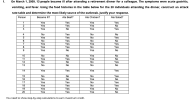 1. On March 1, 2009, 13 people became ill after attending a retirement dinner for a colleague. The symptoms were acute gastritis, vomiting, and fever. Using the food histories in the table below for the 20 individuals attending the dinner, construct an attack rate table and determine the most likely source of the outbreak. Justify your response. Person Became Ill? Ate Beef? Ate Chicken? Ate Salad? 1 Yes Yes 2 3 Yes Yes No Yes Yes Yes Yes No Yes...
Part I – Background on Salmonella Salmonellosis is a gastrointestinal illness caused by bacteria from the...
Part I – Background on Salmonella Salmonellosis is a gastrointestinal illness caused by bacteria from the genus Salmonella. The illness is characterized by the sudden onset of headache, abdominal pain, diarrhea (which may be bloody), nausea, and sometimes vomiting. Fever is almost always present. The illness typically lasts for 5-7 days and usually does not require treatment unless the patient becomes severely dehydrated or the infection spreads from the intestines. In the immune compromised host or an overwhelming infection in...
The population of a community is known to increase at a rate proportional to the number...
 The population of a community is known to increase at a rate proportional to the number of people present at time t. The initial population P. has doubled in 5 years. Suppose it is known that the population is 11,000 after 3 years. What was the initial population Po? (Round your answer to one decimal place.) Po= What will be the population in 10 years? (Round your answer to the nearest person.) persons How fast is the population growing at...
Regionville is a community of 100,00 persons. During 1985, there were 1000 deaths from all causes....
 Regionville is a community of 100,00 persons. During 1985, there were 1000 deaths from all causes. All cases of tuberculosis have been found, and they total 300 (200 males and 100 females). During 1985, there were 60 deaths from TB, 50 of them in males. What is thei a) crude mortality rate for Regionville 6) The proportionate mortality due to TB c) The case fatality rate for TB d) The cause specific mortality rate for TB
The BLS survey found the numbers in the table for a small community. Category Number Calculate...
 The BLS survey found the numbers in the table for a small community. Category Number Calculate the unemployment rate and the labor force participation rate for this community Total number of persons in the community Worked at least 1 hour as paid employees or worked 15 hours or more as unpaid workers in their family business 220 The unemployment rate is percent. Answer to 1 decimal place. 40 The labor force participation rate is >Answer to 1 decimal place. percent....
The type of household for the U.S. population and for a random sample of 411 households...
The type of household for the U.S. population and for a random sample of 411 households from a community in Montana are shown below. Type of Household Percent of U.S. Households Observed Number of Households in the Community Married with children 26% 101 Married, no children 29% 118 Single parent 9% 28 One person 25% 97 Other (e.g., roommates, siblings) 11% 67 Use a 5% level of significance to test the claim that the distribution of U.S. households fits the...
The type of household for the U.S. population and for a random sample of 411 households...
The type of household for the U.S. population and for a random sample of 411 households from a community in Montana are shown below. Type of Household Percent of U.S. Households Observed Number of Households in the Community Married with children 26% 100 Married, no children 29% 118 Single parent 9% 30 One person 25% 93 Other (e.g., roommates, siblings) 11% 70 Use a 5% level of significance to test the claim that the distribution of U.S. households fits the...
The type of household for the U.S. population and for a random sample of 411 households...
 The type of household for the U.S. population and for a random sample of 411 households from a community in Montana are shown below. Observed Number of Households in the Community 90 Type of Household Married with children Married, no children Single parent One person Other (e.g., roommates, siblings) Percent of U.S. Households 26% 29% 9% 25% 11% 126 28 100 67 Use a 5% level of significance to test the claim that the distribution of U.S. households fits the...
1) The epidemic curve for both the Hepatitis Outbreak and Oswego Outbreak case studies are indicative...
1) The epidemic curve for both the Hepatitis Outbreak and Oswego Outbreak case studies are indicative of this type of outbreak. A) propagated (progressive source) B) continuous common source C) point source D) confirmed 2) What is the term used to describe; "The severity of the disease; measured by the case fatality ratio (CFR%)". 3) If a male participant in an HIV study considers himself heterosexual, yet has a history of sex with men, he may not reveal the homosexual...
 1. On March 1, 2009, 13 people became ill after attending a retirement dinner for a colleague. The symptoms were acute gastritis, vomiting, and fever. Using the food histories in the table below for the 20 individuals attending the dinner, construct an attack rate table and determine the most likely source of the outbreak. Justify your response. Person Became Ill? Ate Beef? Ate Chicken? Ate Salad? 1 Yes Yes 2 3 Yes Yes No Yes Yes Yes Yes No Yes...
 The population of a community is known to increase at a rate proportional to the number of people present at time t. The initial population P. has doubled in 5 years. Suppose it is known that the population is 11,000 after 3 years. What was the initial population Po? (Round your answer to one decimal place.) Po= What will be the population in 10 years? (Round your answer to the nearest person.) persons How fast is the population growing at...
 Regionville is a community of 100,00 persons. During 1985, there were 1000 deaths from all causes. All cases of tuberculosis have been found, and they total 300 (200 males and 100 females). During 1985, there were 60 deaths from TB, 50 of them in males. What is thei a) crude mortality rate for Regionville 6) The proportionate mortality due to TB c) The case fatality rate for TB d) The cause specific mortality rate for TB
 The BLS survey found the numbers in the table for a small community. Category Number Calculate the unemployment rate and the labor force participation rate for this community Total number of persons in the community Worked at least 1 hour as paid employees or worked 15 hours or more as unpaid workers in their family business 220 The unemployment rate is percent. Answer to 1 decimal place. 40 The labor force participation rate is >Answer to 1 decimal place. percent....
 The type of household for the U.S. population and for a random sample of 411 households from a community in Montana are shown below. Observed Number of Households in the Community 90 Type of Household Married with children Married, no children Single parent One person Other (e.g., roommates, siblings) Percent of U.S. Households 26% 29% 9% 25% 11% 126 28 100 67 Use a 5% level of significance to test the claim that the distribution of U.S. households fits the...
Most questions answered within 3 hours.
-
Where is the error in this code sequence?
String s1 = "Hello";
String s2 = "ello";...
asked 11 months ago -
Financial data for Joel de Paris, Inc., for last year
follow:
Joel de Paris, Inc.
Balance...
asked 11 months ago -
Consider this reaction:
Al2(SO4)3 (aq)+ BaCl3
(aq) Al2Cl6 (aq)- +
3BaSO4(s) . What is the...
asked 11 months ago -
Suppose that Savneet is considering increasing her
recent random sample from 20 car rentals to 40...
asked 11 months ago -
Trucks arrive at an unloading terminal at an average rate of 120
per hour.
Trucks arrive...
asked 11 months ago -
Why are methanol and ethanol completely soluble in water while
octanol is not very little soluble....
asked 11 months ago -
A facilities manager at a university reads in a research report
that the mean amount of...
asked 11 months ago -
When the CuSO4 is rehydrated by adding water to the anhydrous
compound, is this an endothermic...
asked 11 months ago -
A ray of sunlight is passing from diamond into crown glass; the
angle of incidence is...
asked 11 months ago -
A block of mass 0.249 kg is placed on top of a light, vertical
spring of...
asked 11 months ago -
how do the kidneys compensate in the presences of acidosis
a) trigger hyperventilate
b) reserve acid...
asked 11 months ago -
Question 501 pts
The rental rate of capital to the firm increases. Which of the
following...
asked 11 months ago