write both non-recursive and recursive functions that display strings in backwards in python
write both non-recursive and recursive functions that display strings in backwards in python
Homework Answers
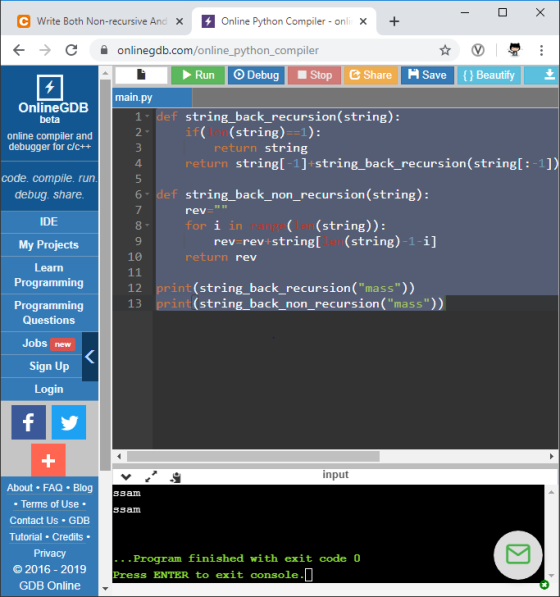
### while pasting indentations/tabs may get disturbed, please refer pic for correct tabs
def string_back_recursion(string):
if(len(string)==1):
return string
return string[-1]+string_back_recursion(string[:-1])
def string_back_non_recursion(string):
rev=""
for i in range(len(string)):
rev=rev+string[len(string)-1-i]
return rev
print(string_back_recursion("mass"))
print(string_back_non_recursion("mass"))
Add Answer to:
write both non-recursive and recursive functions that display
strings in backwards in python
solve with python Write a recursive function recStringWithLenCount() that takes a one-dimensional list of strings as...
 solve with python
Write a recursive function recStringWithLenCount() that takes a
one-dimensional list of strings as a parameter and returns the
count of strings that have at least the length of second parameter
passed into the function that are found in the list. Recall that
you can determine whether an item is a string by writing type(item)
== str. The only list functions you are allowed to use are len(),
indexing (lst[i] for an integer i), or slicing (lst[i:j] for...
solve with python
Write a recursive function recStringWithLenCount() that takes a
one-dimensional list of strings as a parameter and returns the
count of strings that have at least the length of second parameter
passed into the function that are found in the list. Recall that
you can determine whether an item is a string by writing type(item)
== str. The only list functions you are allowed to use are len(),
indexing (lst[i] for an integer i), or slicing (lst[i:j] for...
Python 3: Python 3: Write a LinkedList class that has recursive implementations of the add, display,...
Python 3: Python 3: Write a LinkedList class that has recursive implementations of the add, display, remove methods. You may use default arguments and/or helper functions. class Node: """ Represents a node in a linked list """ def __init__(self, data): self.data = data self.next = None class LinkedList: """ A linked list implementation of the List ADT """ def __init__(self): self.head = None def add(self, val): """ Adds a node containing val to the linked list """ if self.head is...
Write a Python program to create some recursive artwork, using the turtle module by using recursive...
Write a Python program to create some recursive artwork, using the turtle module by using recursive functions. This program should look very creative, wanna get some points!
Write a python program that reads in 5 strings from the keyboard. Count the number of...
Write a python program that reads in 5 strings from the keyboard. Count the number of strings that start with 'th'. Display this count. Use a loop
Python please Write a function print_back_upper() that accepts a string my_str as an argument and displays...
Python please Write a function print_back_upper() that accepts a string my_str as an argument and displays the string backwards and in uppercase, all in one line (Note: Create any necessary variables) For example: if my_str = "Python" then, your output should display as follows: NOHTYP (Hint: You can use for loop navigating up to range of len of string-1, -1, -1 and use reverse() and upper() functions to create and display the string backwards in uppercase)
Write a recursive function sum-odds that takes a non-empty list of integers
in python Part I: Sum of Odd Integers Write a recursive function sum-odds that takes a non-empty list of integers as an argument and returns the sum of only the odd integers in the list. In class we explored a recursive function called rsum that recursively computes the sum of a list of integers use it as a model to get started. Your function must be recursive and must not use any loops
In python programming. Write a recursive function that accepts an integer argument, n. The function should...
In python programming. Write a recursive function that accepts an integer argument, n. The function should display n lines of asterisks on the screen, with the first line showing 1 asterisk, the second line showing 2 asterisks, up to the nth line which shows n asterisks.
Using Python; Caesar part of the homework: Write c_encrypt() and c_decrypt(), both of which take two...
Using Python; Caesar part of the homework: Write c_encrypt() and c_decrypt(), both of which take two arguments, the first one a string and the second one an integer key. Both should return a string. Vigenère part of the homework: Write vig_encrypt() and vig_decrypt() functions. Each takes two strings as inputs, with the first being the plaintext/ciphertext, and the second being the key. Both should be calling functions you wrote earlier to help make the work easier. The key will be...
****python**** Q1. Write a recursive function that returns the sum of all numbers up to and...
 ****python****
Q1.
Write a recursive function that returns the sum of all numbers
up to and including the given value.
This function has to be recursive; you may not use loops!
For example:
Test
Result
print('%d : %d' % (5, sum_up_to(5)))
5 : 15
Q2,
Write a recursive function that counts the number of odd
integers in a given list.
This function has to be recursive; you may not use loops!
For example:
Test
Result
print('%s : %d' % ([2,...
****python****
Q1.
Write a recursive function that returns the sum of all numbers
up to and including the given value.
This function has to be recursive; you may not use loops!
For example:
Test
Result
print('%d : %d' % (5, sum_up_to(5)))
5 : 15
Q2,
Write a recursive function that counts the number of odd
integers in a given list.
This function has to be recursive; you may not use loops!
For example:
Test
Result
print('%s : %d' % ([2,...
2) Please write a C++ program that uses both recursive and iterative functions to find the...
2) Please write a C++ program that uses both recursive and iterative functions to find the GCD of two numbers. In mathematics, the greatest common divisor (gcd) of two or more integers, when at least one of them is not zero, is the largest positive integer that divides the numbers without a remainder. For example, the GCD of 8 and 12 is 4.
 solve with python
Write a recursive function recStringWithLenCount() that takes a
one-dimensional list of strings as a parameter and returns the
count of strings that have at least the length of second parameter
passed into the function that are found in the list. Recall that
you can determine whether an item is a string by writing type(item)
== str. The only list functions you are allowed to use are len(),
indexing (lst[i] for an integer i), or slicing (lst[i:j] for...
solve with python
Write a recursive function recStringWithLenCount() that takes a
one-dimensional list of strings as a parameter and returns the
count of strings that have at least the length of second parameter
passed into the function that are found in the list. Recall that
you can determine whether an item is a string by writing type(item)
== str. The only list functions you are allowed to use are len(),
indexing (lst[i] for an integer i), or slicing (lst[i:j] for...
 ****python****
Q1.
Write a recursive function that returns the sum of all numbers
up to and including the given value.
This function has to be recursive; you may not use loops!
For example:
Test
Result
print('%d : %d' % (5, sum_up_to(5)))
5 : 15
Q2,
Write a recursive function that counts the number of odd
integers in a given list.
This function has to be recursive; you may not use loops!
For example:
Test
Result
print('%s : %d' % ([2,...
****python****
Q1.
Write a recursive function that returns the sum of all numbers
up to and including the given value.
This function has to be recursive; you may not use loops!
For example:
Test
Result
print('%d : %d' % (5, sum_up_to(5)))
5 : 15
Q2,
Write a recursive function that counts the number of odd
integers in a given list.
This function has to be recursive; you may not use loops!
For example:
Test
Result
print('%s : %d' % ([2,...
Most questions answered within 3 hours.
-
Where is the error in this code sequence?
String s1 = "Hello";
String s2 = "ello";...
asked 10 months ago -
Financial data for Joel de Paris, Inc., for last year
follow:
Joel de Paris, Inc.
Balance...
asked 10 months ago -
Consider this reaction:
Al2(SO4)3 (aq)+ BaCl3
(aq) Al2Cl6 (aq)- +
3BaSO4(s) . What is the...
asked 10 months ago -
Suppose that Savneet is considering increasing her
recent random sample from 20 car rentals to 40...
asked 10 months ago -
Trucks arrive at an unloading terminal at an average rate of 120
per hour.
Trucks arrive...
asked 10 months ago -
Why are methanol and ethanol completely soluble in water while
octanol is not very little soluble....
asked 10 months ago -
A facilities manager at a university reads in a research report
that the mean amount of...
asked 10 months ago -
When the CuSO4 is rehydrated by adding water to the anhydrous
compound, is this an endothermic...
asked 10 months ago -
A ray of sunlight is passing from diamond into crown glass; the
angle of incidence is...
asked 10 months ago -
A block of mass 0.249 kg is placed on top of a light, vertical
spring of...
asked 10 months ago -
how do the kidneys compensate in the presences of acidosis
a) trigger hyperventilate
b) reserve acid...
asked 10 months ago -
Question 501 pts
The rental rate of capital to the firm increases. Which of the
following...
asked 10 months ago