The mechanism including co-factor for the reduction of acetaldehyde to ethanol by the yeast enzyme alcohol...
The mechanism including co-factor for the reduction of acetaldehyde to ethanol by the yeast enzyme alcohol dehydrogenase.
Homework Answers

Add Answer to:
The mechanism including co-factor for the reduction of
acetaldehyde to ethanol by the yeast enzyme alcohol...
Alcohol dehydrogenase detoxifies ethanol in two steps. First, ethanol is oxidized to acetaldehyde, which is coupled...
 Alcohol dehydrogenase detoxifies ethanol in two steps. First, ethanol is oxidized to acetaldehyde, which is coupled with the reduction of NAD' to NADH. Second, acetaldehyde is oxidized to acetate, which process also produces an NADH molecule. Under anaerobic conditions, muscle cells needing extra energy couple the reduction of pyruvate to lactate with the oxidation of NADH to NAD*. The NAD is then shuttled to the anaerobic glycolysis reactions which produce a small amount of ATP. One common side effect of...
Which of the following sentences is nottrue about alcohol dehydrogenase a. The enzyme uses NADH as cofactor. b. The enzyme transfers the hydride, H- between the substrates. c. If yeast alcohol dehydr...
 Which of the following sentences is nottrue about alcohol dehydrogenase a. The enzyme uses NADH as cofactor. b. The enzyme transfers the hydride, H- between the substrates. c. If yeast alcohol dehydrogenase is reacted with CH3CD2OH, the generated NADH will contain deuterium in the pro-R position. d. If deuterium NAD+ is reacted with CH3CH2OH, the generated aldehyde will contain deuterium. e. If a pro-R deuterium NADH is reacted with Glyceraldehyde-3-phosphate dehydrogenase, deuterium will be remained in NAD+
Which of the...
Which of the following sentences is nottrue about alcohol dehydrogenase a. The enzyme uses NADH as cofactor. b. The enzyme transfers the hydride, H- between the substrates. c. If yeast alcohol dehydrogenase is reacted with CH3CD2OH, the generated NADH will contain deuterium in the pro-R position. d. If deuterium NAD+ is reacted with CH3CH2OH, the generated aldehyde will contain deuterium. e. If a pro-R deuterium NADH is reacted with Glyceraldehyde-3-phosphate dehydrogenase, deuterium will be remained in NAD+
Which of the...
A suspension of yeast cells is being grown under anaerobic conditions such that glucose is degraded...
A suspension of yeast cells is being grown under anaerobic conditions such that glucose is degraded to ethanol and carbon dioxide. Adding an inhibitor of alcohol dehydrogenase to the yeast cell suspension results in rapid cell death. Why? a.) Without alcohol dehydrogenase, the acetaldehyde concentration increases to levels that are toxic to the yeast cells. b.) NADH generated during glycolysis cannot be recycled back to NAD+, thus anaerobic ATP production through glycolysis cannot be maintained. c.) Pyruvate is no longer...
Ethanol in the body is oxidized to acetaldehyde by liver alcohol dehydrogenase (LADH). Other alcohols are...
Ethanol in the body is oxidized to acetaldehyde by liver alcohol dehydrogenase (LADH). Other alcohols are also oxidized by LADH. Methanol, which is mildly intoxicating, is oxidized by LADH to the highly toxic product formaldehyde. The toxic effects of methanol (a component of many commercial solvents and "wood alcohol" in moonshine) can be reduced by administering ethanol. The ethanol acts as a competitive inhibitor of methanol by displacing it from LADH. This provides sufficient time for the methanol to be...
4. What is the commited step of glycolysis and how is this enzyme regulated? 5. Glyceraldehyde-3-phophate...
 4. What is the commited step of glycolysis and how is this enzyme regulated? 5. Glyceraldehyde-3-phophate dehydrogenase (GAPDH) is the most important enzyme in glycolysis. a. What two reactions are coupled by GAPDH? b. Draw the structure of the thiohemiacetal intermediate and show the mechanism for generating the acyl thioester intermediate. A+Bred Ared +B For the reaction: AG = Given: ngAE RT In n[Aj{8,al Nernst Equation: AE=A Use the reduction potentials in Table 14-4 to calculate the electromotive force, AE,...
4) Alcohol dehydrogenase is involved in the metabolism of alcohol. A cytoplasmic version of the enzyme...
4) Alcohol dehydrogenase is involved in the metabolism of alcohol. A cytoplasmic version of the enzyme catalyses the conversion of alcohol to acetaldehyde and a mitochondrial version catalyses the conversion of acetaldehyde to acetate, see reactions below. Some people react to the consumption of alcohol with the appearance of a facial flush. In less than 100 words total i) name the biochemical basis for this physiological reaction and ii) explain in the language of this unit how the enzymatic properties...
Draw a general flow sheet for the reduction of acetaldehyde to ethanol.
Draw a general flow sheet for the reduction of acetaldehyde to ethanol.
2. The image at right shows NAD+ and ethanol in the active site of alcohol dehydrogenase....
 2. The image at right shows NAD+ and ethanol in the active site of alcohol dehydrogenase. The reaction catalyzed by this enzyme is: CH3CHO + NADH + H+ + CH3CH2OH + NAD+. Which of the statements below concerning this reaction is true? O The proton (H) is likely supplied by a basic amino acid such as lysine in its positively charged form. O The reaction mechanism involves an alkoxide intermediate. O This reaction establishes a stereocenter in ethanol. O NADH...
The consumption of alcohol (ethanol), especially after periods of strenuous activity or after not eating for...
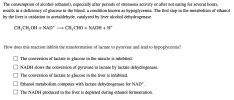 The consumption of alcohol (ethanol), especially after periods of strenuous activity or after not eating for several hours, results in a deficiency of glucose in the blood, a condition known as hypoglycemia. The first step in the metabolism of ethanol by the liver is oxidation to acetaldehyde, catalyzed by liver alcohol dehydrogenase. CH,CH,OH + NAD+ CH CHO + NADH + H+ How does this reaction inhibit the transformation of lactate to pyruvate and lead to hypoglycemia? The conversion of lactate...
4. Ethanal (acetaldehyde), rather than ethanol, causes many of the physiologica problems associated with alcohol abuse....
 4. Ethanal (acetaldehyde), rather than ethanol, causes many of the physiologica problems associated with alcohol abuse. List a few of the acetaldehyde effects that can lead to liver cirrhosis. (3 marks)
 Alcohol dehydrogenase detoxifies ethanol in two steps. First, ethanol is oxidized to acetaldehyde, which is coupled with the reduction of NAD' to NADH. Second, acetaldehyde is oxidized to acetate, which process also produces an NADH molecule. Under anaerobic conditions, muscle cells needing extra energy couple the reduction of pyruvate to lactate with the oxidation of NADH to NAD*. The NAD is then shuttled to the anaerobic glycolysis reactions which produce a small amount of ATP. One common side effect of...
 Which of the following sentences is nottrue about alcohol dehydrogenase a. The enzyme uses NADH as cofactor. b. The enzyme transfers the hydride, H- between the substrates. c. If yeast alcohol dehydrogenase is reacted with CH3CD2OH, the generated NADH will contain deuterium in the pro-R position. d. If deuterium NAD+ is reacted with CH3CH2OH, the generated aldehyde will contain deuterium. e. If a pro-R deuterium NADH is reacted with Glyceraldehyde-3-phosphate dehydrogenase, deuterium will be remained in NAD+
Which of the...
Which of the following sentences is nottrue about alcohol dehydrogenase a. The enzyme uses NADH as cofactor. b. The enzyme transfers the hydride, H- between the substrates. c. If yeast alcohol dehydrogenase is reacted with CH3CD2OH, the generated NADH will contain deuterium in the pro-R position. d. If deuterium NAD+ is reacted with CH3CH2OH, the generated aldehyde will contain deuterium. e. If a pro-R deuterium NADH is reacted with Glyceraldehyde-3-phosphate dehydrogenase, deuterium will be remained in NAD+
Which of the...
 4. What is the commited step of glycolysis and how is this enzyme regulated? 5. Glyceraldehyde-3-phophate dehydrogenase (GAPDH) is the most important enzyme in glycolysis. a. What two reactions are coupled by GAPDH? b. Draw the structure of the thiohemiacetal intermediate and show the mechanism for generating the acyl thioester intermediate. A+Bred Ared +B For the reaction: AG = Given: ngAE RT In n[Aj{8,al Nernst Equation: AE=A Use the reduction potentials in Table 14-4 to calculate the electromotive force, AE,...
 2. The image at right shows NAD+ and ethanol in the active site of alcohol dehydrogenase. The reaction catalyzed by this enzyme is: CH3CHO + NADH + H+ + CH3CH2OH + NAD+. Which of the statements below concerning this reaction is true? O The proton (H) is likely supplied by a basic amino acid such as lysine in its positively charged form. O The reaction mechanism involves an alkoxide intermediate. O This reaction establishes a stereocenter in ethanol. O NADH...
 The consumption of alcohol (ethanol), especially after periods of strenuous activity or after not eating for several hours, results in a deficiency of glucose in the blood, a condition known as hypoglycemia. The first step in the metabolism of ethanol by the liver is oxidation to acetaldehyde, catalyzed by liver alcohol dehydrogenase. CH,CH,OH + NAD+ CH CHO + NADH + H+ How does this reaction inhibit the transformation of lactate to pyruvate and lead to hypoglycemia? The conversion of lactate...
 4. Ethanal (acetaldehyde), rather than ethanol, causes many of the physiologica problems associated with alcohol abuse. List a few of the acetaldehyde effects that can lead to liver cirrhosis. (3 marks)
Most questions answered within 3 hours.
-
Where is the error in this code sequence?
String s1 = "Hello";
String s2 = "ello";...
asked 10 months ago -
Financial data for Joel de Paris, Inc., for last year
follow:
Joel de Paris, Inc.
Balance...
asked 10 months ago -
Consider this reaction:
Al2(SO4)3 (aq)+ BaCl3
(aq) Al2Cl6 (aq)- +
3BaSO4(s) . What is the...
asked 10 months ago -
Suppose that Savneet is considering increasing her
recent random sample from 20 car rentals to 40...
asked 10 months ago -
Trucks arrive at an unloading terminal at an average rate of 120
per hour.
Trucks arrive...
asked 10 months ago -
Why are methanol and ethanol completely soluble in water while
octanol is not very little soluble....
asked 10 months ago -
A facilities manager at a university reads in a research report
that the mean amount of...
asked 10 months ago -
When the CuSO4 is rehydrated by adding water to the anhydrous
compound, is this an endothermic...
asked 10 months ago -
A ray of sunlight is passing from diamond into crown glass; the
angle of incidence is...
asked 10 months ago -
A block of mass 0.249 kg is placed on top of a light, vertical
spring of...
asked 10 months ago -
how do the kidneys compensate in the presences of acidosis
a) trigger hyperventilate
b) reserve acid...
asked 10 months ago -
Question 501 pts
The rental rate of capital to the firm increases. Which of the
following...
asked 10 months ago