For each precipitate (PbCrO4, Bi, Cu2[Fe(CN)6], CdS, HgCl2. Hg2Cl2, Hg, HgI), write a net ionic equation...
For each precipitate (PbCrO4, Bi, Cu2[Fe(CN)6], CdS, HgCl2. Hg2Cl2, Hg, HgI), write a net ionic equation and note colors of products.
Homework Answers
i) Pb + 2 + CrO4-2 = PbCrO4
Yellow color
ii) 3 Bi + 3 = 3 Bi
Bright white
iii) Cu + + Fe (CN) 6 + 2 = Cu2 [Fe (CN) 6)]
Brown color
iv) Cd + 2 + S-2 = CdS
Yellow color
v) Hg + 2 + 2 Cl- = HgCl2
White color
vi) 2 Hg + + Cl2 = Hg2Cl2
White color
vii) Hg + = Hg
Silver colour
viii) Hg + + I- = HgI
Yellow color
If you liked the answer, please rate it in a positive way, you would help me a lot, thank you.
Add Answer to:
For each precipitate (PbCrO4, Bi, Cu2[Fe(CN)6], CdS, HgCl2.
Hg2Cl2, Hg, HgI), write a net ionic equation...
For each confirmatory precipitate (PbCl2, CuS, ZnS, and CaCO3), write a net ionic equation for the...
For each confirmatory precipitate (PbCl2, CuS, ZnS, and CaCO3), write a net ionic equation for the formation of the precipitate.
Write the net ionic equation for: 3 H2S(aq) + 2 Bi(NO3)3(aq) → Bi2S3(s) + 6 HNO3(aq)...
 Write the net ionic equation for: 3 H2S(aq) + 2 Bi(NO3)3(aq) → Bi2S3(s) + 6 HNO3(aq) Click here to enter or edit your answer 357 (aq)+2 Biz (aq)--Bi,S, (s)
2. How are the Group I cations first precipitated from solution? 3. Write the net-ionic equation...
 2. How are the Group I cations first precipitated from solution? 3. Write the net-ionic equation for the initial precipitation of any one Group I cation from your unknown solution. 4. Lead(II) chromate is used as a yellow pigment in paints. Write the net-ionic equation for its formation in this Experiment during the confirmatory test for lead(II). 5. When ammonia is added to a white precipitate of mercury(I) chloride, the precipitate turns grayish-black. Write the net-ionic equation for what happens,...
Write balanced net ionic equation for the following reaction: Fe(OH)3(s)+H2SO4(aq)→? Express your answer as a chemical...
Write balanced net ionic equation for the following reaction: Fe(OH)3(s)+H2SO4(aq)→? Express your answer as a chemical equation. Identify all of the phases in your answer. Write balanced net ionic equation for the following reaction: HClO3(aq)+NaOH(aq)→? Note that HClO3 is a strong acid. Express your answer as a chemical equation. Identify all of the phases in your answer.
Write the complete and net ionic equation for each reaction. If no reaction occurs due to...
 Write the complete and net ionic equation for each reaction. If
no reaction occurs due to no solid precipitate, write NR.
Hg 04 5d + CUNO3)2 Rxn 2B (AICI3 + AgNO3): s199 20460 3 AgNO3 + A113- BA class +AI (NO3Jz. Rxn 2C (Zn(CH;0)+ AgNO.): 2AgNO₃ + 2n(C2H302)2 = Ag (224302J (6) + Zn (NO3)2 Rxn 2D (Pb(NO3)2 + AgNO3): Rxn 2E (Na3PO4 + AgNO3): Rxn 2F (NaOH + AgNO3): Rxn 2G: (Na2CO3 + AgNO3): Rxn 3A (CuSO4 + Na2CO3):...
Write the complete and net ionic equation for each reaction. If
no reaction occurs due to no solid precipitate, write NR.
Hg 04 5d + CUNO3)2 Rxn 2B (AICI3 + AgNO3): s199 20460 3 AgNO3 + A113- BA class +AI (NO3Jz. Rxn 2C (Zn(CH;0)+ AgNO.): 2AgNO₃ + 2n(C2H302)2 = Ag (224302J (6) + Zn (NO3)2 Rxn 2D (Pb(NO3)2 + AgNO3): Rxn 2E (Na3PO4 + AgNO3): Rxn 2F (NaOH + AgNO3): Rxn 2G: (Na2CO3 + AgNO3): Rxn 3A (CuSO4 + Na2CO3):...
Using the data in Tables 5 and 6: Write the complete ionic equation for each reaction...
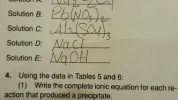 Using the data in Tables 5 and 6: Write the complete ionic equation for each reaction that produced a precipitate.
need molecular, ionic and net ionic equation pls Predict the products of each of the following...
 need molecular, ionic and net ionic equation pls
Predict the products of each of the following reactions using the solubility rules and write balanced chemical reactions. 1. Cu(NO): o) +NaOH a CaClz AgNOs 2. CaCO 3. HCI 4. AICI) (a) + Na:S (a) 5. H:SO + LIOH ( 6. AgNOs a) +KBr (a) +HCI ( 7. Pb(NO)2 Ba(C:HiO2 8. KSO + NaBri 9. (NH)PO 10. HNOp + Sr(OH)
Predict the products of each of the following reactions using the solubility...
need molecular, ionic and net ionic equation pls
Predict the products of each of the following reactions using the solubility rules and write balanced chemical reactions. 1. Cu(NO): o) +NaOH a CaClz AgNOs 2. CaCO 3. HCI 4. AICI) (a) + Na:S (a) 5. H:SO + LIOH ( 6. AgNOs a) +KBr (a) +HCI ( 7. Pb(NO)2 Ba(C:HiO2 8. KSO + NaBri 9. (NH)PO 10. HNOp + Sr(OH)
Predict the products of each of the following reactions using the solubility...
write the molecular equation and the net ionic equation of each reaction. 20 7. barium chloride + sodium phosphate L...
 write the molecular equation and the net ionic equation of
each reaction.
20 7. barium chloride + sodium phosphate Loim Bach, Na₃PO4 8. calcium nitrate + sodium phosphate a im Ca (NO) Naz P04 9. calcium chloride + sodium carbonate CaCl2 Olm Nazo3 10. magnesium nitrate + sodium carbonate 1015m ng (NO3)2 0.1m Nazcos 11. barium nitrate + sodium carbonate 10. Im Ba(NO3)2 o.om Nazco3 12. lead(II) nitrate + sodium carbonate 0. Im Pb (NO3)2 0.Im NazC03 13. barium chloride...
write the molecular equation and the net ionic equation of
each reaction.
20 7. barium chloride + sodium phosphate Loim Bach, Na₃PO4 8. calcium nitrate + sodium phosphate a im Ca (NO) Naz P04 9. calcium chloride + sodium carbonate CaCl2 Olm Nazo3 10. magnesium nitrate + sodium carbonate 1015m ng (NO3)2 0.1m Nazcos 11. barium nitrate + sodium carbonate 10. Im Ba(NO3)2 o.om Nazco3 12. lead(II) nitrate + sodium carbonate 0. Im Pb (NO3)2 0.Im NazC03 13. barium chloride...
Write the molar equation and net ionic equation for each reaction. Reaction 1. silver nitrate +...
 Write the molar equation and net ionic equation for each
reaction.
Reaction 1. silver nitrate + sodium chloride AgNO3 Nach 2. silver nitrate + sodium bromide AS Noz doim Narse 3. silver nitrate + potassium iodide A No3 KI 4. silver nitrate + sodium phosphate AS NO3 Naz PO 4 5. barium nitrate + potassium sulfate BaCNO3)2 Krsou 6. lead(II) nitrate + potassium sulfate Tome Pb(NO372 ksoy 7. barium chloride + sodium phosphate Dim Back Na₃PO4 8. calcium nitrate +...
Write the molar equation and net ionic equation for each
reaction.
Reaction 1. silver nitrate + sodium chloride AgNO3 Nach 2. silver nitrate + sodium bromide AS Noz doim Narse 3. silver nitrate + potassium iodide A No3 KI 4. silver nitrate + sodium phosphate AS NO3 Naz PO 4 5. barium nitrate + potassium sulfate BaCNO3)2 Krsou 6. lead(II) nitrate + potassium sulfate Tome Pb(NO372 ksoy 7. barium chloride + sodium phosphate Dim Back Na₃PO4 8. calcium nitrate +...
III ) Fe+3(aq) + SCN-(aq) ß→ Fe(SCN)+2(aq) (3) Prepare a stock solution by mixing 2mL each...
III ) Fe+3(aq) + SCN-(aq) ß→ Fe(SCN)+2(aq) (3) Prepare a stock solution by mixing 2mL each of 0.1M FeCl3 and 0.1M KSCN in 100mL graduated cylinder. Add enough water to make 100mL solution. Note the color. If you are the first one to use this station, make this solution and save it for the rest of the class. If you are using someone else's stock solution, make sure to make observations of each reactant. (4) *Add about 1mL of 0.1M...
 Write the net ionic equation for: 3 H2S(aq) + 2 Bi(NO3)3(aq) → Bi2S3(s) + 6 HNO3(aq) Click here to enter or edit your answer 357 (aq)+2 Biz (aq)--Bi,S, (s)
 2. How are the Group I cations first precipitated from solution? 3. Write the net-ionic equation for the initial precipitation of any one Group I cation from your unknown solution. 4. Lead(II) chromate is used as a yellow pigment in paints. Write the net-ionic equation for its formation in this Experiment during the confirmatory test for lead(II). 5. When ammonia is added to a white precipitate of mercury(I) chloride, the precipitate turns grayish-black. Write the net-ionic equation for what happens,...
 Write the complete and net ionic equation for each reaction. If
no reaction occurs due to no solid precipitate, write NR.
Hg 04 5d + CUNO3)2 Rxn 2B (AICI3 + AgNO3): s199 20460 3 AgNO3 + A113- BA class +AI (NO3Jz. Rxn 2C (Zn(CH;0)+ AgNO.): 2AgNO₃ + 2n(C2H302)2 = Ag (224302J (6) + Zn (NO3)2 Rxn 2D (Pb(NO3)2 + AgNO3): Rxn 2E (Na3PO4 + AgNO3): Rxn 2F (NaOH + AgNO3): Rxn 2G: (Na2CO3 + AgNO3): Rxn 3A (CuSO4 + Na2CO3):...
Write the complete and net ionic equation for each reaction. If
no reaction occurs due to no solid precipitate, write NR.
Hg 04 5d + CUNO3)2 Rxn 2B (AICI3 + AgNO3): s199 20460 3 AgNO3 + A113- BA class +AI (NO3Jz. Rxn 2C (Zn(CH;0)+ AgNO.): 2AgNO₃ + 2n(C2H302)2 = Ag (224302J (6) + Zn (NO3)2 Rxn 2D (Pb(NO3)2 + AgNO3): Rxn 2E (Na3PO4 + AgNO3): Rxn 2F (NaOH + AgNO3): Rxn 2G: (Na2CO3 + AgNO3): Rxn 3A (CuSO4 + Na2CO3):...
 Using the data in Tables 5 and 6: Write the complete ionic equation for each reaction that produced a precipitate.
 need molecular, ionic and net ionic equation pls
Predict the products of each of the following reactions using the solubility rules and write balanced chemical reactions. 1. Cu(NO): o) +NaOH a CaClz AgNOs 2. CaCO 3. HCI 4. AICI) (a) + Na:S (a) 5. H:SO + LIOH ( 6. AgNOs a) +KBr (a) +HCI ( 7. Pb(NO)2 Ba(C:HiO2 8. KSO + NaBri 9. (NH)PO 10. HNOp + Sr(OH)
Predict the products of each of the following reactions using the solubility...
need molecular, ionic and net ionic equation pls
Predict the products of each of the following reactions using the solubility rules and write balanced chemical reactions. 1. Cu(NO): o) +NaOH a CaClz AgNOs 2. CaCO 3. HCI 4. AICI) (a) + Na:S (a) 5. H:SO + LIOH ( 6. AgNOs a) +KBr (a) +HCI ( 7. Pb(NO)2 Ba(C:HiO2 8. KSO + NaBri 9. (NH)PO 10. HNOp + Sr(OH)
Predict the products of each of the following reactions using the solubility...
 write the molecular equation and the net ionic equation of
each reaction.
20 7. barium chloride + sodium phosphate Loim Bach, Na₃PO4 8. calcium nitrate + sodium phosphate a im Ca (NO) Naz P04 9. calcium chloride + sodium carbonate CaCl2 Olm Nazo3 10. magnesium nitrate + sodium carbonate 1015m ng (NO3)2 0.1m Nazcos 11. barium nitrate + sodium carbonate 10. Im Ba(NO3)2 o.om Nazco3 12. lead(II) nitrate + sodium carbonate 0. Im Pb (NO3)2 0.Im NazC03 13. barium chloride...
write the molecular equation and the net ionic equation of
each reaction.
20 7. barium chloride + sodium phosphate Loim Bach, Na₃PO4 8. calcium nitrate + sodium phosphate a im Ca (NO) Naz P04 9. calcium chloride + sodium carbonate CaCl2 Olm Nazo3 10. magnesium nitrate + sodium carbonate 1015m ng (NO3)2 0.1m Nazcos 11. barium nitrate + sodium carbonate 10. Im Ba(NO3)2 o.om Nazco3 12. lead(II) nitrate + sodium carbonate 0. Im Pb (NO3)2 0.Im NazC03 13. barium chloride...
 Write the molar equation and net ionic equation for each
reaction.
Reaction 1. silver nitrate + sodium chloride AgNO3 Nach 2. silver nitrate + sodium bromide AS Noz doim Narse 3. silver nitrate + potassium iodide A No3 KI 4. silver nitrate + sodium phosphate AS NO3 Naz PO 4 5. barium nitrate + potassium sulfate BaCNO3)2 Krsou 6. lead(II) nitrate + potassium sulfate Tome Pb(NO372 ksoy 7. barium chloride + sodium phosphate Dim Back Na₃PO4 8. calcium nitrate +...
Write the molar equation and net ionic equation for each
reaction.
Reaction 1. silver nitrate + sodium chloride AgNO3 Nach 2. silver nitrate + sodium bromide AS Noz doim Narse 3. silver nitrate + potassium iodide A No3 KI 4. silver nitrate + sodium phosphate AS NO3 Naz PO 4 5. barium nitrate + potassium sulfate BaCNO3)2 Krsou 6. lead(II) nitrate + potassium sulfate Tome Pb(NO372 ksoy 7. barium chloride + sodium phosphate Dim Back Na₃PO4 8. calcium nitrate +...
Most questions answered within 3 hours.
-
Where is the error in this code sequence?
String s1 = "Hello";
String s2 = "ello";...
asked 10 months ago -
Financial data for Joel de Paris, Inc., for last year
follow:
Joel de Paris, Inc.
Balance...
asked 10 months ago -
Consider this reaction:
Al2(SO4)3 (aq)+ BaCl3
(aq) Al2Cl6 (aq)- +
3BaSO4(s) . What is the...
asked 10 months ago -
Suppose that Savneet is considering increasing her
recent random sample from 20 car rentals to 40...
asked 10 months ago -
Trucks arrive at an unloading terminal at an average rate of 120
per hour.
Trucks arrive...
asked 10 months ago -
Why are methanol and ethanol completely soluble in water while
octanol is not very little soluble....
asked 10 months ago -
A facilities manager at a university reads in a research report
that the mean amount of...
asked 10 months ago -
When the CuSO4 is rehydrated by adding water to the anhydrous
compound, is this an endothermic...
asked 10 months ago -
A ray of sunlight is passing from diamond into crown glass; the
angle of incidence is...
asked 10 months ago -
A block of mass 0.249 kg is placed on top of a light, vertical
spring of...
asked 10 months ago -
how do the kidneys compensate in the presences of acidosis
a) trigger hyperventilate
b) reserve acid...
asked 10 months ago -
Question 501 pts
The rental rate of capital to the firm increases. Which of the
following...
asked 10 months ago